

Wikipedia and the Policing of Scientific Orthodoxy

Wikipedia was supposed to liberate human knowledge, not police it. Yet the encyclopedia that invited humanity to document its collective understanding has developed mechanisms for marginalizing scientific dissent, silencing contributors, and presenting editorial policy as scientific consensus. Its administrators don’t need to burn books to stifle dissent. In an information ecosystem dominated by Wikipedia, making discovery difficult may be enough.
The Betrayal of a Beautiful Idea
On January 15, 2001, Jimmy Wales and Larry Sanger launched an experiment in collective intelligence that would fundamentally transform humanity’s relationship with knowledge. Wikipedia challenged the traditional authority of academic institutions, commercial publishers, and professional editors by inviting ordinary people to construct a comprehensive record of human understanding. Knowledge would no longer be the exclusive province of an intellectual establishment. Anyone with something meaningful to contribute could help build the encyclopedia.
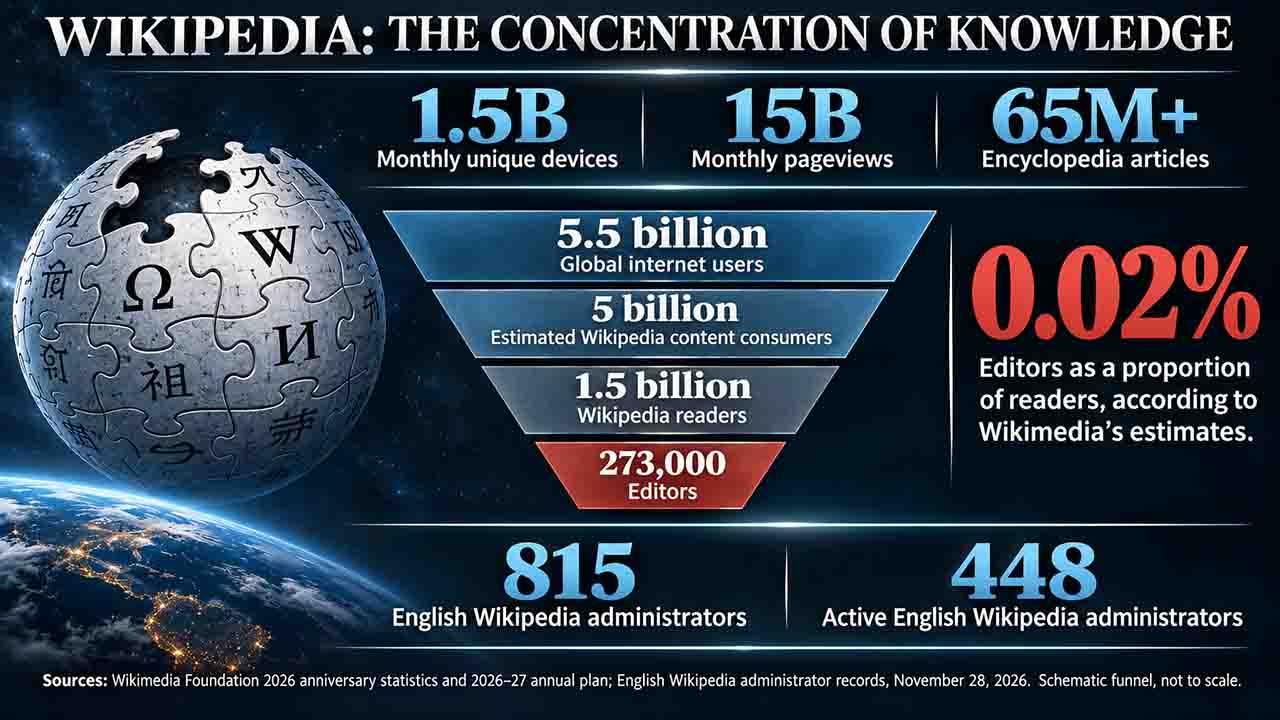
Twenty-five years later, the scale of that achievement is almost incomprehensible. In January 2026, the Wikimedia Foundation reported more than 65 million articles across over 300 languages, nearly 15 billion monthly pageviews, and more than 1.5 billion unique devices accessing Wikipedia every month. Approximately 250,000 registered editors contribute monthly to this enormous intellectual infrastructure. Wikipedia is among the world’s ten most-visited websites and the only one operated by a nonprofit organization.
Wikipedia has become something considerably more consequential than an encyclopedia. It’s become a surrogate for species-level knowledge: the place humanity goes to discover what humanity knows. Students consult it before writing papers, journalists before developing stories, investors before evaluating technologies, and scientists before exploring unfamiliar disciplines. Search engines incorporate its descriptions into knowledge panels, while artificial intelligence systems absorb and reproduce its information. Its authority derives from the widespread perception that Wikipedia represents the accumulated knowledge of our civilization.
But Wikipedia doesn’t represent the sum of human knowledge. It represents the subset of documented human knowledge that has survived its editorial process. The tragedy is that billions of people don’t necessarily recognize the difference. An institution founded on intellectual inclusion has developed increasingly sophisticated mechanisms for intellectual exclusion, yet its defenders frequently dismiss concerns about those mechanisms as misunderstandings of ordinary editorial policy. Wikipedia can’t simultaneously celebrate its status as humanity’s knowledge commons and minimize its responsibility toward the people it excludes.
Welcome to Wikipedia. Now Please Go Away.
Imagine discovering a significant omission in a Wikipedia article concerning a subject you’ve spent decades studying. Perhaps you’re a physicist investigating anomalous experimental results, an engineer developing an unconventional technology, or a historian who has uncovered previously overlooked documentation. You assemble references, write an explanation, and contribute your knowledge to an encyclopedia that has spent a quarter of a century encouraging people to do precisely that. Shortly afterward, your contribution disappears.
You try again, providing additional references and explaining the scientific context, only to encounter objections involving undue weight, reliable sources, original research, fringe theories, notability, or consensus. Your objections are addressed by individuals operating under pseudonyms whose qualifications may be entirely unknown to you. If the disagreement escalates, your persistence may be interpreted as disruptive editing, leading to warnings, restrictions, or even an indefinite account block. An invitation to participate in humanity’s collective knowledge has become an administrative battle over your right to contribute to it.
Historian Timothy Messer-Kruse described a remarkably similar experience in his 2012 essay, The ‘Undue Weight’ of Truth on Wikipedia. Having spent a decade researching the 1886 Haymarket affair and publishing two books and several articles on the subject, Messer-Kruse attempted to correct Wikipedia’s assertion that prosecutors had presented no evidence connecting the defendants to the bombing. His references to historical court records and scholarly research encountered resistance based on Wikipedia’s policies concerning primary sources and the relative prominence of competing interpretations. His expertise didn’t translate into editorial authority.
For experienced Wikipedia editors, such incidents may represent the routine application of policy. For the contributor, however, the experience can feel distinctly Orwellian. An institution that invited you to participate has rejected your contribution, and challenging that rejection requires mastering a regulatory system whose rules are interpreted by the very community you’re challenging. Most scientists and engineers have better things to do than become experts in Wikipedia’s administrative procedures. Eventually, many simply walk away. Their knowledge may survive elsewhere, but their voice has disappeared from the encyclopedia.
Jimmy Wales and the Semantics of Suppression
In a 2026 interview with Jonny Thomson for Big Think, Jimmy Wales attempted to distinguish censorship from editorial judgment. According to Wales, censorship “means, ultimately, physical, legal consequences.” He contrasted governmental restrictions on expression with a newspaper declining to publish someone’s submission. By defining censorship primarily in terms of coercion, Wales places Wikipedia’s editorial exclusions outside the conceptual boundaries of censorship.
It’s an extraordinarily convenient definition. It’s also an inadequate one. Cambridge Dictionary defines censorship more broadly, encompassing the prevention of information from being seen or made public because of its perceived objectionable or sensitive nature. Publishers, religious organizations, corporations, and other nongovernmental institutions can restrict the dissemination of information without threatening imprisonment or physical violence. State censorship is a particularly dangerous form of intellectual suppression, but it’s hardly the only one.
Wales deserves credit for Wikipedia’s resistance to governmental censorship. When Turkey blocked access to the encyclopedia in 2017, Wikipedia refused demands to remove disputed material and successfully challenged the restrictions through the Turkish legal system. In the same Big Think interview, Wales described access to knowledge and participation in its sharing and creation as fundamental human rights. Those are admirable principles. They’re also precisely the principles that frustrated Wikipedia contributors believe the institution has betrayed.
The fundamental weakness in Wales’s defense is that editorial review and suppression aren’t mutually exclusive. Editorial review is a process. Suppression can be its outcome. A neighborhood newspaper declining to publish a letter and the world’s dominant encyclopedia excluding scientifically substantive information may both involve editorial judgment, but their consequences are profoundly different. Telling contributors that they haven’t been censored because nobody has threatened them with imprisonment trivializes their actual complaint. Wikipedia’s legal right to exclude information doesn’t absolve it of responsibility for the consequences of doing so.
The Invisible Government of Human Knowledge
Beneath Wikipedia’s clean, accessible interface lies an extraordinarily complex administrative apparatus. Its English-language edition operates through policies, guidelines, noticeboards, arbitration proceedings, protection mechanisms, source restrictions, deletion discussions, and an extensive history of administrative precedents. Wikipedia may have dispensed with the traditional editorial board, but it hasn’t dispensed with institutional hierarchy. It’s constructed an alternative hierarchy whose workings are largely invisible to ordinary readers.
Administrators possess the technical ability to block accounts, delete pages, protect articles against editing, and enforce community and arbitration decisions. Under extended confirmed protection, editing can be restricted to accounts at least 30 days old with a minimum of 500 edits. Topic bans can prevent contributors from participating in particular areas, while broader sanctions can exclude them from the encyclopedia altogether. None of these administrative privileges requires recognized scientific, engineering, or academic qualifications.
Wikipedia’s defenders correctly point out that revision histories, administrative logs, archived discussions, and arbitration decisions are frequently accessible to the public. Pseudonymity also protects contributors against harassment and retaliation. Nevertheless, technical transparency doesn’t necessarily translate into meaningful accountability. Reconstructing a contentious editorial dispute may require examining years of archived discussions, hundreds of historical revisions, and proceedings scattered across numerous administrative pages. Ordinary readers see the finished article, not the battles that determined what survived.
The most valuable expertise in a Wikipedia dispute can therefore become expertise in Wikipedia itself. A physicist with 30 years of laboratory experience may find themselves procedurally outmatched by someone who has spent ten years mastering editorial policies and administrative processes. Scientific credentials shouldn’t exempt anyone from evidentiary standards, but neither should bureaucratic proficiency be confused with scientific authority. An institution devoted to documenting knowledge shouldn’t systematically advantage the people most experienced at policing it over the people actually producing it.
Silencing Dissent by Attrition
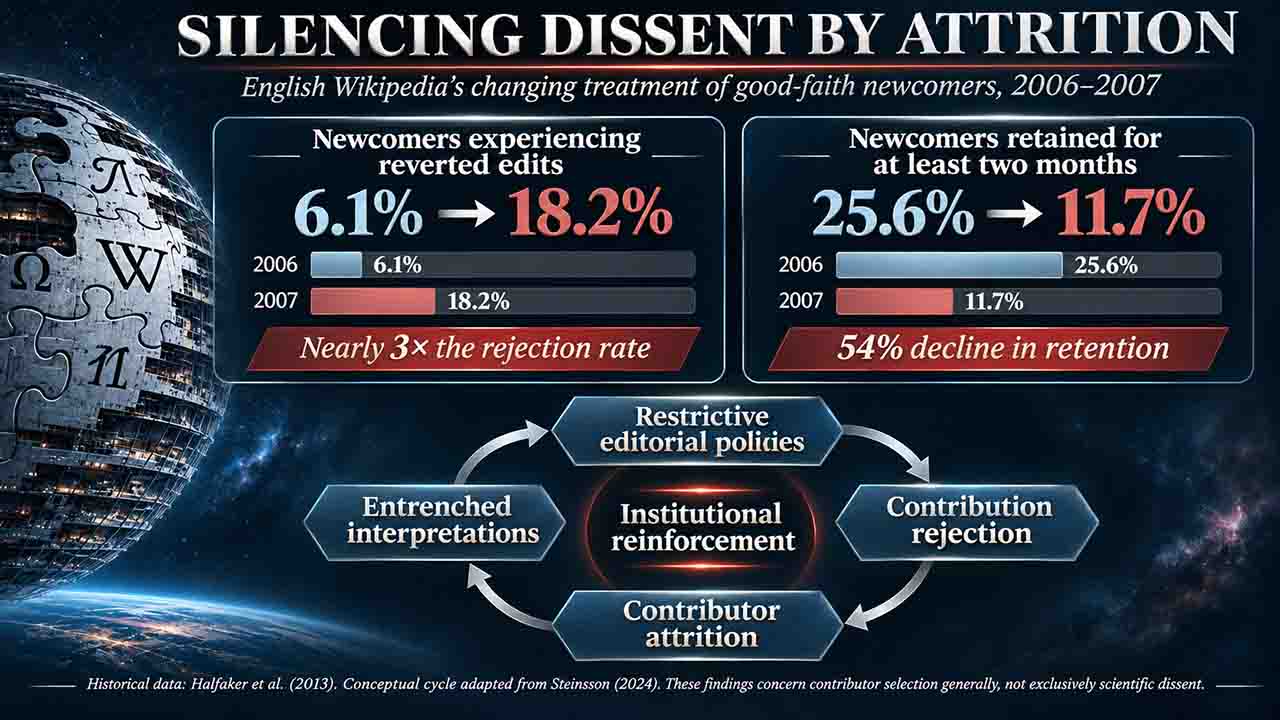
In 2013, researchers Aaron Halfaker, R. Stuart Geiger, Jonathan Morgan, and John Riedl published a revealing study in American Behavioral Scientist examining the decline of Wikipedia’s contributor population. Their research identified increasingly restrictive quality-control practices and automated rejection mechanisms as important factors in declining newcomer retention. They also found that Wikipedia’s mechanisms for changing its institutional norms had become resistant to proposals from newer contributors. The safeguards developed to manage Wikipedia’s extraordinary popularity were undermining its ability to attract and retain the people responsible for its success.
Political scientist Sverrir Steinsson subsequently examined the institutional consequences of contributor attrition in a paper published in the American Political Science Review, appearing online in 2023 and in print in 2024. Steinsson analyzed 63 Wikipedia articles, examining historical content, archived discussions, administrative sanctions, contributor histories, and disputes over the interpretation of editorial rules. His research documented how participants supporting more accommodating treatment of fringe viewpoints gradually departed or were excluded, while their opponents accumulated greater institutional influence.
Steinsson regards much of this transformation as beneficial, arguing that Wikipedia became more reliable as its treatment of fringe claims grew more restrictive. Nevertheless, the institutional mechanism he identifies should concern anyone interested in intellectual diversity. An institution doesn’t necessarily need to formally prohibit dissent to become intellectually homogeneous. It can produce a similar outcome by discouraging, exhausting, or excluding participants who repeatedly challenge prevailing interpretations of its rules.
Wikipedia’s editorial consensus is produced by the people who remain sufficiently motivated and sufficiently empowered to participate in its formation. It isn’t a representative survey of scientific opinion, nor is it the product of experimental verification. When contributors depart, the knowledge and perspectives they bring may depart with them. A bureaucracy can manufacture the appearance of unanimity through attrition. When the people who disagree have left the room, the silence they leave behind shouldn’t be mistaken for consensus.
Guerrilla Skepticism and the Science Police
In 2010, skeptical activist Susan Gerbic established Guerrilla Skepticism on Wikipedia, an organized initiative dedicated to improving the encyclopedia’s coverage of scientific skepticism, paranormal claims, and related subjects. The project developed recruitment, training, mentoring, and collaborative editing practices, creating an infrastructure considerably more sophisticated than the spontaneous participation of independent volunteers commonly associated with Wikipedia’s founding vision.
Writing in Skeptical Inquirer in 2024, Gerbic reported that her organization had produced more than 2,200 Wikipedia articles that had collectively received over 170 million views. More than 100 people recruited from the scientific skepticism community had volunteered to participate in what she playfully described as her “Secret Cabal.” Much of the organization’s work involves documenting legitimate science and improving biographies. Nevertheless, its reported accomplishments demonstrate the extraordinary influence an organized advocacy community can exercise through Wikipedia.
In his 2021 paper, Policing Orthodoxy on Wikipedia: Skeptics in Action?, published in the Journal of Science Communication, sociologist Brian Martin examined the relationship between Wikipedia’s editorial culture and organized skepticism. Martin identified patterns involving derogatory labeling, the classification of heterodox ideas, and the establishment of categories without adequate supporting references. His study doesn’t establish that skeptical organizations control Wikipedia, but it raises legitimate questions about the influence of communities that assume responsibility for policing the boundaries of science.
Consider the disparity between an organized network of experienced Wikipedia editors and a small scientific community attempting to develop an unconventional technology. The researchers are occupied with experimental design, laboratory instrumentation, funding applications, data analysis, and scientific publication. Established editors possess procedural knowledge, institutional relationships, and the ability to coordinate their efforts. Organized skeptics have every right to contribute to Wikipedia, but their participation deserves the same scrutiny as organized advocacy by any other community. Skepticism shouldn’t confer a privileged exemption from skepticism.
Cold Fusion: The Controversy That Refused to Die
On March 23, 1989, electrochemists Martin Fleischmann and Stanley Pons announced that they’d observed anomalous heat generation during experiments involving the electrolysis of heavy water using palladium electrodes. Their findings appeared to challenge conventional expectations concerning the electrostatic repulsion between positively charged nuclei, suggesting the possibility of nuclear energy generation under conditions radically different from those associated with conventional fusion reactors. The announcement ignited one of the most contentious scientific controversies of the twentieth century.
The scientific establishment had legitimate reasons for skepticism. Conventional deuterium fusion produces characteristic nuclear reaction products, including neutrons, protons, tritium, and helium-3, yet the reported thermal output wasn’t accompanied by nuclear signatures consistent with established reaction pathways. Reproducibility proved difficult, and investigators encountered problems involving calorimetric calibration, deuterium loading ratios, electrode microstructure, hydrogen recombination, and materials characterization. The original announcement was premature, and commercially viable cold fusion remains unproven. However, the failure to substantiate the original claims didn’t eliminate every scientific question raised by the experiments.
The US Department of Energy reassessed the field in 2004. In 2019, researchers associated with a multimillion-dollar Google-funded initiative published a major reassessment in Nature. Although they didn’t establish the existence of cold fusion, their investigation identified worthwhile scientific questions involving highly hydrogen-loaded metals and low-energy nuclear processes. On February 17, 2023, the Department of Energy’s ARPA-E announced $10 million in funding for eight low-energy nuclear reaction (LENR) research projects, including investigations at MIT, Stanford University, Lawrence Berkeley National Laboratory, and the University of Michigan. These projects involve metal hydrides, deuterium-loaded nanomaterials, laser excitation, nuclear diagnostics, and instrumentation designed to detect potential neutron, gamma-ray, and ion emissions.
Now consider Wikipedia. Its cold fusion article acknowledges Google’s unsuccessful investigation but omits ARPA-E’s $10 million research initiative. More remarkably, Wikipedia still lists cold fusion as an example of pathological science, alongside Martian canals and N-rays, associating it with wishful thinking and subjective interpretations of experimental evidence. Its pathological science article omits both the Google and ARPA-E initiatives, perpetuating a historical scientific judgment without acknowledging significant subsequent research. The United States government can spend millions of dollars investigating a scientific question without endorsing its answer. Surely Wikipedia can document that investigation without condemning the inquiry itself.
When Scientific Disagreement Becomes an Administrative Offense
Wikipedia’s treatment of cold fusion has generated more than disagreements over scientific terminology. In 2009, disputes concerning the subject escalated into arbitration proceedings involving contributors and administrators. One particularly revealing case involved a contributor operating under the name Abd and Wikipedia administrator William M. Connolley, whom Abd accused of improperly banning him from editing the cold fusion article.
Wikipedia’s Arbitration Committee found that Abd had engaged in tendentious editing and violated an earlier arbitration remedy. However, it also concluded that Connolley had misused his administrative tools while personally involved in the dispute. Abd received a three-month site ban and a one-year restriction concerning the cold fusion article, while Connolley was stripped of his administrative privileges. The committee also urged the Wikipedia community to clarify the circumstances under which individual administrators could impose editing bans without first obtaining consensus.
The case doesn’t establish that the scientific claims defended by the sanctioned contributor were correct. It establishes something different and equally relevant: administrative overreach isn’t merely an accusation invented by people unhappy with Wikipedia’s coverage. Wikipedia’s own arbitration process documented an instance in which institutional authority had been improperly exercised during a dispute concerning unconventional science. That the misconduct was ultimately addressed demonstrates the value of Wikipedia’s accountability mechanisms, but it doesn’t erase the misconduct or the burden placed upon those challenging it.
For small scientific communities, these conflicts represent a potentially extraordinary diversion of resources. Instead of developing more precise calorimeters, improving experimental reproducibility, or investigating nuclear reaction products, knowledgeable contributors can find themselves debating Wikipedia’s interpretation of their field. Scientific legitimacy should emerge from the quality of experimental evidence, not from an investigator’s willingness to endure months of administrative combat over the wording of an encyclopedia article.
The Difference Between Science and the Science Police
In 2016, researchers at NASA’s Eagleworks laboratory published experimental results concerning the EmDrive, an asymmetric microwave resonant cavity purportedly capable of generating thrust without expelling conventional propellant. Operating at approximately 1.937 gigahertz and using microwave input power levels of 40, 60, and 80 watts, the researchers reported an apparent thrust-to-power ratio of approximately 1.2 millinewtons per kilowatt. If independently confirmed as anomalous thrust, the results would have presented an extraordinary challenge to established expectations concerning momentum conservation.
Physicist Martin Tajmar and his colleagues at Technische Universität Dresden subsequently subjected the device to more sophisticated experimental scrutiny. Their investigation incorporated a specially configured pendulum thrust balance, battery-powered operation, vacuum testing, and improvements intended to eliminate thermal deformation, electromagnetic interactions, and mechanical measurement artifacts. Their published results found no anomalous thrust exceeding conventional radiation-pressure limits, placing stringent constraints on the proposed propulsion mechanism.
This is what scientific skepticism looks like. Tajmar didn’t need to declare the investigation intellectually illegitimate. He developed an experimental apparatus capable of testing the claim. His measurements provided substantially more useful information than a thousand arguments about whether the EmDrive deserved to be investigated in the first place. The experiment’s failure to validate the technology was itself a scientific achievement.
An encyclopedia should document this entire process: the hypothesis, the experimental apparatus, the reported measurements, the scientific criticism, the independent replication attempts, and the failure of the device to demonstrate its claimed performance. Wikipedia does document substantial portions of that history, illustrating the kind of treatment other controversial research deserves. Failed experiments contribute knowledge. Unsuccessful technologies contribute knowledge. Science advances through the elimination of possibilities as well as their confirmation. An encyclopedia should document the investigation, not merely pronounce judgment upon its participants.
When the Scientific Answer Is Still “We Don’t Know”
Not every scientific controversy can be resolved as straightforwardly as the EmDrive. Modified Newtonian Dynamics, proposed by physicist Mordehai Milgrom in 1983, attempts to explain galactic dynamics through modifications to conventional gravitational or inertial behavior at accelerations near 1.2 ten-billionths of a meter per second squared. Although the conventional dark matter framework remains dominant, MOND has achieved notable successes in describing certain galactic rotation curves while encountering significant difficulties at galaxy-cluster and cosmological scales. Its minority status doesn’t make its extensive theoretical and observational literature scientifically illegitimate.
The science of consciousness provides another example. In April 2025, an international research consortium published the results of an ambitious adversarial collaboration in Nature, comparing Integrated Information Theory with Global Neuronal Workspace Theory. The investigation involved 256 participants and incorporated functional magnetic resonance imaging, magnetoencephalography, and intracranial electroencephalography. Researchers established experimental predictions in advance, only to discover results that challenged significant predictions of both theoretical frameworks.
Similarly, NASA’s September 2023 report on unidentified anomalous phenomena recognized the scientific value of investigating poorly understood aerospace observations. Its recommendations emphasized improved instrumentation, standardized reporting, sensor calibration, and systematic data acquisition. Infrared imaging equipment, radar systems, and airborne observation platforms can produce misleading results through parallax, incomplete distance measurements, sensor artifacts, and observer motion. NASA’s participation doesn’t establish extraterrestrial visitation, but it recognizes that unexplained observations can warrant organized scientific investigation.
These distinctions should be fundamental to science communication. There are established scientific facts, unresolved controversies, minority theoretical frameworks, exploratory investigations, experimentally unsupported claims, and conclusively discredited ideas. They aren’t interchangeable categories. When scientists themselves haven’t reached agreement, an encyclopedia shouldn’t imply otherwise. Uncertainty isn’t an embarrassment that Wikipedia editors need to eliminate from the scientific record. It’s part of the scientific record.
The Unequal Economics of Intellectual Legitimacy
Established scientific disciplines enjoy enormous institutional advantages. They possess university departments, professional societies, major academic journals, extensive review literature, government advisory committees, communications departments, and billions of dollars in research infrastructure. When Wikipedia requires contributors to substantiate a scientific position through independent secondary sources, established disciplines can generally satisfy those requirements with comparatively little difficulty.
Emerging research communities operate under radically different conditions. Their most important findings may initially appear in specialized journals, conference proceedings, government technical reports, doctoral dissertations, and primary experimental publications. A promising technology may have only a handful of laboratories investigating it, and independent review literature may lag behind experimental developments by years. Wikipedia’s preference for established secondary sources consequently creates a structural advantage for mature knowledge over emerging knowledge.
The disadvantage becomes compounded when scientists attempt to improve coverage of their own fields. Researchers with the most substantial technical knowledge may encounter conflict-of-interest concerns, particularly when discussing their own work. Meanwhile, scientists attempting to correct outdated descriptions must divert time away from experimentation and publication. A small research community struggling to acquire funding for a new laboratory instrument can’t necessarily afford to devote hundreds of hours to defending its Wikipedia article against contributors who possess considerably more institutional experience.
This creates the potential for a vicious cycle. An emerging scientific field struggles to receive encyclopedic recognition because it lacks substantial mainstream recognition, while its limited visibility may contribute to difficulties securing the resources necessary to obtain that recognition. Wikipedia didn’t create the enormous disparities in scientific funding and institutional influence, but its policies can reinforce them. Applied without sufficient sensitivity to emerging knowledge, those policies risk becoming another mechanism through which established institutions preserve their intellectual advantages.
The Knowledge Diaspora
One of the most revealing consequences of dissatisfaction with Wikipedia has been the proliferation of alternative encyclopedias. Some emphasize scholarly expertise, others seek to accommodate perspectives excluded from Wikipedia, and still others embrace explicitly ideological or technological alternatives. Their founders have pursued different objectives, but many share a dissatisfaction with how the world’s dominant encyclopedia determines what information deserves inclusion.
Wikipedia cofounder Larry Sanger himself attempted to establish an alternative. Citizendium, launched as a pilot project in 2006, sought to combine collaborative knowledge production with real-name participation and expert guidance. Scholarpedia developed a model based on expert authorship and peer review, while HandWiki emerged as a specialized encyclopedia for scientific, technical, and general knowledge. A March 2026 survey published by EnHub identified HandWiki, Justapedia, Citizendium, MDWiki, WikiDoc, and the Encyclopedia of Life among the platforms offering different approaches to knowledge production.
More explicitly ideological competitors have included Conservapedia, Infogalactic, and Grokipedia. Launched by Elon Musk’s xAI in October 2025, Grokipedia was promoted as a response to perceived biases in Wikipedia. However, a 2026 study by Saeedeh Mohammadi and Taha Yasseri, published in the Proceedings of the National Academy of Sciences, compared 17,790 matched articles and found that departures from Wikipedia included a rightward shift in the political orientation of cited news sources in some subject areas. Grokipedia’s articles also contained fewer references relative to their length. Replacing one encyclopedia with another doesn’t necessarily eliminate editorial bias.
The existence of competing encyclopedias doesn’t prove every allegation of Wikipedia censorship, but alternatives explicitly created in response to perceived exclusion represent a warning that shouldn’t be ignored. When people lose confidence in a purportedly universal knowledge commons, they begin constructing separate intellectual environments more accommodating to their perspectives. Some may be more rigorous, while others simply replace one orthodoxy with another. Wikipedia’s greatest potential failure may be driving humanity away from a shared intellectual commons and into competing knowledge systems that increasingly reflect the ideological commitments of their respective communities.
You Can Leave Wikipedia, but You Can’t Escape
Wikipedia’s defenders may argue that anyone dissatisfied with its editorial decisions is free to publish elsewhere. Technically, they’re right. Wikipedia’s freely licensed content can even be reproduced and modified by competing encyclopedias. But reproducing the encyclopedia’s content isn’t equivalent to reproducing its audience, institutional authority, contributor population, or extraordinary position within the global information ecosystem.
Wikipedia benefits from the same network effects that have entrenched dominant social media platforms. Extensive content attracts search traffic, search traffic attracts readers, some readers become contributors, and those contributors expand the encyclopedia’s content. Universities, journalists, independent websites, and other organizations link to Wikipedia, further enhancing its discoverability. Meanwhile, decades of habitual use have established Wikipedia as the default starting point for investigating unfamiliar subjects. Even an alternative with comparable content would face the enormous challenge of breaking those habits.
In 2021, researchers Nicholas Vincent and Brent Hecht published an investigation into Wikipedia’s prominence within search engine results. Their research found Wikipedia links appearing in approximately 67% to 84% of sampled desktop search result pages for common and trending queries across three American search engines. The encyclopedia frequently occupied prominent positions, including knowledge panels and locations visible without scrolling. Its influence extended far beyond the people who deliberately navigated to Wikipedia.org.
Telling excluded contributors to establish their own websites ignores these enormous structural advantages. It’s rather like telling someone dissatisfied with Facebook to create their own social network. The technical freedom to establish an alternative doesn’t eliminate the barriers to making that alternative competitive. Wikipedia’s defenders may insist that nobody is being silenced because they’re free to publish elsewhere. But the freedom to speak somewhere that practically nobody is listening isn’t equivalent to meaningful participation in humanity’s dominant knowledge commons.
Orthodoxy at Machine Scale
Wikipedia’s institutional power becomes considerably more concerning in the age of artificial intelligence. Its content is incorporated into search engines, knowledge graphs, digital assistants, machine-learning datasets, and automated information services. The encyclopedia’s enormous corpus of structured, multilingual, freely available information makes it particularly valuable to developers constructing systems capable of answering questions about virtually anything humanity has documented.
Even before the emergence of modern generative AI, researchers had identified evidence that Wikipedia could influence scientific knowledge itself. In their study, Science Is Shaped by Wikipedia: Evidence From a Randomized Control Trial, Neil Thompson and Douglas Hanley investigated the effects of introducing scientific information into Wikipedia. Their experimental work involving chemistry articles found that material added to the encyclopedia subsequently influenced the language used in related scientific publications. Scientific papers referenced in Wikipedia also received additional citations. Wikipedia doesn’t simply reflect scientific knowledge; under certain circumstances, it helps shape it.
Wikipedia also presents opportunities for circular sourcing, a phenomenon popularly known as citogenesis. An assertion originating on Wikipedia may be repeated by a journalist or independent publisher, after which the resulting publication can be cited by Wikipedia as apparently independent corroboration. The assertion acquires an illusion of legitimacy through repetition, despite originating from a single source. Artificial intelligence creates additional pathways through which information can be summarized, reproduced, and incorporated into subsequent publications.
Consider the implications for scientists and engineers working in controversial fields. A dismissive description appearing in a Wikipedia article can potentially propagate through search summaries, machine-generated biographies, educational resources, and AI-assisted research. An omission may likewise be inherited by systems that depend heavily on the encyclopedia. The full extent of these effects remains to be established, but the risk is profound. An editorial dispute occurring between a handful of volunteers could ultimately influence how machines explain a scientific subject to millions of people. Intellectual orthodoxy has acquired the potential to reproduce itself at machine scale.
The New Inquisition
The history of intellectual orthodoxy offers uncomfortable parallels with Wikipedia’s institutional evolution. The Catholic Inquisition developed elaborate procedures for identifying unacceptable doctrines, determining the legitimacy of competing interpretations, and responding to individuals whose beliefs challenged established authority. Its institutional architecture transformed intellectual disagreements into questions concerning the legitimacy and behavior of the people expressing them.
Wikipedia obviously isn’t equivalent to the historical Inquisition. Its administrators can’t imprison scientists, physically punish dissenters, or prohibit independent research. The comparison concerns institutional mechanisms, not moral equivalence. Nevertheless, the familiar combination of authoritative doctrine, specialized interpreters, procedural restrictions, intellectual classifications, and sanctions against dissenting participants deserves examination wherever it appears.
Sociologist Robert K. Merton identified organized skepticism as one of the fundamental norms of science, alongside universalism, communal ownership of knowledge, and disinterestedness. Genuine scientific skepticism requires that claims remain subject to systematic scrutiny regardless of the prestige or authority of the people advancing them. Physicist and philosopher Thomas Kuhn similarly recognized that established scientific paradigms influence which questions researchers consider legitimate and how they interpret experimental anomalies. Both perspectives emphasize the importance of maintaining intellectual openness.
Dogmatism emerges when skepticism becomes asymmetrical. Unconventional claims are subjected to intense scrutiny while established interpretations are treated as presumptively legitimate. Researchers challenging orthodoxy become objects of suspicion, while those defending it may enjoy greater institutional confidence. Skepticism ceases to function as a methodology for investigating the unknown and instead becomes an identity organized around defending the known. At that point, the self-appointed guardians of scientific truth risk becoming precisely what the scientific revolution was intended to overcome.
The Scientific Establishment Has Been Wrong Before
In 1912, Alfred Wegener proposed that Earth’s continents had once been joined and subsequently drifted apart. His evidence involved continental geometry, fossil distributions, geological formations, and paleoclimatic indicators. However, Wegener lacked a convincing physical mechanism explaining continental motion, and his theory encountered widespread resistance. It wasn’t until decades later, following advances in ocean-floor mapping, paleomagnetism, seafloor spreading, and geophysics, that plate tectonics fundamentally transformed humanity’s understanding of the planet.
In 1982, materials scientist Dan Shechtman observed extraordinary diffraction patterns while examining rapidly solidified aluminum-manganese alloys using electron microscopy. The patterns exhibited rotational symmetries incompatible with conventional definitions of periodic crystalline order. His findings encountered considerable skepticism, yet ultimately contributed to a fundamental revision of crystallography. In 2011, Shechtman received the Nobel Prize in Chemistry for the discovery of quasicrystals.
Similar controversies surrounded Barry Marshall and Robin Warren’s research into Helicobacter pylori and peptic ulcer disease, which challenged prevailing medical explanations and earned them the 2005 Nobel Prize in Physiology or Medicine. Stanley Prusiner’s investigation of infectious agents capable of propagating through abnormal protein conformations challenged conventional expectations concerning biological infection, ultimately earning him the 1997 Nobel Prize for his work on prions.
None of these discoveries establishes that today’s unconventional scientific theories will eventually be vindicated. Most extraordinary claims will fail, and most challenges to established physics will prove incorrect. Nor should Wikipedia be expected to anticipate scientific revolutions. The lesson is that scientific consensus is provisional, and the boundaries of knowledge are constantly moving. An institution dedicated to documenting science should be particularly careful not to confuse the present limits of scientific acceptance with the permanent limits of scientific possibility.
The Right to Be Documented Isn’t the Right to Be Believed
Wikipedia’s defenders frequently invoke the danger of providing undue credibility to pseudoscience. It’s a legitimate concern. An unrestricted encyclopedia could become a promotional platform for fraudulent technologies, ineffective medical treatments, fabricated discoveries, conspiracy theories, and commercial exploitation. Humanity deserves reliable information, and Wikipedia’s insistence on verifiability and responsible sourcing has contributed enormously to the encyclopedia’s value.
But this presents a false choice between intellectual orthodoxy and intellectual anarchy. Documenting a scientific investigation isn’t equivalent to endorsing its conclusions. Wikipedia can describe government-funded LENR research while making clear that commercially viable cold fusion remains unproven. It can describe NASA’s EmDrive experiments alongside Tajmar’s subsequent findings. It can discuss competing theories of gravitation, consciousness, or quantum mechanics without suggesting that all of them possess equal evidentiary support. This isn’t a concession to pseudoscience. It’s accurate scientific communication.
Wikipedia could improve its coverage of emerging research by distinguishing more explicitly between established consensus, significant minority hypotheses, exploratory research, unresolved experimental anomalies, experimentally unsupported claims, and discredited theories. Assessments of controversial scientific fields could be dated and periodically reviewed as new literature becomes available. Articles could provide proportionate descriptions of substantive scientific disagreements, accompanied by appropriate qualifications and references. Readers deserve to know where scientific knowledge ends and scientific uncertainty begins.
The institution must also reconsider its treatment of the people who attempt to contribute. More accessible appeals, clearer explanations of rejected contributions, independent subject-matter review, understandable summaries of significant editorial disputes, and consistent disclosure expectations for organized advocacy could improve accountability without sacrificing editorial rigor. Pseudonymity could be preserved while strengthening procedural fairness. Most importantly, Wikipedia must recognize that a contributor challenging an established interpretation isn’t necessarily an enemy of knowledge. They may be trying to improve it.
Humanity’s Knowledge Belongs to Humanity
Wikipedia is one of the greatest intellectual achievements of the internet age. A decentralized community constructed the largest general-purpose encyclopedia in human history, made it freely accessible, and demonstrated that millions of people could collaborate in the production and preservation of knowledge. Its achievements deserve recognition, and the extraordinary work of its volunteer contributors shouldn’t be diminished by criticism of its institutional shortcomings.
But Wikipedia’s very success has changed the nature of its responsibilities. It’s no longer merely another website exercising ordinary editorial discretion. It’s become a central component of humanity’s intellectual infrastructure, an institution whose decisions influence reputations, research visibility, public understanding, and the information reproduced by increasingly powerful artificial intelligence systems. An institution occupying that position can’t dismiss legitimate concerns about suppression through convenient definitions of censorship or assurances that dissatisfied contributors are free to go elsewhere.
Scientists, engineers, inventors, and intellectual explorers aren’t entitled to have their theories accepted, their experimental results treated as conclusive, or their technologies endorsed. But when their work is scientifically substantive and appropriately documented, they deserve something better than institutional contempt, procedural exhaustion, and the assumption that prevailing editorial judgments represent the final boundaries of legitimate inquiry. Humanity deserves an encyclopedia capable of explaining not only what we know, but also what we’re trying to discover.
The next great scientific discovery won’t emerge from asking Wikipedia what humanity already knows. It’ll emerge from someone having the courage to question it. Perhaps that person will challenge an established theory, discover an unexpected experimental result, or develop a technology that conventional wisdom regarded as impossible. Science depends upon people willing to venture beyond the boundaries of accepted knowledge. An encyclopedia worthy of humanity should have the courage to document their journey.
References
Wikipedia: History, Governance & Editorial Policies
- Why Neutrality Is Worth Chasing, Even If No One Gets There — Jimmy Wales, Big Think, 2026.
- Wikipedia Celebrates 25 Years of Knowledge at Its Best — Wikimedia Foundation, 2026.
- Wikipedia Year in Review 2025 — Wikimedia Foundation, 2025.
- Wikimedia Foundation Annual Plan 2026–2027 — Wikimedia Foundation, 2026.
- Wikipedia: List of Administrators — English Wikipedia, accessed November 28, 2026.
- Wikipedia: Neutral Point of View — Wikipedia editorial policy.
- Wikipedia: Consensus — Wikipedia editorial policy.
- Wikipedia: Fringe Theories — Wikipedia editorial guideline.
- Wikipedia: No Original Research — Wikipedia editorial policy.
- Wikipedia: Verifiability — Wikipedia editorial policy.
- Wikipedia: Reliable Sources — Wikipedia editorial guideline.
- Wikipedia Is Not Censored — Wikipedia editorial policy.
- Wikipedia: Protection Policy — Wikipedia administrative policy.
- Wikipedia: Blocking Policy — Wikipedia administrative policy.
- Wikipedia: Banning Policy — Wikipedia administrative policy.
- Wikipedia: Arbitration Committee — Wikipedia governance and dispute resolution.
- Wikipedia: Contentious Topics — Wikipedia administrative procedures.
Academic Research on Wikipedia’s Editorial Culture
- Rule Ambiguity, Institutional Clashes, and Population Loss: How Wikipedia Became the Last Good Place on the Internet — Sverrir Steinsson, American Political Science Review, 2024.
- The Rise and Decline of an Open Collaboration System: How Wikipedia’s Reaction to Popularity Is Causing Its Decline — Aaron Halfaker, R. Stuart Geiger, Jonathan T. Morgan, and John Riedl, American Behavioral Scientist, 2013.
- Policing Orthodoxy on Wikipedia: Skeptics in Action? — Brian Martin, Journal of Science Communication, 2021.
- Is Wikipedia Biased? — Shane Greenstein and Feng Zhu, American Economic Review, 2012.
- Wikipedia: Why Is the Common Knowledge Resource Still Neglected by Academics? — Dariusz Jemielniak, GigaScience, 2019.
Censorship, Editorial Bias & Contributor Experiences
- The ‘Undue Weight’ of Truth on Wikipedia — Timothy Messer-Kruse, The Chronicle of Higher Education, 2012.
- Wikipedia Experience Sparks National Debate — Bowling Green State University, 2012.
- The ‘Undue Weight’ of Truth on Wikipedia: Community Discussion — Wikimedia Mailing List Archive, 2012.
- Wikipedia Is Badly Biased — Larry Sanger, 2020.
- Wikipedia’s War on Neutrality — Danielle Shapiro, City Journal.
- Wikipedia: Criticisms — Wikipedia.
- Censorship: Definition and Meaning — Cambridge Dictionary.
- Wikipedia Arbitration Case: Cold Fusion — Wikipedia Arbitration Committee, 2009.
- Wikipedia Arbitration Case: Cold Fusion 2 — Abd and William M. Connolley — Wikipedia Arbitration Committee, September 13, 2009.
- Arbitration Report: Abd and William M. Connolley — The Signpost, September 14, 2009.
Organized Skepticism & Scientific Orthodoxy
- Join Guerrilla Skepticism on Wikipedia and Help Us Find More Science Experts — Susan Gerbic, Skeptical Inquirer, 2024.
- Center for Inquiry — Official website.
- Skeptical Inquirer — Committee for Skeptical Inquiry.
- Wikipedia Under Threat — Rupert Sheldrake.
- Wikipedia: Captured by Skeptics? — Skeptical About Skeptics.
Cold Fusion, LENR & Pathological Science
- Electrochemically Induced Nuclear Fusion of Deuterium — Martin Fleischmann and Stanley Pons, Journal of Electroanalytical Chemistry, 1989.
- Report of the Review of Low Energy Nuclear Reactions — U.S. Department of Energy, Office of Science, December 1, 2004.
- Revisiting the Cold Case of Cold Fusion — Curtis P. Berlinguette et al., Nature, 2019.
- U.S. Department of Energy Announces $10 Million in Funding to Projects Studying Low-Energy Nuclear Reactions — Advanced Research Projects Agency-Energy (ARPA-E), February 17, 2023.
- Neutron Emission from Laser-Stimulated Metal Hydrides — ARPA-E and Massachusetts Institute of Technology.
- Ionizing Radiation Detection for Exploratory Experiments in Low-Energy Nuclear Reactions — ARPA-E and University of Michigan.
- Advanced Materials Characterization and Nuclear Product Detection for LENR — ARPA-E and Texas Tech University.
- Low-Energy Nuclear Reactions Workshop — Advanced Research Projects Agency-Energy, October 21–22, 2021.
- Cold Fusion — Wikipedia, current article.
- Cold Fusion: Archived Article Revision — Wikipedia, permanent article revision examined November 28, 2026.
- Pathological Science — Wikipedia, current article.
- Pathological Science: Archived Article Revision — Wikipedia, permanent revision listing cold fusion as an example of pathological science.
- Colloquium on Pathological Science — Irving Langmuir, Knolls Research Laboratory, December 18, 1953.
- Controversy in Chemistry: How Do You Prove a Negative? — The Cases of Phlogiston and Cold Fusion — Jay A. Labinger and Stephen J. Weininger, Angewandte Chemie International Edition, 2005.
Advanced Propulsion, Gravitation & Frontier Science
- Measurement of Impulsive Thrust from a Closed Radio-Frequency Cavity in Vacuum — Harold White et al., Journal of Propulsion and Power, 2016.
- High-Accuracy Thrust Measurements of the EMDrive and Elimination of False-Positive Effects — Martin Tajmar, Oliver Neunzig, and Marcel Weikert, CEAS Space Journal, 2022.
- A Modification of the Newtonian Dynamics as a Possible Alternative to the Hidden Mass Hypothesis — Mordehai Milgrom, The Astrophysical Journal, 1983.
- Adversarial Testing of Global Neuronal Workspace and Integrated Information Theories of Consciousness — Cogitate Consortium, Nature, 2025.
- Unidentified Anomalous Phenomena Independent Study — NASA, September 2023.
Alternative Encyclopedias & the Fragmentation of Knowledge
- Largest Encyclopedias of 2026: Exploring Top Wikipedia Alternatives — EnHub, March 2026.
- Selective Divergence Between Grokipedia and Wikipedia Articles — Saeedeh Mohammadi and Taha Yasseri, Proceedings of the National Academy of Sciences, 2026.
- Citizendium — Collaborative encyclopedia founded by Larry Sanger.
- Scholarpedia — Peer-reviewed scholarly encyclopedia.
- HandWiki — Science and technology encyclopedia.
- Conservapedia — Alternative encyclopedia.
- Infogalactic — Alternative encyclopedia.
- Justapedia — Alternative encyclopedia.
- Grokipedia — AI-generated encyclopedia developed by xAI.
Wikipedia’s Informational Influence, Search Engines & Artificial Intelligence
- A Deeper Investigation of the Importance of Wikipedia Links to Search Engine Results — Nicholas Vincent and Brent Hecht, Proceedings of the ACM on Human-Computer Interaction, 2021.
- Science Is Shaped by Wikipedia: Evidence From a Randomized Control Trial — Neil C. Thompson and Douglas Hanley, MIT Sloan Research Paper No. 5238-17, 2017.
- Citogenesis — Randall Munroe, XKCD, 2011.
- Wikipedia: List of Citogenesis Incidents — Documented examples of circular sourcing.
- Wikimedia Enterprise — Wikimedia content distribution infrastructure.
Scientific Philosophy, Orthodoxy & Paradigm Change
- The Structure of Scientific Revolutions — Thomas S. Kuhn, University of Chicago Press, originally published 1962.
- The Sociology of Science: Theoretical and Empirical Investigations — Robert K. Merton, University of Chicago Press, 1973.
- Science and Pseudo-Science — Stanford Encyclopedia of Philosophy.
- Inquisition — Encyclopaedia Britannica.
- The Nobel Prize in Chemistry 2011: Dan Shechtman and the Discovery of Quasicrystals — Nobel Prize.
- The Nobel Prize in Physiology or Medicine 2005: Barry Marshall and Robin Warren — Nobel Prize.
- The Nobel Prize in Physiology or Medicine 1997: Stanley Prusiner and the Discovery of Prions — Nobel Prize.
- Continental Drift — Encyclopaedia Britannica.