

The Hutchison Effect: The Mystery of Metal Jellification
Solid aluminum torn apart like modeling clay. Steel crumbling like a cookie. Unburned wood embedded inside a block of metal. In the 1980s, Canadian experimenter John Hutchison documented a series of bizarre materials effects that challenged conventional explanations. Decades later, surviving specimens, eyewitness testimony, and published metallurgical investigations offer an opportunity to revisit the mystery through the lens of modern materials science.
The Discovery of the Hutchison Effect
In 1979, an independent Canadian experimenter named John Hutchison began reporting unusual phenomena associated with his investigations into high-voltage electricity. Inspired by the work of Nikola Tesla and other early pioneers of electrical engineering, Hutchison had assembled an extraordinary collection of surplus military electronics, radio transmitters, electrostatic generators, high-voltage transformers, and experimental apparatus in British Columbia. Unlike conventional laboratory researchers working toward a predicted result, Hutchison was an exploratory experimenter, investigating what might happen when different forms of electrical and electromagnetic energy interacted.
In 1980, Hutchison attracted the attention of electrical engineer George D. Hathaway, who, along with his business associate Alex Pezarro, established Pharos Technologies to investigate and promote the phenomena. They initially characterized the Hutchison Effect as a Lift and Disruption System, or LADS, reflecting two broad categories of reported effects. The first involved the apparent spontaneous movement and levitation of objects. The second involved the deformation, fragmentation, and structural disruption of materials, including instances in which normally rigid metals reportedly became temporarily pliable before returning to their original state of rigidity.
Hathaway introduced the phenomena during the Second International Symposium on Non-Conventional Energy Technology in Atlanta in 1983, followed by a more extensive technical presentation at the 1988 New Energy Technology Symposium in Hull, Quebec, published in its 1990 proceedings. During his involvement with Hutchison, Hathaway documented experiments, characterized electromagnetic fields, drew circuit diagrams, collected materials specimens, and arranged for laboratory analyses. Revisiting the experiments during a January 2022 discussion at the Alternative Propulsion Engineering Conference (APEC), Hathaway recalled that he and his associates had supplied Hutchison with pristine materials and personally witnessed some of those materials undergoing structural disruption.
Although the levitation footage would eventually become the centerpiece of television documentaries, the materials effects left behind a potentially more scientifically valuable legacy. During several visits to Hutchison’s laboratory in New Westminster, British Columbia, beginning in 2005, I had an opportunity to examine and photograph dozens of specimens attributed to his earlier experiments. I never personally witnessed the Hutchison Effect occurring, and Hathaway clarified that his own experiments had taken place in earlier laboratory configurations rather than the New Westminster facility I visited. Nevertheless, the specimens offered something that the grainy Super 8 footage couldn’t: physical artifacts that could be handled, photographed, sectioned, chemically analyzed, and examined under electron microscopes.
Inside Hutchison’s High-Voltage Experiments
Hutchison’s experimental apparatus bore little resemblance to the carefully organized equipment found in a conventional physics laboratory. His collection included Tesla transformers, radio-frequency transmitters, high-voltage DC power supplies, spark-gap devices, capacitors, resonant circuits, and a Van de Graaff generator rated at approximately 200,000 volts. Together, these devices created an electromagnetic environment containing static electric fields, oscillating fields, and broadband electrical emissions. Many of the components were surplus industrial or military equipment, repurposed in ways that their original manufacturers could hardly have anticipated.
Hathaway’s documentation indicates that materials were typically placed on a wooden surface at least a meter from the nearest apparatus, without direct electrical connections to the specimens. The equipment reportedly consumed approximately 1,500 watts from household electrical outlets, with experimental sessions lasting from half an hour to six hours. Hutchison separately described operating his laboratory at power levels ranging from 400 to 4,000 watts. These figures describe reported electrical input rather than the amount of energy reaching the specimens, an important distinction when assessing the physical plausibility of the materials effects.
Hathaway’s electromagnetic measurements identified a prominent frequency component near 800 kilohertz, associated with a vacuum-tube Tesla transformer, along with broadband emissions generated by electrical discharges. His reported radio-frequency field measurements were surprisingly modest. An electromagnetic wave at 800 kilohertz has a free-space wavelength of approximately 375 meters, considerably larger than the affected specimens. This presents an immediate difficulty for explanations attempting to associate centimeter-scale metallic disruption directly with the wavelengths of the radio-frequency signals Hathaway measured.
The laboratory environment itself introduced additional engineering complications. Closely packed conductive equipment can create parasitic capacitance, inductive coupling, reflections, reradiation, and unintended electrical resonances. Metallic cabinets, wiring, structural supports, and grounding arrangements can influence local field distributions in ways that aren’t necessarily apparent from a circuit diagram. Hathaway examined several configurations of Hutchison’s apparatus and found substantial differences in their electrical connections and physical arrangements. Although complex electromagnetic interactions deserve consideration, the available measurements don’t establish that sufficiently powerful fields existed at the specimens to account for their reported deformation.
Metal Jellification & the Mystery of Cold Melting
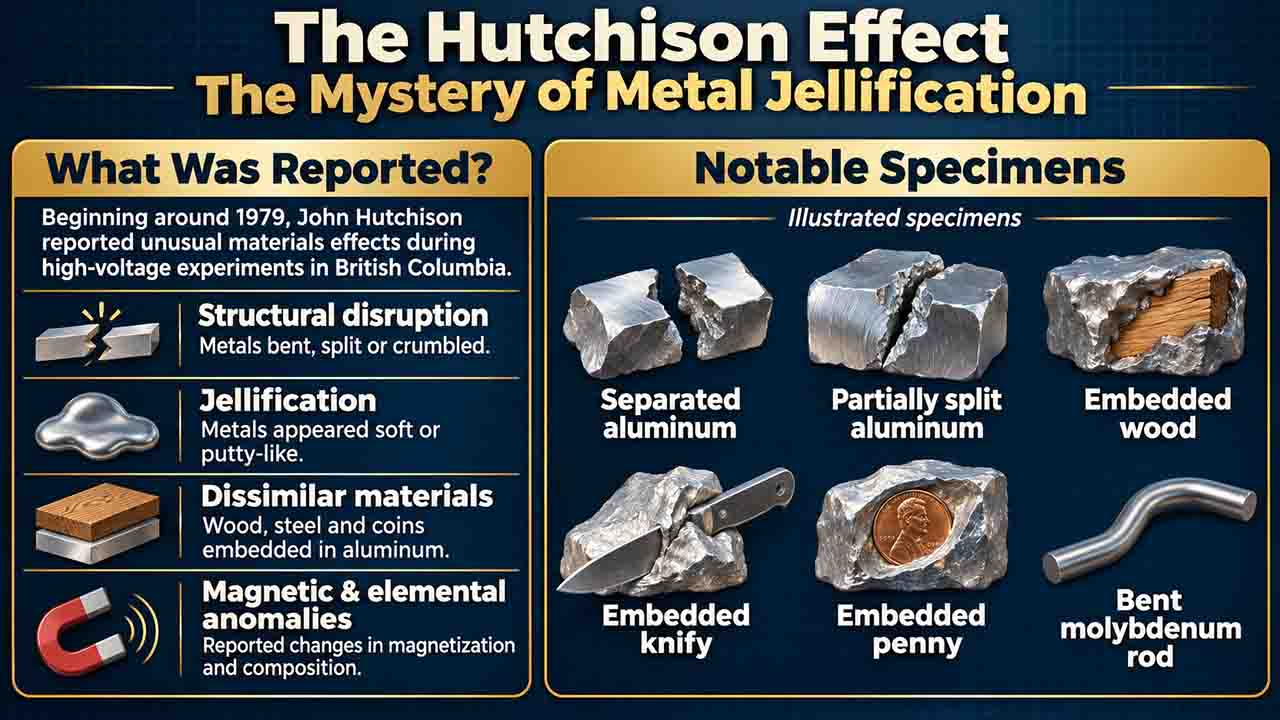
Among the most unusual phenomena described by Hutchison and Hathaway was a reported transformation in the mechanical behavior of metals that became known as jellification or gelification. Normally rigid metallic specimens appeared to become temporarily pliable, behaving more like rubber, putty, or a viscous substance than structural metal. Some reportedly bent or twisted, while others stretched and separated before returning to an apparently rigid state. The term cold melting was also used, although these descriptions don’t establish that the metals actually entered a liquid phase. Jellification remains a description of the reported behavior rather than a recognized metallurgical state.
Hathaway described aluminum specimens quivering and occasionally releasing droplets that appeared to be molten metal, yet reportedly leaving the underlying paper or cardboard without visible thermal damage. Other materials reportedly twisted into unusual shapes without the obvious markings associated with mechanical loading. Not all of the effects were described as occurring without heat, however. Some ferrous specimens reportedly became incandescent or emitted sparks, indicating that the Hutchison Effect encompassed a broader range of phenomena than the term cold melting suggests.
Understanding these reports requires distinguishing between metallic cohesion and resistance to plastic deformation. Most engineering metals consist of crystalline grains containing structural defects called dislocations. These defects allow portions of the crystalline lattice to move relative to one another under mechanical stress, enabling permanent deformation without requiring all the atomic bonds within the material to be broken simultaneously. Temperature, alloy composition, grain size, and dislocation mobility influence the forces required to deform a metal. A process that substantially increased dislocation mobility could therefore reduce a metal’s resistance to deformation without necessarily transforming it into a liquid.
The thermal properties of the specimens illustrate why the historical claims attracted attention. Pure aluminum melts at approximately 660°C, copper at 1,085°C, molybdenum at 2,623°C, and tungsten at 3,422°C. Heating and melting a kilogram of aluminum from room temperature requires approximately one megajoule of energy, equivalent to operating a 1,500-watt heater for roughly 11 minutes under ideal conditions. Heating a localized region would require considerably less energy, however, and many alloys lose substantial mechanical strength well below their melting temperatures. Without direct temperature measurements during deformation, the appearance of a cooled specimen can’t reveal whether it softened through a thermal, mechanical, electromagnetic, or other process.
Spontaneous Metal Fracture & Structural Disruption
Among the most striking specimens I examined at Hutchison’s laboratory was a substantial rectangular aluminum bar, estimated to be approximately three inches wide and two inches thick, that had separated into two pieces. Examining the matching halves revealed details that weren’t apparent in most television footage. The damaged ends appeared stretched, curled, and distorted, resembling the appearance of modeling clay pulled apart before being allowed to harden. Close-up photographs also revealed a coarse, granular texture that contrasted sharply with the comparatively smooth manufactured surfaces of the original stock. The most extensive deformation was concentrated around the region where the bar had separated.
The mechanical scale of such a specimen is worth considering. A solid aluminum bar with a three-by-two-inch cross-section has an area of approximately 3,870 square millimeters. If it were manufactured from 6061-T6 aluminum, a common structural alloy with a typical yield strength of approximately 276 megapascals, uniformly loading the bar to its yield strength in tension would require a force exceeding one million newtons, equivalent to the weight of roughly 109 metric tons under Earth’s gravity. This is an illustrative comparison rather than a measurement of Hutchison’s specimen, whose alloy and temper remain uncertain. Cracks, localized stresses, elevated temperatures, and material defects could substantially reduce the force needed to initiate failure.
A second aluminum bar exhibited similar deformation but hadn’t completely separated. Portions of the material appeared to have stretched and pulled away from the surrounding metal before the disruption stopped. Taken together, the complete and incomplete specimens offered a potentially valuable comparison between different stages of structural failure. Hathaway also reported observing an extruded aluminum specimen separate into metallic sheets over several minutes. He suggested that the disruption might have followed grain boundaries, and portions were subsequently removed for X-ray fluorescence and electron microscopy. His assessment was that the effect extended through the bulk material rather than being limited to its surface.
Other specimens included a steel block that reportedly separated into three sections, a large cylindrical steel component exhibiting extensive localized damage, and a heavily distorted brass bar that appeared almost as though it had been struck with a cutting tool. Hathaway also documented a steel shaft approximately 52 millimeters in diameter that reportedly lost around six millimeters of material from one end through a crumbling process. Aluminum, brass, and steel differ considerably in their crystalline structures, fracture behavior, and resistance to deformation. Comparing their damaged regions could help determine whether they experienced similar loading conditions, different conventional failure mechanisms, or some other process capable of producing structural disruption across multiple classes of materials.
The Anomalous Fusion of Metals & Organic Materials
Perhaps the most compelling specimen I examined was a block of aluminum containing an embedded piece of wood. According to its reported history, the wood had originally been resting on the surface of the aluminum before becoming incorporated into the metal during an experimental event. The specimen was subsequently sectioned, exposing the interior interface between the two materials. When I photographed the sample, I was able to examine the wood closely enough to make a small indentation with my fingernail. It retained some of its original softness and exhibited no obvious signs of charring.
The thermal behavior of wood makes this specimen particularly interesting. Significant chemical degradation of its constituent polymers typically occurs between approximately 200°C and 300°C, although prolonged exposure to considerably lower temperatures can also cause damage. Aluminum, by comparison, requires temperatures approaching 660°C to melt in its pure form, with common structural alloys melting over somewhat lower temperature ranges. Sustained direct contact with molten aluminum would ordinarily be expected to alter wood chemically and structurally. However, the extent of that alteration depends on exposure time, moisture content, heat transfer, and other processing conditions. Chemical examination of the embedded wood would therefore provide considerably more information than its external appearance alone.
Another specimen contained a steel knife embedded within aluminum. Hutchison displayed the specimen in historical footage, and Hathaway described an experiment in which a cutlery knife resting on an aluminum bar became embedded several millimeters into its surface. The specimen I examined had been cut open to expose the blade and surrounding aluminum, and attempts to manually pry the knife loose were unsuccessful. A third specimen contained a Canadian penny embedded near a damaged region of an aluminum bar. I photographed both the coin and the manufacturer’s markings on the reverse side of the bar, preserving potential clues to the identity and history of the materials.
The term fusion, frequently used to describe these specimens, encompasses several very different engineering processes. Casting, mechanical encapsulation, interlocking, diffusion bonding, and welding can all produce structures in which dissimilar materials become difficult to separate. Additional reports of metal becoming incorporated into rubber raise similar questions about the nature of the interface. The scientific significance of these specimens depends less on the fact that two materials are physically joined than on how that joining occurred. Microscopic examination could reveal whether the interfaces contain machining marks, casting structures, chemical reaction products, diffusion layers, or other evidence of their formation. True microscopic interpenetration would be a substantially different phenomenon from one material simply becoming embedded within another.
Refractory Metals & Magnetic Anomalies
Hathaway’s collection included a bent molybdenum rod approximately 5.5 inches long and six millimeters in diameter. Molybdenum belongs to a class of refractory metals valued for their resistance to high temperatures and demanding mechanical environments. Its melting temperature exceeds 2,600°C, and its elastic modulus of approximately 330 gigapascals is nearly five times that of aluminum. Hathaway reported corrected Rockwell B hardness measurements of 95 in the deformed region and 91 in a control sample. The difference could reflect conventional work hardening or other metallurgical changes, but it represents one of the relatively few quantitative mechanical measurements available for the historical specimens.
Other photographs, supplied to me by researcher Gary Stevenson, reportedly depicted tungsten specimens that had undergone apparent melting or deformation. Tungsten has the highest melting temperature of any pure metal under ordinary pressure, exceeding 3,400°C. Its density of approximately 19.3 grams per cubic centimeter makes it more than seven times as dense as aluminum, and its elastic modulus approaches 400 gigapascals. These characteristics make tungsten valuable in applications involving extreme temperatures, electrical contacts, and specialized aerospace components. The identity of the photographed specimens requires independent confirmation, however, and neither their appearance nor their reported deformation establishes that they reached a liquid state.
Magnetic anomalies represented another category of reported materials effects. Hathaway described steel files that fractured into several sections, with adjoining fracture faces subsequently exhibiting magnetic repulsion rather than the attraction ordinarily expected when a uniformly magnetized bar is broken apart. Hutchison also demonstrated a stainless-steel specimen that strongly attracted coins near one end while exhibiting little apparent attraction elsewhere. He interpreted this as a possible magnetic monopole, but ferromagnetic materials can develop complex internal domain arrangements, nonuniform magnetization, and localized magnetic-field gradients. Establishing anything more unusual would require quantitative mapping of the complete magnetic field rather than demonstrations of attraction or repulsion alone.
The reported effects extended beyond metallic specimens. Hathaway described quartz undergoing apparent melting and structural disruption, while historical footage and eyewitness accounts included liquids moving, plastics deforming, sealed containers compressing, and organic materials splitting or emitting fumes. Quartz is particularly interesting because its piezoelectric properties allow electrical stimulation to produce mechanical strain. Plastics and organic materials may also respond to electrostatic forces, dielectric heating, acoustic vibration, or chemical degradation. The breadth of these reports is one reason the Hutchison Effect is better understood as a collection of claimed phenomena than as a single experimentally established physical process.
George Hathaway’s Hutchison Effect Research
In October 2009, nearly three decades after beginning his involvement with Hutchison, Hathaway presented a technical examination of the materials specimens at the Materials Science & Technology conference in Pittsburgh, Pennsylvania. His 12-page paper, Hutchison Effect Metal Samples: Description and Analysis, appeared in the conference proceedings under the symposium theme of new roles for electric and magnetic fields. The paper represented an important departure from the popular literature surrounding the Hutchison Effect, providing a participant’s technical account of the equipment, physical specimens, and analytical investigations.
Hathaway organized the reported materials effects into eight categories encompassing thermal activity, jelly-like behavior, delamination, fracture, extensive deformation, pitting, crumbling, and compositional segregation. This classification provides a more productive framework for investigating the phenomena than assuming that every specimen represents an identical process. A metal undergoing localized heating, for example, presents a different engineering problem from an extruded aluminum bar separating longitudinally into fibers. Similarly, magnetic changes in a steel specimen require different analytical techniques from the examination of an aluminum block containing embedded wood.
Among the analytical methods associated with Hathaway’s investigations were X-ray fluorescence, scanning electron microscopy, energy-dispersive X-ray spectroscopy, electron microprobe analysis, and mechanical hardness testing. Electron micrographs revealed microscopic features that couldn’t be resolved in ordinary photographs, including rounded aluminum fibers with dimensions extending into the tens of micrometers and regularly spaced structures on certain steel fracture surfaces. Such images provide valuable morphological information, although they don’t independently establish the forces or temperatures responsible for creating those structures. Similar microscopic features can arise through multiple metallurgical processes.
Hathaway subsequently documented his experiences in Mindbending: The Hutchison Files: 1981 to 1995, and discussed them extensively during his 2022 APEC appearance. His recollections were particularly valuable because he openly acknowledged both his direct observations and the limitations of his investigation. He had witnessed structural disruption, handled materials, supplied experimental specimens, and attempted to characterize the electrical environment, yet he hadn’t succeeded in making the effects reliably controllable. Hathaway eventually questioned whether the apparatus alone could explain the phenomena, considering a possible role for Hutchison himself. That interpretation remains speculative, but his inability to establish a reproducible relationship between the equipment and the materials changes is central to understanding the historical research.
Elemental Redistribution & Claims of Nuclear Transmutation
Beyond their unusual physical appearance, some Hutchison specimens reportedly exhibited differences in localized elemental composition. During my visits to Hutchison’s laboratory, I photographed spectroscopic records associated with Hathaway’s materials investigations, subsequently making them available in a public photographic archive. The records included comparisons between reportedly unaffected material and damaged regions of aluminum and brass specimens. Several comparisons appeared to show changes in the relative intensities of elemental spectral peaks, while an analysis associated with a damaged steel cylinder reportedly indicated no obvious compositional difference between the affected and unaffected regions.
Hathaway’s 2009 paper also documented localized concentrations of alloying elements near damaged regions. Electron microscopy and microanalysis reportedly identified copper-rich and manganese-rich globular structures within an aluminum specimen, while copper-colored globules were observed near the fracture region of a steel boring bar. Hathaway characterized these findings as apparent de-alloying, suggesting that constituents normally distributed throughout an alloy might have become concentrated in particular locations. An important question is whether those concentrations formed during the reported disruption or existed previously as part of the material’s manufacturing history, inclusions, precipitates, or ordinary compositional inhomogeneity.
The electrically driven movement of atoms through metallic materials is already an established area of scientific research. In semiconductor manufacturing, electromigration is a major reliability concern involving the gradual transport of atoms through microscopic conductors exposed to high electrical current densities. In aluminum interconnects, current densities can approach one million amperes per square centimeter, contributing to the formation of voids, material accumulations, and eventual conductor failure. Other mechanisms, including thermomigration, grain-boundary diffusion, precipitation, and phase segregation, can also redistribute elements. However, the distances, timescales, and electrical conditions involved in microelectronic conductors differ substantially from those associated with Hutchison’s bulk metal specimens.
Interpreting the historical spectra requires considerable care. Characteristic X-ray line designations such as Al K refer to electronic transitions associated with aluminum and shouldn’t be mistaken for indications of additional elements. Moreover, spectral peak intensities aren’t directly equivalent to elemental concentrations. Surface roughness, oxidation, detector geometry, instrumental calibration, and the composition of the surrounding material can all influence the resulting spectra. Although Hutchison suggested that nuclear transmutation might have occurred, demonstrating such a process would require calibrated chemical measurements, isotopic analysis, contamination controls, and a defensible accounting of the original and final material composition. Elemental redistribution offers a more conventional and experimentally accessible hypothesis, but the existing records don’t establish that it occurred during the experiments.
Independent Metallurgical Analysis of the Hutchison Effect
One of the most important scientific investigations associated with the Hutchison Effect appeared in 2009, when Lawrence E. Murr, Sara M. Gaytan, and M. I. Lopez of the University of Texas at El Paso published a metallurgical examination in the journal Materials Research Innovations. Their paper, Materials Characterisation of Bizarre and Catastrophic ‘Burst’ Failure in Metal by ‘Hutchison Effect’, appeared in volume 13, issue 4, on pages 425–430. Unlike Hathaway’s participant-authored conference paper, this investigation brought the specimen into the domain of academic materials characterization by researchers working outside the original experimental collaboration.
The researchers examined an aluminum-alloy rod exhibiting a striking failure morphology. Rather than terminating in a comparatively simple fracture surface, the damaged end had separated into metallic layers ranging from approximately 50 micrometers to two millimeters in thickness. Portions of these layers had further divided into elongated strands, giving the damaged region an appearance reminiscent of unraveling rope. The morphology was consistent in its general appearance with some of the delaminated aluminum specimens documented in Hathaway’s collection, although establishing a common formation mechanism would require additional evidence.
The investigation employed optical metallography, field-emission scanning electron microscopy, and transmission electron microscopy. These complementary techniques allow researchers to examine materials across several orders of magnitude in scale. Optical metallography provides information about grain structures and larger material phases, while scanning electron microscopy reveals detailed surface morphology and fracture characteristics. Transmission electron microscopy can investigate much finer structural features, including crystalline defects, precipitates, dislocations, and other microscopic evidence associated with a material’s manufacturing and deformation history.
The investigators reported that their characterization revealed no unfamiliar metallurgical phenomena within the aluminum specimen, yet they weren’t able to determine the mechanism responsible for its unusual macroscopic failure. This is an important and frequently overlooked distinction. Their research didn’t independently reproduce the Hutchison Effect or establish that electromagnetic fields had caused the damage. It also didn’t identify a definitive conventional formation mechanism. The apparent discrepancy between the specimen’s dramatic external appearance and its comparatively conventional microscopic characteristics suggests that the most productive scientific question may concern how the material was subjected to failure, rather than whether it entered an exotic state of matter.
Electroplasticity, Magnetoplasticity & Metal Softening
One of the most relevant areas of established science for comparison with the Hutchison Effect is electroplasticity, which investigates how electrical stimulation influences the mechanical behavior of materials. In 1986, A. F. Sprecher, S. L. Mannan, and H. Conrad published a detailed study in Acta Metallurgica examining aluminum, copper, nickel, iron, niobium, tungsten, and titanium under tensile loading. Applying electrical pulses lasting approximately 60 microseconds at current densities near 1,000 amperes per square millimeter, the researchers observed changes in the mechanical loads required to deform the metals. Their analysis identified both thermal contributions and plastic deformation potentially associated with enhanced dislocation mobility.
Research published in the Journal of Applied Physics in 2019 extended this investigation to AZ31B magnesium alloy. Jingyi Zhao and Zhencheng Ren examined electrical pulses approximately 100 microseconds in duration, at repetition frequencies between 120 and 800 hertz. By comparing different electrical loading conditions with comparable resistive heating, they identified reductions in flow stress that couldn’t be attributed solely to bulk temperature changes. Under one set of experimental conditions, a pronounced additional reduction in deformation resistance emerged around a peak current density of 130 amperes per square millimeter, with the material’s temperature maintained near 150°C.
A comprehensive 2025 review in the Annual Review of Materials Research, followed by additional literature on electrically assisted metal processing in 2026, illustrates how far the field has advanced. Researchers are investigating the interactions between electrical currents, crystalline defects, grain boundaries, localized heating, and mechanical deformation in both metals and ceramics. Related technologies include electromagnetic forming, ultrasonic-assisted manufacturing, and magnetoplasticity. Together, these research areas demonstrate that material deformability can be influenced through mechanisms beyond conventional bulk heating. However, the current densities employed in many electroplasticity experiments are extremely high, and the specimens are usually subjected to direct electrical and mechanical loading. Hutchison’s claims of remotely induced deformation without direct electrical connections represent a substantially different physical proposition.
One characteristic that particularly interested me during my examination of Hutchison’s specimens was the concentration of disruption near the centers of several aluminum, brass, and steel bars. During our APEC discussion, Hathaway acknowledged a general geometric pattern and recalled a steel file separating into four approximately equal-length sections. He also emphasized that he couldn’t correlate these dimensions with recognizable wavelengths in the electromagnetic environment he had measured. Mechanical resonance, acoustic standing waves, residual stresses, bending moments, and localized electromagnetic interactions all deserve consideration. However, establishing a meaningful geometric pattern would require examining the entire population of exposed specimens, including those that remained unaffected. Without such records, resonance remains an interesting research hypothesis rather than an established explanation.
Hutchison Effect Replication & Government Investigations
The Hutchison Effect attracted attention from individuals associated with Canadian and American government and military research. A historical compilation titled The Hutchison File, published in 1996, preserves early engineering presentations and reproductions of correspondence concerning investigations into the phenomena. Additional information emerged through a Freedom of Information Act request submitted by researcher Brian Allan. In a response dated May 8, 2000, the U.S. Department of Energy documented an account by retired Army Colonel John B. Alexander, who recalled arranging an Army-associated contractor investigation involving Hathaway and Pezarro around 1983.
The same correspondence indicated that a report had been prepared by John Rink and Robert Freeman, both former Los Alamos National Laboratory employees. However, searches conducted in response to the information request failed to locate the report or other responsive laboratory records. Alexander recalled that copies were no longer available through the organizations concerned. The correspondence provides evidence that individuals associated with government research had taken an interest in the Hutchison Effect, but the absence of the underlying technical report prevents an independent assessment of their findings. Government interest shouldn’t be confused with governmental verification of the phenomena.
Hathaway provided additional context during his 2022 APEC appearance, recalling a later demonstration arranged for visitors associated with Los Alamos, which he tentatively dated to the early 1990s. The demonstration failed to produce the significant materials effects that he and his associates had described. A transformer failed, and some objects reportedly fell over elsewhere in the facility, but the anticipated phenomena didn’t materialize. The visitors departed without obtaining convincing experimental results. Skeptical investigations, including Joe Nickell’s 2007 discussion of Hutchison’s claims in Skeptical Inquirer, have also raised questions about the reliability of demonstrations and the adequacy of experimental controls. Criticisms directed at levitation footage don’t automatically establish how particular materials specimens were formed, but they reinforce the importance of independently controlled observation.
Numerous conventional materials processes also deserve investigation before the specimens can be attributed to an unknown physical mechanism. Extruded aluminum can undergo directional fracture and exfoliation corrosion. Steel can experience embrittlement, fatigue, stress corrosion, and sudden release of residual mechanical stresses. Certain alloys can undergo localized grain-boundary melting below their nominal bulk melting temperatures, while electrical discharges and mechanical processing can create unusual surface and fracture morphologies. Conventional fabrication must also remain among the possibilities where a specimen’s origin hasn’t been independently documented. The essential scientific problem is the absence of a reliable experimental process connecting the surviving artifacts to their reported formation. Without that connection, the materials can be investigated as physical evidence, but their origins can’t be established solely from the historical claims.
Investigating the Hutchison Effect with Modern Materials Science
The instrumentation available to materials scientists today offers opportunities for examining surviving Hutchison specimens that were considerably less accessible during the original experiments. High-resolution X-ray micro-computed tomography could provide nondestructive three-dimensional images of internal cracks, embedded objects, concealed cavities, casting porosity, and material interfaces. The completely and partially separated aluminum bars would be particularly valuable candidates, alongside the specimens containing wood, a steel knife, and a Canadian penny. Even the coin offers potential forensic information: Canadian pennies contained approximately 98% copper during the 1980s, switched to copper-plated zinc in 1997, and began incorporating copper-plated steel in 2000. Identifying the coin’s composition and date could help constrain the specimen’s possible formation history.
More detailed examinations could employ electron backscatter diffraction to map crystalline orientations and identify evidence of deformation, grain-boundary movement, or recrystallization. Calibrated micro-X-ray fluorescence and electron microprobe analysis could establish spatial variations in elemental composition, while scanning and transmission electron microscopy could investigate fracture surfaces and microscopic structural changes. Spectroscopic examination of the embedded wood could reveal chemical evidence of thermal degradation, and examination of metal-to-metal interfaces could identify diffusion layers, intermetallic compounds, machining features, or mechanical encapsulation. Independent laboratories working with documented chains of custody, blinded sample identification, and conventionally manufactured control specimens could substantially improve the evidentiary value of these investigations.
If a controllable process were eventually demonstrated that substantially reduced the mechanical resistance of metals to deformation without conventional bulk heating, its engineering implications would be considerable. Aerospace manufacturers could benefit from reduced forming forces for high-strength aluminum and titanium alloys, while machining operations might require less energy and experience reduced tool wear. Other potential applications include solid-state joining, metal-organic composites, recycling, alloy purification, and localized modification of mechanical properties. Existing research into electrically assisted forming and electromagnetic manufacturing already demonstrates the industrial value of controlling the relationship between external energy and material behavior. Any reproducible Hutchison-type process would need to demonstrate capabilities beyond those established technologies.
Metals have a memory. Fracture, deformation, manufacturing, and thermal exposure can leave microscopic traces within their crystalline structures, sometimes preserving evidence of events that occurred decades earlier. Nearly half a century after John Hutchison began his experiments, much of the original electromagnetic environment may be impossible to reconstruct, but the physical artifacts could still preserve evidence of the processes responsible for their formation. Hathaway’s eyewitness testimony, his technical documentation, and the independent metallurgical examination by Murr and his colleagues provide a starting point for investigating those questions. Whether the specimens ultimately reveal conventional metallurgy, unusual failure mechanisms, or a phenomenon requiring further scientific explanation, the answers may still be embedded within the materials themselves. The challenge now is learning how to read them.
References
Hutchison Effect Technical Literature
- Hutchison Effect Metal Samples: Description and Analysis — George D. Hathaway, Materials Science & Technology Conference, 2009, pp. 667–678.
- Materials Characterisation of Bizarre and Catastrophic ‘Burst’ Failure in Metal by ‘Hutchison Effect’ — Lawrence E. Murr, Sara M. Gaytan, and M. I. Lopez, Materials Research Innovations, Vol. 13, No. 4, 2009, pp. 425–430.
- Mindbending: The Hutchison Files: 1981 to 1995 — George Hathaway, revised and expanded edition, Integrity Research Institute.
- The Hutchison File — Pelayo Calante and Andrew Michrowski, editors, Planetary Association for Clean Energy, 1996. Includes Hathaway’s earlier Lift and Disruption System technical presentation and historical correspondence.
Electroplasticity & Materials Engineering
- On the Mechanisms for the Electroplastic Effect in Metals — A. F. Sprecher, S. L. Mannan, and H. Conrad, Acta Metallurgica, Vol. 34, No. 7, 1986, pp. 1145–1162.
- Electroplasticity in AZ31B Subjected to Short-Duration High-Frequency Pulsed Current — Jingyi Zhao and Zhencheng Ren, Journal of Applied Physics, Vol. 125, 2019.
- Electroplasticity of Metals and Ceramics: Current Status — Apurv Dash et al., Annual Review of Materials Research, Vol. 55, 2025, pp. 151–174.
- Electric-Current-Assisted Processing of Metals: Mechanisms, Microstructural Control, and Plasticity Enhancement — Yang Yang et al., Review of Materials Research, Vol. 2, 2026.
- Aluminum 6061-T6 and 6061-T651 Material Properties — ASM International and MatWeb Materials Property Database.
- Wood Products: Thermal Degradation and Fire — Mark A. Dietenberger and Laura Hasburgh, USDA Forest Products Laboratory, 2016.
- Chemical and Mechanical Characterization of Pyrolysis in Wood — Laura Hasburgh, USDA Forest Products Laboratory, 2020.
- Canadian One-Cent Coin: History and Technical Specifications — Royal Canadian Mint.
Historical Investigations & Critical Assessments
- Hutchison Effect: Freedom of Information Act Correspondence — Historical U.S. Army and Department of Energy correspondence supplied to researcher Brian Allan, 1999–2000.
- Mysterious Entities of the Pacific Northwest, Part I — Joe Nickell, Skeptical Inquirer, January/February 2007.
Original Photographic & Analytical Archives
- Hutchison Effect Metal Samples — Tim Ventura, photographic archive documenting metallic deformation, structural disruption, jellification, and the incorporation of dissimilar materials.
- Hutchison Effect Spectroscopic Analysis — Tim Ventura, photographic archive of spectroscopic records associated with George Hathaway’s materials investigations.
Historical Footage, Interviews & Conference Presentations
- The Hutchison Effect: Archival Video Documentation — Recording 1 — Historical footage and materials documentation.
- The Hutchison Effect: Archival Video Documentation — Recording 2 — Historical footage and materials documentation.
- The Hutchison Effect: Archival Video Documentation — Recording 3 — Materials effects and specimen documentation.
- The Hutchison Effect: Archival Video Documentation — Recording 4 — Experimental recollections and materials discussion.
- APEC 1/1: The Graviflyer, Tesla Resonant Motor & Hutchison Effect — Alternative Propulsion Engineering Conference, January 1, 2022, featuring George Hathaway’s retrospective discussion of the Hutchison Effect experiments and materials specimens.