

The Enshittification of Science: The Corporate Capture of Peer-Reviewed Journals

Scientists produce the discoveries, write the papers, and provide much of the peer review that gives scientific journals their authority. Yet powerful publishers control many journals researchers depend on for recognition, collecting publication fees and access payments across their portfolios. It’s science’s version of Cory Doctorow’s enshittification: a system for sharing knowledge becomes a captive market, enriching its gatekeepers while limiting the scientific community’s control over its own work.
Follow the Research. Follow the Money.
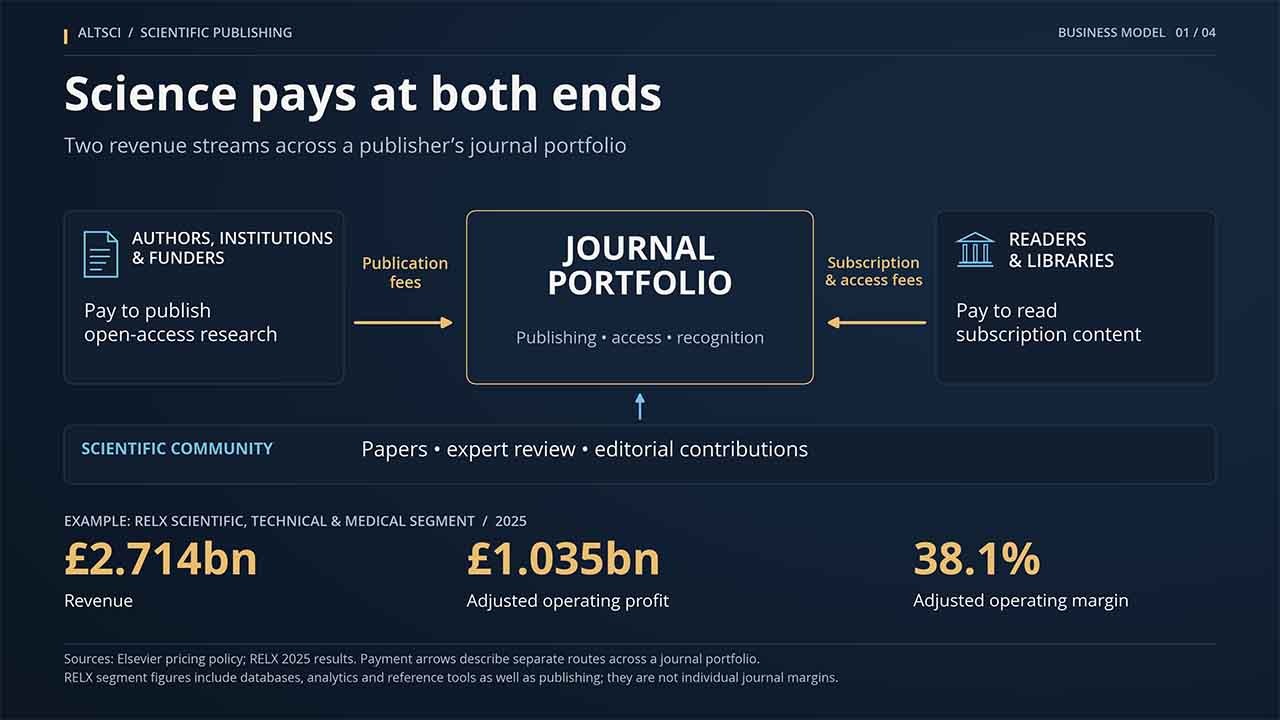
Follow a publicly funded research paper from the laboratory to publication, and an unusual commercial arrangement comes into view. A grant supports the investigation. A university supplies equipment, facilities, and some of the salaries. Researchers design experiments, calibrate instruments, analyze measurements, and write the manuscript. Other scientists assess whether its methods and conclusions hold up. A publisher coordinates the editorial process and produces the version that enters the scholarly record. The institutions that financed the discovery and supplied the expertise then become customers for access, publication, or both across the publisher’s portfolio. Scientific labor creates much of the value on which the business depends.
At the powerful end of this industry, the financial resources are substantial. RELX, Elsevier’s parent company, reported £2.714 billion in 2025 revenue for its Scientific, Technical & Medical segment, alongside £1.035 billion in adjusted operating profit and an adjusted operating margin of 38.1%. That segment includes databases, analytics, and reference tools as well as research publishing; its margin isn’t the profit on every journal or article. Nevertheless, the figures establish the commercial scale surrounding the editorial work. A journal’s difficulty finding reviewers can exist inside a business that generates more than a billion pounds in annual adjusted operating profit.
Publishers collect revenue through several arrangements. Subscription journals generally charge readers or institutions, and many allow authors to publish without an article processing charge. Author-paid open access makes the resulting article freely readable, with the bill often paid by a grant, university, or funder. Hybrid journals offer both routes. Institutional agreements can combine reading and publishing. Across these models, the community’s dependence can survive: scientists supply the findings and much of their evaluation, then finance their circulation through organizations whose terms they have limited power to change.
Publishers perform necessary work. Managing submissions, supporting editors, producing accessible documents, preserving records, and investigating integrity problems all have costs. Commercial publishing can deliver these services competently. The public-interest question is whether prices and contractual terms reflect useful services under meaningful competition, or the power to charge communities that can’t readily leave. When reviewing is described as an underfunded obligation, attention should extend to how publishing revenue is allocated and who bears the uncounted costs. Scientific communities deserve an accounting of the relationship between what they contribute, what they pay, and the authority they retain.

How a Scientific Service Became a Corporate Asset
Scientific journals began by solving a practical communication problem. In 1665, the Journal des sçavans, covering broad learned news, appeared in France. It was followed by Philosophical Transactions in England, a personal commercial venture in which Henry Oldenburg assembled reports from his correspondence network. Printed records helped establish priority and carry observations beyond meetings and private letters. The communities they served were limited by money, language, status, and institutional connections. Their importance came from making knowledge more durable and easier to exchange. The case for reclaiming scientific publishing rests on that continuing function, without requiring nostalgia for a past in which participation was supposedly open to everyone.
Journals and modern peer review also have different histories. The Royal Society took institutional control of Philosophical Transactions in 1752; written refereeing developed there in the 1830s. Historians Aileen Fyfe and Noah Moxham have shown that referees helped manage institutional reputation and the expense of printing as well as assess scholarly work. The modern association of refereeing with systematic quality control developed later. Scientific publishing’s rules have therefore changed repeatedly as circumstances changed. Today’s arrangements are institutional choices with a history, and they remain available for revision.
Commercial concentration became increasingly consequential as professional science expanded and journals accumulated prestige. In a 2015 study, Vincent Larivière, Stefanie Haustein, and Philippe Mongeon examined roughly 44.5 million documents indexed in Web of Science between 1973 and 2013. In 2013, the five leading publishers in each broad subject group accounted for 53% of natural and medical sciences papers and 51% of social sciences and humanities papers. Those lists differed; the natural and medical sciences group included the nonprofit American Chemical Society. Digital publishing coincided with increasing concentration in several fields. The cost of delivering another electronic copy fell dramatically compared with printing and shipping another issue, while control over journal portfolios and archives remained commercially valuable. Institutions still needed the particular literature those portfolios contained.
The concentration figures also reveal how visibility shapes the argument. A 2025 study by Simon van Bellen, Juan Pablo Alperin, and Larivière found that the five largest publishers accounted for 59% of 2021 articles in Web of Science, compared with 44% in the broader Dimensions database. The same study found that the leading publishers’ share had declined in Dimensions since the late 1990s while rising in Web of Science. Smaller publishers and independent journals constitute a substantial scholarly world that selective indexes can obscure. That makes the highly visible publishing ecosystem central to the commercial-capture argument, especially where institutions use it to recognize achievement. Alternatives already exist, but their existence alone doesn’t give them equivalent standing in the systems that allocate careers and funding.
Dependence Enables Extraction
Cory Doctorow’s concept of enshittification describes how a useful intermediary can deteriorate as it gains power over dependent participants. In his influential 2023 account, platforms initially attract users with favorable terms, then shift value toward business customers, and eventually extract more for themselves once both groups face difficulty leaving. High switching costs, weak competitive pressure, and control over the relationship allow the intermediary to change the bargain. The concept’s explanatory power comes from that sequence of dependence and extraction. Simply being large, charging money, or making a profit doesn’t establish it.
Scholarly publishing has its own version of the dependence. Economists Doh-Shin Jeon and Jean-Charles Rochet analyzed academic journals as a two-sided market in a 2010 paper. The framework concerns the interdependence of authors and readers and the effects of a journal’s pricing choices. Authors want recognized outlets and access to readers. Readers need particular findings. Universities purchase access and evaluate researchers. Funders finance the work and frequently its publication. Reviewers supply expertise that makes the resulting record more credible. These roles overlap, so publishing isn’t a tidy copy of an advertiser-supported social network. Yet the central relationship is recognizable: the intermediary coordinates groups whose participation makes the service valuable, while its position can allow it to impose terms that each participant would struggle to change alone.
Scientific articles also make unusual commercial products. A different paper usually can’t substitute for the specific experiment, dataset, or theoretical argument a researcher needs to examine. Libraries can buy another journal, but doing so won’t necessarily provide the missing evidence. Authors face a parallel problem when an alternative outlet offers competent evaluation but lacks the reputation their institutions reward. Competition is weakened when products perform distinct scholarly functions and when customers cannot carry accumulated recognition easily from one venue to another. Where lawful alternative copies are unavailable, that difficulty of substitution gives an established publisher bargaining power beyond the cost of producing a document.
Doctorow had already identified this relationship in 2021, describing academic publishing as a form of “chokepoint capitalism” built around influence over researchers’ career prospects. Applied to journals, his later enshittification framework identifies what commercial extraction can erode: affordability, freedom to participate, practical access, and the community’s authority over its own institutions. Excellent research can continue to appear throughout this process. The scientific merit of individual papers doesn’t resolve whether the surrounding system serves science well. Commercial capture occurs when dependence gives the intermediary increasing freedom to define the bargain in its own interests.
Prestige Is the Lock
Consider a researcher approaching a hiring decision who believes a particular journal will make the difference between a temporary contract and a permanent position. Its publishing terms may be difficult to justify, its review process frustrating, and its policies unpopular. Those objections still have to compete with the consequences of choosing another outlet. The relevant transaction includes professional recognition as well as editorial services. A researcher can dislike the publishing arrangement and rationally participate in it because the people evaluating that researcher’s future attach significance to the journal’s name.
The San Francisco Declaration on Research Assessment, developed after a 2012 meeting and published in 2013, addresses this substitution directly. It recommends judging research on its merits instead of using journal metrics as proxies for individual papers or people. Its technical objections include skewed citation distributions and differences among fields. A journal’s average citation performance cannot establish the quality of every article it contains. Nevertheless, journal-level indicators can offer an attractive shortcut when committees face large volumes of work. That shortcut gives the publication venue influence over decisions it wasn’t designed to make.
Once professional advancement depends on recognized venues, a new journal has two jobs: provide sound editorial evaluation and persuade institutions to trust its standing. The second can be harder than the first. Established authors may prefer familiar outlets, while junior scientists may have less room to experiment. Readers and reviewers follow their fields’ established literature, reinforcing the advantage. This creates a coordination problem: many participants can favor a different arrangement while waiting for others to move first. A technically capable publishing alternative therefore needs institutional recognition and committed communities alongside its submission platform.
Universities help maintain this dependence whenever they object to publishing costs while continuing to treat journal brands as convenient measures of achievement. Funding agencies reinforce it when they reward the same signals. Their involvement gives the protest both its seriousness and its practical direction. Publishers’ influence is partly sustained by decisions made inside science. Institutions can reduce that influence by changing how they evaluate work, recognizing reviewing and data stewardship, and supporting credible venues whose reputation is still developing. The power to loosen the lock already resides with many of the organizations paying to remain inside it.
Open Access and the Persistence of Market Power
Open access has delivered a substantial public benefit: a researcher or reader can encounter a paper and examine it without first passing an institutional subscription check. That matters for teaching, independent investigation, interdisciplinary research, and public scrutiny. But open access describes availability, not a single ownership or funding model. Authors may pay, institutions may sponsor a journal, libraries may support a consortium, or a research organization may maintain the infrastructure. The arrangements determine who can afford to contribute and who controls the terms. Removing the reader’s paywall doesn’t automatically settle those questions.
Author charges can be considerable. In Elsevier’s price list dated May 9, 2025, the open-access option for Cell was listed at $11,400 before tax. Its stated pricing criteria include journal citation performance, editorial and technical processes, competition, market conditions, and other revenue. Pricing therefore reflects a journal’s market position as well as the work involved. Waivers and institutional agreements can reduce what an author pays, but access to those arrangements varies. An established title can carry its commercial leverage from a subscription model into an author-funded model while offering a real improvement in readership access.
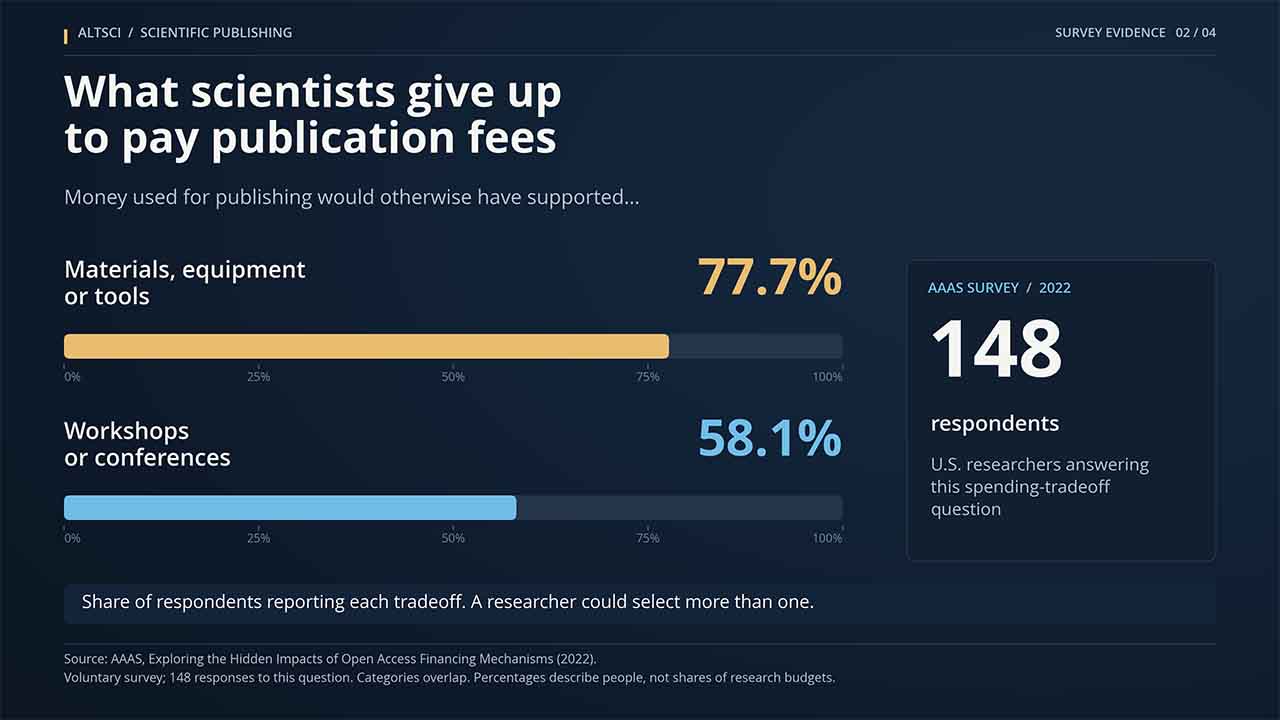
An international survey conducted in 2021 and published in Learned Publishing in 2022 helps explain why this transition produces mixed responses. Francisco Segado-Boj and colleagues obtained 3,422 valid responses from corresponding authors, a response rate of 4.14%. Respondents in lower-income countries more strongly agreed that article processing charges had harmed their careers. Those who more often paid these charges through grants or institutional funds reported refusing fee-charging journals less often. These were reported perceptions from a particular sample, rather than a measurement of every researcher’s lost opportunities. They nevertheless expose an uneven bargain: a fee that looks manageable within one institution’s publishing agreement can be a serious obstacle outside it. A separate 2022 AAAS survey documented respondents using money for publication fees that they would otherwise have spent on research materials, equipment, tools, workshops, or conferences.
Fee-linked rewards can bring reviewing and publication into the same transaction. The Royal Society, a nonprofit learned society, offers eligible reviewers tokens worth £200 toward charges in its fully open-access journals, subject to conditions and a 24-month limit. The tokens have no cash equivalent: their financial value depends on later publishing within the scheme on a paper whose authors include the token holder. Reviewers can welcome that recognition while questioning the limits of a reward usable only for another publishing transaction. Making papers freely readable remains an incomplete reform wherever contributing to the literature still depends heavily on access to publication funding.

Peer Review Becomes a Question of Priorities
A serious review can require several kinds of technical expertise. An instrumentation paper may need scrutiny of calibration procedures, sensor drift, control measurements, and error propagation. A computational study may depend on data leakage checks, appropriate validation sets, documented software versions, and reproducible analysis. A statistically significant result may still depend on unjustified exclusions or a comparison chosen after the data were examined. Finding those weaknesses demands time and specialist knowledge. A journal’s professional presentation can’t substitute for this work, and an editor cannot obtain it simply by sending another automated invitation.
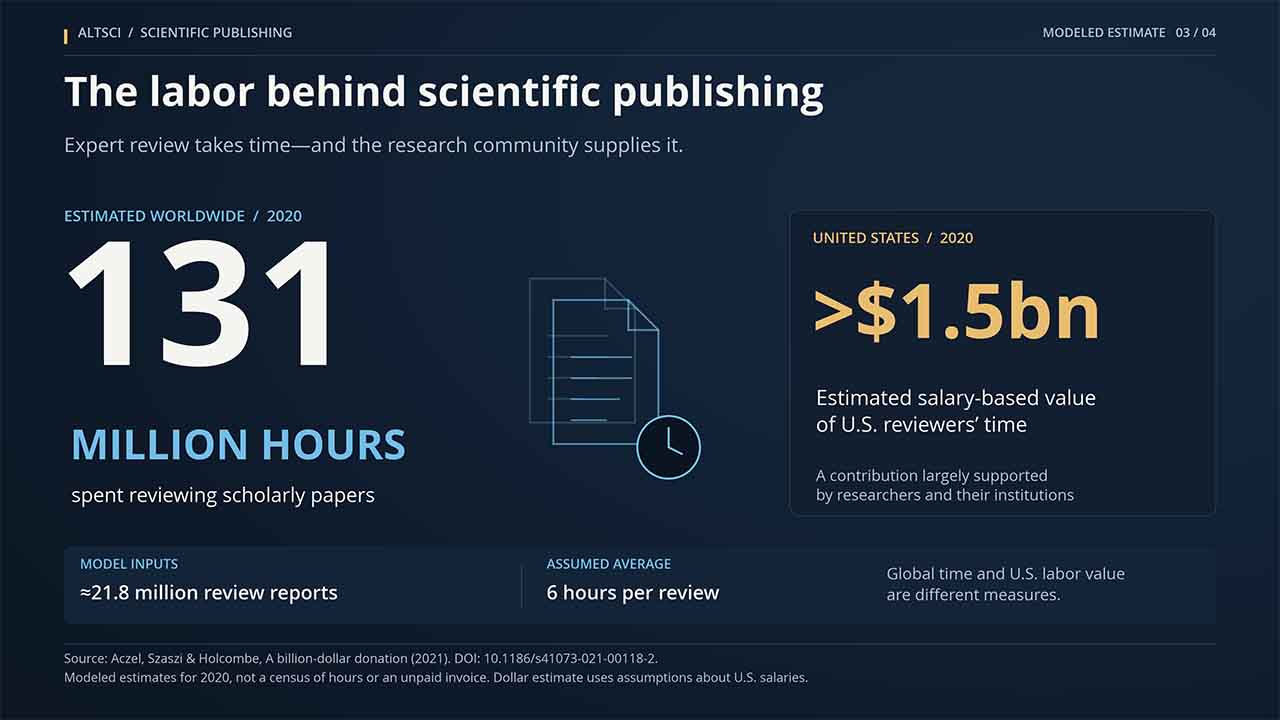
Balazs Aczel, Barnabas Szaszi, and Alex Holcombe estimated the scale of that contribution in a 2021 study. Their model put global reviewing effort in 2020 at about 131 million hours, using an estimated 21.8 million reviews and an assumption of six hours per review. The salary-based value of US reviewers’ time alone exceeded $1.5 billion. These were modeled estimates, not timesheets or payments withheld from individuals. The model covered the wider journal system, including nonprofit journals. Their significance is that substantial publishing costs are borne outside publishers’ accounts. Universities, research institutes, and researchers themselves support the labor that helps make the published product credible.
The distribution of review requests also raises a coordination question. IOP Publishing’s 2024 survey received 3,046 responses overall. On its question about reviewing time, 54% reported an appropriate number of reviewing requests, 16% received too many, and 30% reported time for more. The survey concerned physical and environmental science researchers and doesn’t describe every discipline. Its findings suggest that some respondents have time for more review requests. They don’t establish whether those researchers have the specialist expertise needed for manuscripts awaiting review. Better recruitment, methodological support, training, and communication are organizational tasks for which publishing operations can allocate resources and measure results.
This reframes the funding question. Profitable publishing businesses don’t automatically leave individual editors with sufficient staff, nor does every slow decision demonstrate neglect. But recurring appeals for voluntary effort should be accompanied by evidence of what organizations invest in the evaluation they sell as a source of trust. Spending on editorial coordination, statistical assessment, integrity investigations, and correction processes deserves scrutiny alongside financial performance. Scientists already provide a great deal through reciprocity. That contribution shouldn’t make the institutions benefiting from it less accountable for maintaining a competent, respectful, and adequately supported review process.
The Cost Extends Beyond the Invoice
Restricted access can obstruct the ordinary technical work of understanding a claim. An abstract may announce an improvement in detector sensitivity without giving the bandwidth, integration time, operating temperature, or noise model needed to interpret it. A materials paper may report exceptional performance while leaving processing conditions and uncertainty estimates in the full methods or supplementary files. Researchers need those details to compare experiments, identify limitations, and decide what to try next. Every barrier between a claim and the information required to evaluate it adds friction to science’s cumulative process.
Repositories demonstrate that distribution can be organized differently. arXiv provides dissemination, discovery, and preservation with subject moderation rather than journal peer review. Zenodo, developed through CERN and OpenAIRE and launched in 2013, supports papers, data, software, and other research outputs. These services require staff, infrastructure, maintenance, and funding, but they separate functions that traditional journals bundle together. Evaluation can be organized elsewhere: Peer Community In arranges expert review and public recommendations for preprints, with a route to publication in Peer Community Journal without author charges. These models remain dependent on financial and institutional support. Their achievement is to make alternative arrangements practical while preserving identifiable processes of evaluation.
Institutional resistance is already testing alternative routes. MIT ended its Elsevier negotiations in June 2020 after concluding that the proposed terms didn’t meet its framework for open and equitable scholarly communication. Its libraries generally retained access to pre-2020 articles and developed other routes for newer papers. Current guidance describes expedited delivery for certain articles, usually within 30 minutes, and interlibrary borrowing that typically takes one or two days. Leaving a subscription arrangement therefore involves practical tradeoffs. MIT’s experience shows the importance of library expertise and retained access in making a refusal workable; smaller institutions may have fewer resources to manage the same transition.
The resulting costs include budgets, staff time, delays, and opportunities that are difficult to count. An institution supporting alternative access must fund it, just as an institution subscribing must decide what other activities its budget can sustain. Those choices deserve comparison with investments in shared repositories, editorial support, research software, and reproducibility. The public interest is broader than reducing one invoice. Scientific knowledge becomes useful through examination and reuse, including by people outside wealthy institutions. A publishing arrangement should be evaluated by how well it enables that process and how fairly it distributes the resources required.

The Scientific Community Has Already Begun to Leave
In April 2023, the editors of NeuroImage and NeuroImage: Reports resigned and began building a new journal with MIT Press. In their opening editorial, they described a dispute over NeuroImage’s publication charge, which had reached $3,450 by 2022 after the journal became fully open access in 2020. They considered the fee excessive and objected to their lack of control over it. Their response was to transfer their editorial effort to Imaging Neuroscience. This was a conflict over the terms of open publishing and the authority of the community supplying its scientific judgment.
Imaging Neuroscience launched with a $1,600 charge. In an October 2026 retrospective, founding editor Stephen Smith reported that it had fallen to $1,400 and that the journal had received almost 2,900 submissions and published 1,110 papers in just over three years. He also disclosed an important part of the economics: editors had agreed to forgo the stipends they previously received, helping keep charges down. The alternative retained a subsidy from academic labor. Smith credited MIT Press’s professional support as essential to establishing the operation. He also identified recruiting timely reviewers as a major ongoing challenge. The move demonstrated that a community could build another viable publishing relationship while making deliberate choices about its costs and control.
The linguistics community supplied an earlier example. Lingua’s editors and editorial board resigned in 2015, and Glossa began publishing in 2016. In a 2022 interview, editor Johan Rooryck described how his initially informal arrangement with Elsevier had developed into a 27-page contract that, he said, claimed ownership of his correspondence with authors and a list of 3,000 authors and reviewers. “I increasingly felt like a prisoner,” he recalled. Glossa’s governance addressed control directly. In a 2023 presentation, Rooryck explained how a nonprofit foundation held the protected title, with arrangements designed to make its sale difficult, while the editorial community retained scientific responsibilities and contracted for publishing services. The people sustaining the journal had sought continuing authority over the institution they were building.
These departures required organization, funding, administrative work, and authors willing to entrust papers to new venues. A successful migration can’t be accomplished by announcing that everyone should publish somewhere else. It needs a credible institution ready to receive the work and professional communities prepared to recognize it. The practical lesson is that expertise and trust can travel when institutions support the transition. Publishers retain valuable capabilities, but the scientific authority surrounding a journal also rests on contributors, reviewers, and editors who can choose to establish that authority elsewhere.
AI Raises the Ownership Question Again
Artificial intelligence could reduce some of the work required to operate a journal, particularly alongside conventional checking software. Crossref already makes Retraction Watch records available through its programming interface and data downloads, providing a basis for checking references against known retractions. A submission system can also be designed to flag missing statements, compare numbers across tables and abstracts, and help locate relevant expertise. Language models may assist with interpreting unstructured text and organizing feedback, provided their output is checked. Resolving a reference identifier can confirm a bibliographic record; determining whether the cited work supports a particular claim requires examining its content. Those are different tasks requiring different evaluations.
The economic question is who receives the benefit. If a tool reduces the time required to process a manuscript, the savings could support lower charges, additional specialist review, faster corrections, or stronger editorial staffing. They could also increase the provider’s margin. Technology doesn’t determine that allocation. Demonstrated efficiency gains should therefore be discussed together with pricing, service commitments, and accountability. A publishing system can become faster and more automated while leaving its users’ dependence intact. The case for modernization is strongest when it specifies how authors, reviewers, and readers will experience the improvement.
Major publishers already see AI as part of their commercial future. In its 2025 results, RELX described growth in analytics and decision tools and the rollout of products including Scopus AI and Sherpath AI. Services that connect content, discovery, and research workflows may be useful, but integration can also increase the difficulty of changing suppliers. Institutions should examine whether they can export records, compare recommendations, access underlying sources, and retain independent workflows. The prospect of replacing a journal access problem with dependence on a comprehensive research platform deserves attention before those arrangements become established.
A scientific community designing its own infrastructure would test both technical performance and institutional consequences. False positives, missed errors, confidentiality, and the human time spent correcting automated feedback all belong in an evaluation. So do interoperability, preservation, the ability to change providers, and clear responsibility for decisions. Researchers need access to the evidence behind an automated criticism and a practical way to challenge it. If institutions cannot inspect decisions or change suppliers, automation can make a commercial dependency more efficient without making science more independent. Its benefits depend partly on who has the power to set those terms.
A Declaration of Scientific Independence
The responsibility for changing scholarly publishing belongs especially to institutions with the power to make alternatives credible. Universities can evaluate papers, datasets, and scientific contributions more directly instead of relying on journal reputation. Funders can recognize that preservation, editorial work, and reviewing require dependable support. Libraries can coordinate purchasing and invest in shared infrastructure. Learned societies can protect community control when contracting for publishing services. Each decision changes the conditions under which publishers compete and the consequences researchers face when choosing a venue.
That responsibility includes protecting people who have the least freedom to dissent. A doctoral student or researcher on a temporary contract shouldn’t have to demonstrate moral courage by accepting a disadvantage that an established institution could remove. Senior academics can submit strong work to credible alternatives, serve as editors, and recognize those outlets in hiring and funding decisions. Institutions can make service and evaluation count toward advancement. Collective action becomes practical when those with secure positions use their influence to reduce the risks for everyone else.
The demands are concrete: understandable prices, transparent services, adequately supported review, practical rights to share research, reliable preservation, and governance responsive to scientific communities. Providers should be able to earn revenue for valuable work within arrangements that allow their customers to compare performance and change suppliers. Shared infrastructure needs sustained funding rather than another expectation of unlimited volunteer effort. Reclaiming control means accepting responsibility for the functions being reclaimed, including the difficult work of evaluating claims, correcting errors, and maintaining an accessible scholarly record.
Scientific publishing derives its authority from a community’s continuing willingness to contribute, examine, and trust the work it circulates. Commercial organizations can help sustain that activity, but their importance doesn’t give them an unlimited claim on its resources or rules. Universities and funders helped make journal brands into career necessities. They can change the rules that sustain that dependence. Scientific communities already supply the knowledge and judgment that give publishing its authority. They should have the institutional power to determine how that authority is used.
References
Enshittification and Corporate Control
- The Pricing of Academic Journals: A Two-Sided Market Perspective — Doh-Shin Jeon and Jean-Charles Rochet, American Economic Journal: Microeconomics, May 2010.
- TikTok’s Enshittification — Cory Doctorow, Pluralistic, January 21, 2023.
- All of Science Gets a General Index — Cory Doctorow, Pluralistic, October 28, 2021; second essay on the page.
The History and Concentration of Scientific Publishing
- Philosophical Transactions in the 17th Century — University of St Andrews, History of Scientific Journals project.
- What Was the Function of Early Peer Review? — Aileen Fyfe, University of St Andrews, 2018.
- The Oligopoly of Academic Publishers in the Digital Era — Vincent Larivière, Stefanie Haustein and Philippe Mongeon, PLOS ONE, 2015.
- Scholarly Publishing’s Hidden Diversity: How Exclusive Databases Sustain the Oligopoly of Academic Publishers — Simon van Bellen, Juan Pablo Alperin and Vincent Larivière, PLOS ONE, 2025.
Publisher Finances and Pricing
- Article Publishing Charge (APC) Price List — Elsevier, prices dated May 9, 2025; the Cell open-access option is listed at US$11,400 before tax.
- Results for the Year to 31 December 2025 — RELX, released February 12, 2026.
- Journal Pricing — Elsevier; subscription pricing, publication charges and publishing models.
Publication Fees and Research Budgets
- Exploring the Hidden Impacts of Open Access Financing Mechanisms — American Association for the Advancement of Science, 2022; survey report.
- Promoting Equitable Access to Research Results — Lyric Jorgenson, National Institutes of Health, June 8, 2023; slide 18 reproduces the AAAS survey chart.
- Attitudes, Willingness, and Resources to Cover Article Publishing Charges: The Influence of Age, Position, Income Level Country, Discipline and Open Access Habits — Francisco Segado-Boj, Juan-Jose Prieto-Gutiérrez and Juan Martín-Quevedo, Learned Publishing, 2022.
- Reviewer Rewards — The Royal Society; publication-fee tokens and eligibility terms.
Peer Review, Researcher Surveys and Research Assessment
- A Billion-Dollar Donation: Estimating the Cost of Researchers’ Time Spent on Peer Review — Balazs Aczel, Barnabas Szaszi and Alex O. Holcombe, Research Integrity and Peer Review, 2021.
- State of Peer Review 2024: Results — IOP Publishing; reviewer workload, experiences, preferences and attitudes toward AI.
- State of Peer Review 2024: Methods and Respondents — IOP Publishing; survey recruitment, sample size and respondent characteristics.
- State of Peer Review 2024: Discussion — IOP Publishing; interpretation of the survey findings and limitations.
- San Francisco Declaration on Research Assessment — DORA, 2013; principles for evaluating research beyond journal-based metrics.
Editorial Departures and Community Control
- Imaging Neuroscience Opening Editorial — Stephen Smith and colleagues, Imaging Neuroscience, 2023.
- Imaging Neuroscience: The First Three Years—Editorial — Stephen M. Smith, Imaging Neuroscience, October 8, 2026.
- Glossa: How a Journal Took Matters into Their Own Hands to Make Research Available — Interview with Johan Rooryck, originally published by Utrecht University; republished by cOAlition S, June 15, 2022.
- The Glossa Experience — Johan Rooryck, October 19, 2023; presentation on community governance and publishing arrangements.
Open Repositories and Institutional Alternatives
- About arXiv — arXiv; research dissemination, moderation and preservation.
- About Zenodo — Zenodo; repository history, research outputs and infrastructure.
- Peer Community In: Frequently Asked Questions — Peer Community In; preprint review, public recommendations and publication options.
- MIT and Elsevier — MIT Libraries; the decision to end subscription negotiations and its implications.
- How to Access Elsevier Articles — MIT Libraries; alternative routes to research articles.
Research Integrity and Automated Checking
- Retraction Watch Database — Crossref; retraction data, downloads and API access.