

Tesla, Einstein, and the Philadelphia Experiment: The Engineering Behind the Mystery

A remarkable 1994 research paper connected Nikola Tesla’s rotating magnetic fields, World War II radar stealth, and Einstein’s theories of spacetime torsion to the legendary Philadelphia Experiment. Its engineering calculations and laboratory experiments raise an intriguing question: Could powerful electromagnetic fields explain some of the mystery, or reveal physical effects that science has yet to fully explore?
Tesla’s Egg of Columbus: A Small Machine With an Extraordinary Legacy
The story begins with a metal egg spinning on a platform. During the 1893 World’s Columbian Exposition in Chicago, Nikola Tesla demonstrated the rotating magnetic field, one of the most consequential principles in electrical engineering. His Egg of Columbus apparatus used stationary electromagnetic windings to make a conducting egg rotate and rise onto its narrow end. There was no mechanical shaft connected to the egg and no need for a rotating electromagnet. The movement came from alternating electrical currents flowing through carefully arranged coils beneath the platform. To spectators, the egg appeared to respond to an invisible mechanical force. To Tesla, it was a demonstration of the operating principle behind the polyphase induction motor.
The underlying engineering was revolutionary. By supplying spatially separated windings with alternating currents displaced in electrical phase, Tesla could produce a magnetic field whose direction rotated continuously. That moving field induced electrical currents inside a nearby conductor. The induced currents interacted with the magnetic field, creating torque that accelerated the metal object. As the egg gained rotational speed, its geometry, frictional contact, and gyroscopic behavior allowed it to stand upright. The demonstration didn’t require antigravity or free levitation; the egg remained supported by the platform. Its importance was that electrical power could create controlled mechanical rotation without the brushes and commutators required by many earlier motor designs.
The same principle became fundamental to industrial electric motors, pumps, compressors, machine tools, and countless other applications. A rotating magnetic field can transfer energy into a conductor without direct electrical contact, making induction motors comparatively rugged and mechanically simple. Tesla’s demonstration also introduced a relationship between magnetism and angular momentum that would become important to later researchers. In the Einstein–de Haas effect, changing a material’s magnetization transfers angular momentum to the material itself. The related Barnett effect shows that mechanical rotation can produce magnetization. These phenomena involve genuine physical relationships, although rotating electromagnetic fields, rotating machinery, and the intrinsic quantum spin of electrons aren’t interchangeable.
Tesla’s later work supplied a second historical connection. In an August 1917 interview published in Electrical Experimenter, journalist H. Winfield Secor described Tesla’s proposal to place a large electrical coil around a vessel for submarine detection. Tesla envisioned high-frequency oscillating currents interacting with nearby metallic objects, potentially revealing a submerged submarine through its electromagnetic response. The proposal involved a coil comparable in size to a ship, substantial electrical power, and sensitive detection equipment. It wasn’t a proposal to make a vessel invisible or move it through spacetime. Nevertheless, it established that Tesla had considered using large shipboard electromagnetic systems for military purposes decades before the Philadelphia Experiment story emerged.
The Philadelphia Experiment: A Legend Confronts the Naval Records
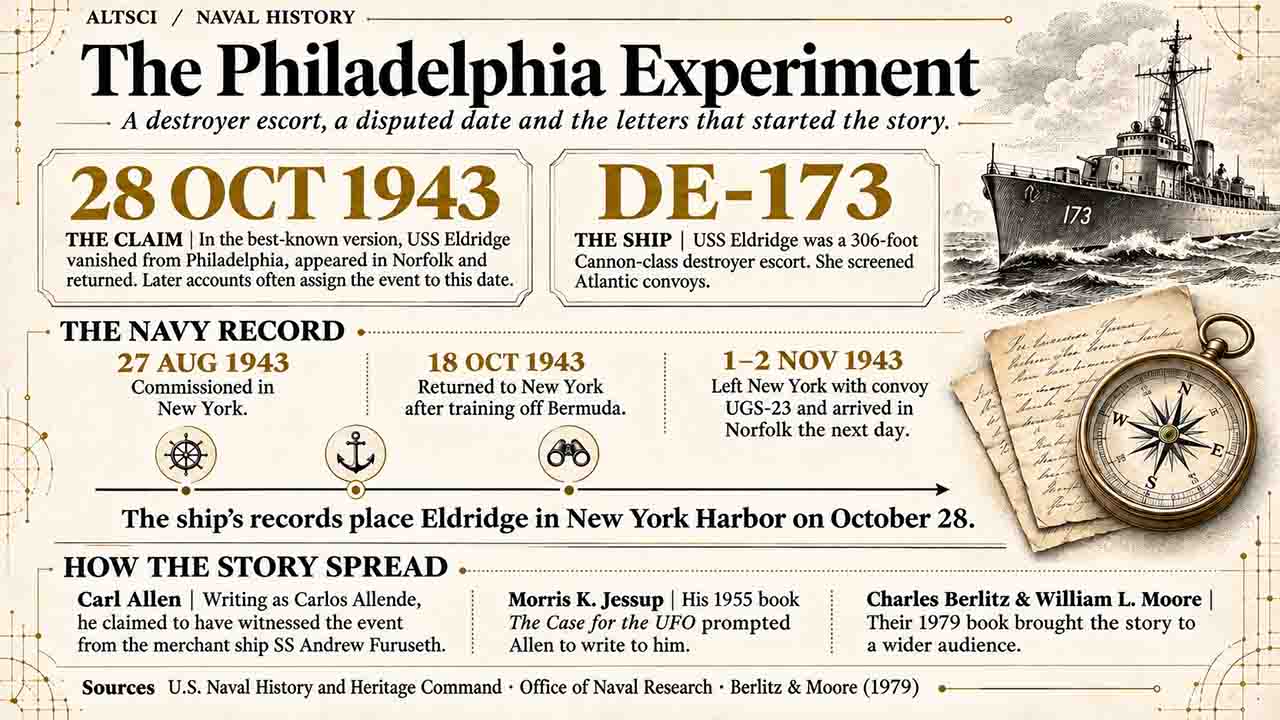
The Philadelphia Experiment narrative describes an extraordinary event supposedly involving USS Eldridge, a Cannon-class destroyer escort designated DE-173. According to the familiar account, a secret Navy experiment in 1943 generated an intense electromagnetic field around the vessel. Witnesses allegedly saw the ship disappear into a greenish haze before vanishing completely. Some versions claim it briefly appeared at Norfolk, Virginia, hundreds of miles away, before returning to Philadelphia. Others describe crew members suffering disorientation, psychological disturbances, or horrifying physical injuries. The story eventually acquired connections to Nikola Tesla, Albert Einstein, John von Neumann, and a classified wartime effort to manipulate electromagnetic fields.
The documentary history is much less dramatic. Eldridge was launched on July 25, 1943, and commissioned on August 27. Its wartime records place it in New York and nearby waters during the principal alleged October 28 experiment, rather than at Philadelphia or Norfolk. The Navy’s historical review places the vessel in Norfolk beginning November 2, after the date commonly associated with the supposed disappearance. Movement records for the merchant ship Andrew Furuseth, whose crew was allegedly involved in witnessing the event, also conflict with the story. The Navy has repeatedly reported finding no records confirming an invisibility or teleportation experiment. These documents don’t prove that every classified wartime project is known, but they directly challenge the specific ship movements described in the legend.
The recognizable story developed more than a decade after the alleged events. During the 1950s, Morris K. Jessup, author of The Case for the UFO, received correspondence attributed to Carlos Allende, also known as Carl Allen. The letters described unusual naval experiments and suggested connections between electromagnetic phenomena and Einstein’s theoretical work. An annotated copy of Jessup’s book later reached the Office of Naval Research, where it attracted enough curiosity to be privately reproduced by two officers. The story gained wider attention through Charles Berlitz and William Moore’s 1979 book The Philadelphia Experiment: Project Invisibility. Over time, the narrative accumulated increasingly elaborate details, but its strongest claims remained unsupported by contemporary wartime documentation.
What makes the story technically interesting is that the Navy really was conducting extensive electromagnetic research during World War II. Degaussing systems used electrical coils to reduce a ship’s magnetic signature and protect it against magnetic mines. Radar engineers were investigating microwave reflection, absorbing materials, antennas, and electronic countermeasures. High-power generators, switching equipment, and shipboard electrical installations could produce magnetic fields, radio-frequency interference, vibration, heat, and occasional electrical discharges. These effects offer possible explanations for selected elements of later accounts, but they shouldn’t be confused with optical invisibility or teleportation. A ship that’s less detectable by a magnetic mine hasn’t disappeared from radar, and a vessel with a reduced radar signature hasn’t become invisible to the human eye.
The Corum Investigation: Three Researchers Revisit the Mystery
In 1994, Kenneth L. Corum, James F. Corum, and J. F. X. Daum presented a paper titled Tesla’s Egg of Columbus, Radar Stealth, the Torsion Tensor, and the Philadelphia Experiment at the International Tesla Symposium in Colorado Springs. Their investigation was unusual because it approached a sensational historical claim through electrical engineering, microwave physics, and mathematical relativity. James Frederick Corum had earned a doctorate in electrical engineering from Ohio State University in 1974, with research examining rotating Lorentz transformations and electrodynamics. Corum and Daum had also collaborated on Tesla-coil research documented in a 1992 Battelle technical report. The researchers weren’t simply retelling the legend; they were attempting to identify physical mechanisms that could account for some of its reported phenomena.
Their paper developed several interconnected arguments. First, Tesla’s rotating magnetic fields demonstrated that stationary electrical machinery could create controlled magnetic rotation. Second, the microwave properties of ferromagnetic materials could change under a sufficiently strong magnetic bias, potentially reducing radar reflection. Third, a ship-sized electrical coil operating near resonance might generate large circulating currents and substantial magnetic fields. Fourth, those fields might produce environmental effects involving seawater, electrical discharges, fog, vibration, and human perception. The researchers then extended the discussion into differential geometry, electron spin, and theories of spacetime torsion, proposing experiments that might distinguish conventional electromagnetic effects from more speculative gravitational interactions.
The paper’s technical scope was substantial. It included calculations for microwave frequencies in the L-band and X-band, magnetic fields measured in tens or hundreds of thousands of amperes per meter, and a proposed resonant ship circuit carrying approximately 15,000 amperes. Its laboratory work involved a steel toroid, four electrical windings, a capacitor charged to 8,000 volts, an X-band microwave source, and a crystal detector. The authors also reported experiments involving saltwater motion. Later sections examined Gabriel Kron’s tensor analysis of electrical machinery, Einstein’s attempts to unify gravitation and electromagnetism, and interferometric techniques capable of measuring extremely small phase differences. Few papers associated with the Philadelphia Experiment have attempted such a broad technical synthesis.
Yet the researchers included important qualifications. They acknowledged that portions of the work were speculative, that their radar calculations depended on assumed material properties, and that their laboratory observations didn’t establish the more extraordinary interpretations. Their discussion of time travel and teleportation concluded without numerical predictions demonstrating that either effect could occur. These limitations are essential to understanding the paper. Its engineering calculations, experimental observations, historical interpretations, and theoretical proposals represent different levels of evidence. Treating them as one continuous experimental demonstration would misrepresent what the authors actually reported.
Radar Stealth: Could a Magnetic Field Make Steel Disappear?
Radar operates by transmitting electromagnetic waves and measuring energy scattered back from objects in their path. The strength of the return depends on the object’s dimensions, geometry, electrical conductivity, magnetic permeability, surface characteristics, and orientation relative to the radar. Steel generally reflects microwave energy efficiently, but its response isn’t determined by conductivity alone. Magnetic materials can absorb energy through internal losses, particularly near ferromagnetic resonance, where the material’s magnetic moments respond strongly to an applied microwave field. By changing an external magnetic bias, engineers can shift the resonance frequency and alter how much incident energy is absorbed, reflected, or transmitted.
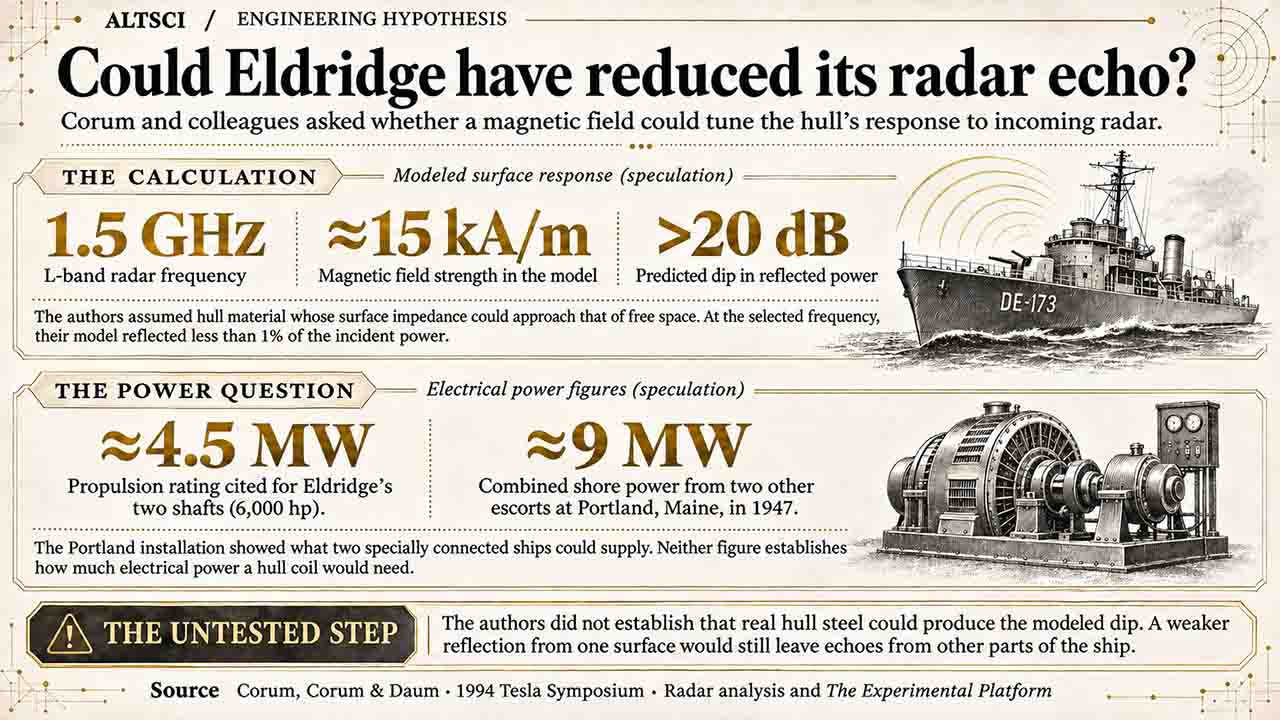
The Corum researchers investigated whether this principle could be applied to a ship’s steel structure. Their calculations examined magnetically biased ferromagnetic surfaces at frequencies near 1.5 gigahertz and approximately 10 gigahertz. Some modeled conditions produced deep reflection minima, suggesting that less than one percent of incident microwave power might be reflected under particular assumptions. A reduction to one percent corresponds to 20 decibels of reflected-power suppression, a substantial change in radar performance. The researchers considered whether powerful magnetic fields generated by shipboard coils could tune a hull toward such a condition. Modern experiments with specially engineered ferrite absorbers confirm that magnetic bias can indeed shift microwave absorption characteristics.
The difficulty lies in the magnetic properties assumed by the calculations. Several examples combine high magnetic susceptibility with strong applied fields. When those parameters are interpreted according to the paper’s stated saturation-magnetization model, selected examples imply magnetic polarizations of approximately 30.5 tesla, 62.8 tesla, and 340.6 tesla. By comparison, highly pure iron reaches magnetic saturation at approximately 2.15 tesla. These differences aren’t small corrections. They indicate that some of the most dramatic calculated reflection reductions rely on hypothetical material properties far beyond those of ordinary iron or shipbuilding steel. The authors acknowledged that their chosen parameters weren’t necessarily available in real materials, limiting the calculations’ direct application to an actual destroyer escort.
Even a surface capable of absorbing nearly all incident microwave energy at one frequency wouldn’t automatically make an entire ship disappear from radar. A destroyer’s radar cross section depends on the shape of its hull, the angles of its steel plating, its deckhouses, masts, antennas, openings, edges, and multiple scattering paths. An absorbing material might perform exceptionally well at one frequency, polarization, and angle of incidence while remaining highly reflective under other conditions. Magnetic bias could also redirect or change the polarization of scattered energy rather than eliminate it. A practical radar-stealth system would require carefully characterized materials, extensive electromagnetic modeling, and calibrated measurements over multiple frequencies and viewing angles. The Corum paper established an interesting theoretical possibility, but it didn’t demonstrate a magnetically invisible ship.
Inside the Laboratory: A Steel Toroid, 8,000 Volts, and an Unexpected Signal
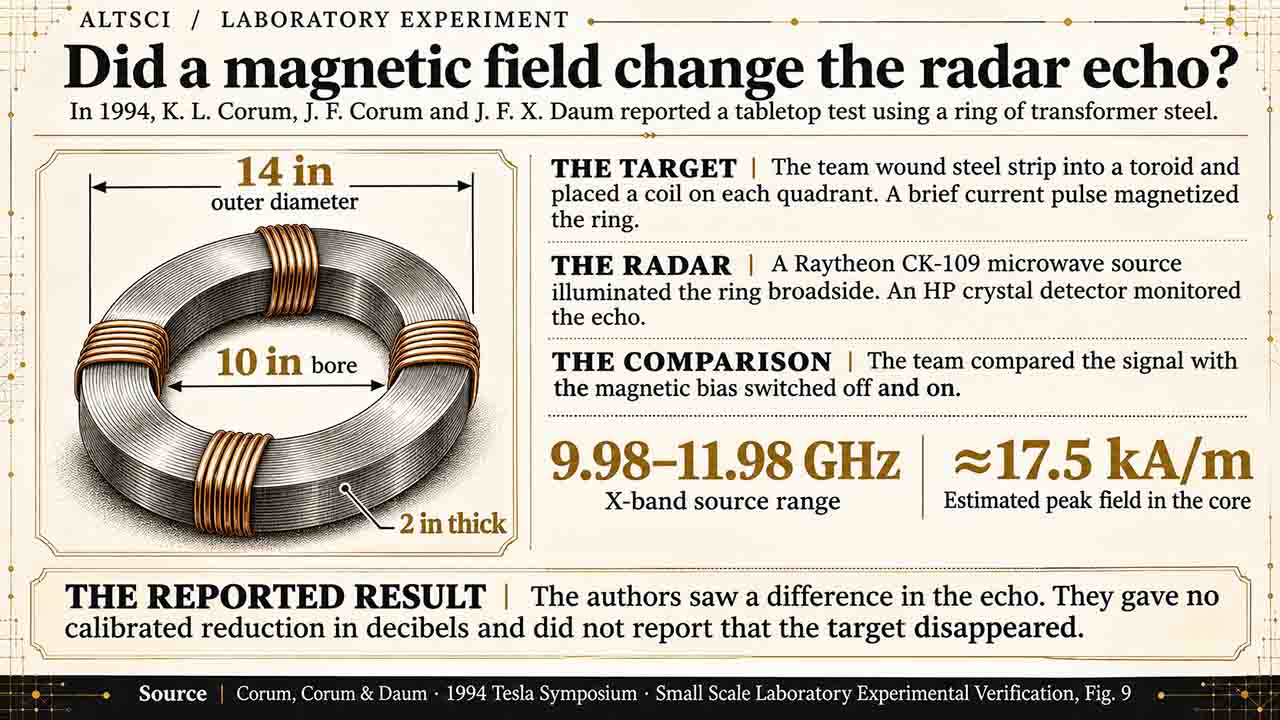
The paper’s most consequential laboratory observation came from a steel toroidal core surrounded by four electrical windings, each containing approximately 120 turns. The researchers connected the windings in series and energized them using a capacitor discharge. The capacitor had a reported capacitance of 10 microfarads and was charged to 8,000 volts, storing approximately 320 joules of electrical energy. With an estimated circuit inductance of half a henry, an idealized calculation predicted a peak discharge current near 36 amperes. The authors estimated that the pulse could generate a magnetic field strength of approximately 17,500 amperes per meter. Unlike Tesla’s Egg of Columbus, which used continuously rotating magnetic fields, this experiment employed a transient magnetic excitation.
To investigate microwave reflection, the researchers used an X-band source covering approximately 9.98 to 11.98 gigahertz and a Hewlett-Packard crystal detector. The detector monitored radiation scattered from the magnetically excited apparatus. During the capacitor discharge, the oscilloscope recorded a change in detector output. Figure 9 of the original paper shows the transient response, which the researchers interpreted as evidence that magnetic excitation had altered the microwave reflection characteristics of the target. If confirmed through calibrated measurements, such an effect could contribute to the development of magnetically tunable microwave materials. But the published trace doesn’t establish precisely how much reflected power changed or identify the mechanism responsible.
The experimental limitations are significant. A capacitor discharging hundreds of joules into a nearby coil can produce strong electromagnetic interference. Transient fields can couple into detector wiring, microwave-source electronics, grounding systems, and oscilloscope inputs. Magnetic forces can move the apparatus slightly, changing the scattering geometry. A magnetized target can also alter the polarization of reflected microwaves, potentially reducing the signal received by one detector without reducing total scattered energy. The paper doesn’t provide the full calibration records, repeated-shot statistics, uncertainty measurements, or control experiments needed to exclude these alternatives. Its estimated laboratory field was also approximately fifteen times smaller than the bias used in several of its X-band theoretical examples.
The researchers reported a second observation involving salt water. When they energized an electromagnetic apparatus near brine, the water reportedly moved or was displaced, and a modified configuration produced swirling motion. Conductive liquids can respond to electromagnetic forces through magnetohydrodynamics, a field used in specialized pumps, liquid-metal processing, and plasma research. Electrical currents induced in the liquid can interact with magnetic fields to produce mechanical forces. Heating, vibration, bubbles, and electrical leakage can also move water. Without quantitative measurements of pressure, fluid velocity, temperature, current distribution, and reaction force, the observation can’t establish an unusual mechanism. The experiment is scientifically approachable, but the available evidence doesn’t justify extending it to ship-sized cavities, levitation, or spacetime effects.
Engineering the Impossible: A 15,000-Ampere Coil Around a Warship
One of the most technically ambitious sections of the Corum paper considered what would happen if a large electrical coil were wrapped around a destroyer escort. The proposed installation involved approximately 100 turns of conductor operating at 60 hertz, with an estimated inductance of 12.3 millihenries and an effective resistance of 0.020 ohm. The researchers examined a resonant configuration capable, in their idealized model, of sustaining approximately 15,000 amperes of circulating current. Electrical resonance was central to the proposal. When inductance and capacitance are properly matched, energy oscillates between magnetic and electric storage, allowing circulating currents to become much larger than the current supplied directly by the generator.
The numbers illustrate both the attraction and the difficulty of the design. Under the paper’s assumptions, the circuit would require approximately 572 microfarads of capacitance and achieve a quality factor near 232. At the proposed current, the coil’s reactive voltage would approach 70,000 volts RMS, with a peak voltage near 98,000 volts. The circulating reactive power would be approximately 1.04 gigavolt-amperes reactive, while the maximum stored magnetic energy would approach 2.8 megajoules. These figures describe an enormous resonant electrical installation. They don’t mean the ship would need to generate a continuous gigawatt of real power, because reactive energy circulates within the resonator. The distinction is important, but it doesn’t eliminate the engineering problem.
At 15,000 amperes, the assumed conductor resistance alone would dissipate approximately 4.5 megawatts as heat. That’s a major electrical load before accounting for additional losses in the ship’s steel hull, surrounding seawater, magnetic materials, switching equipment, capacitors, and power-conversion system. The conductor arrangement would also require extensive mechanical support, insulation, cooling, and protection against high-voltage breakdown. The steel hull would change the coil’s inductance and introduce eddy currents, while seawater would create additional electromagnetic loading. Those effects could reduce the resonant quality factor substantially. The idealized circuit calculation demonstrates how current magnification works, but it doesn’t establish that the proposed installation could operate aboard a real ship under wartime conditions.
The vessel’s machinery introduces another obstacle. USS Eldridge belonged to the Cannon class, which used diesel-electric propulsion with direct-current main generators. The preserved USS Slater, another Cannon-class escort, documents 1,200-kilowatt, 525-volt DC propulsion generators and electric motors driving the propeller shafts. Some other destroyer-escort classes used different generating arrangements, including turboelectric systems. Specifications from those vessels can’t simply be transferred to Eldridge. A high-power, 60-hertz resonant coil would require a suitable alternating-current supply or conversion equipment, along with the necessary distribution and control systems. The Corum paper didn’t establish that such an installation existed aboard Eldridge, leaving a substantial gap between its circuit model and the historical ship.
Einstein’s Unfinished Work: What Spacetime Torsion Actually Means
The paper’s most speculative argument begins with Einstein’s attempts to develop a unified description of gravitation and electromagnetism. In general relativity, the metric tensor describes the geometry of spacetime, determining distances, time intervals, and the trajectories of freely moving objects. Curvature describes how that geometry departs from flat spacetime. Torsion is a different geometrical property associated with how directions are transported through space and time. Ordinary general relativity uses a connection without torsion, but alternative theories allow it. The distinction matters because the metric tensor, affine connection, curvature tensor, and torsion tensor are separate mathematical objects. The expression “Einstein’s Metric Torsion Tensor” doesn’t identify a single standard tensor recognized in modern gravitational physics.
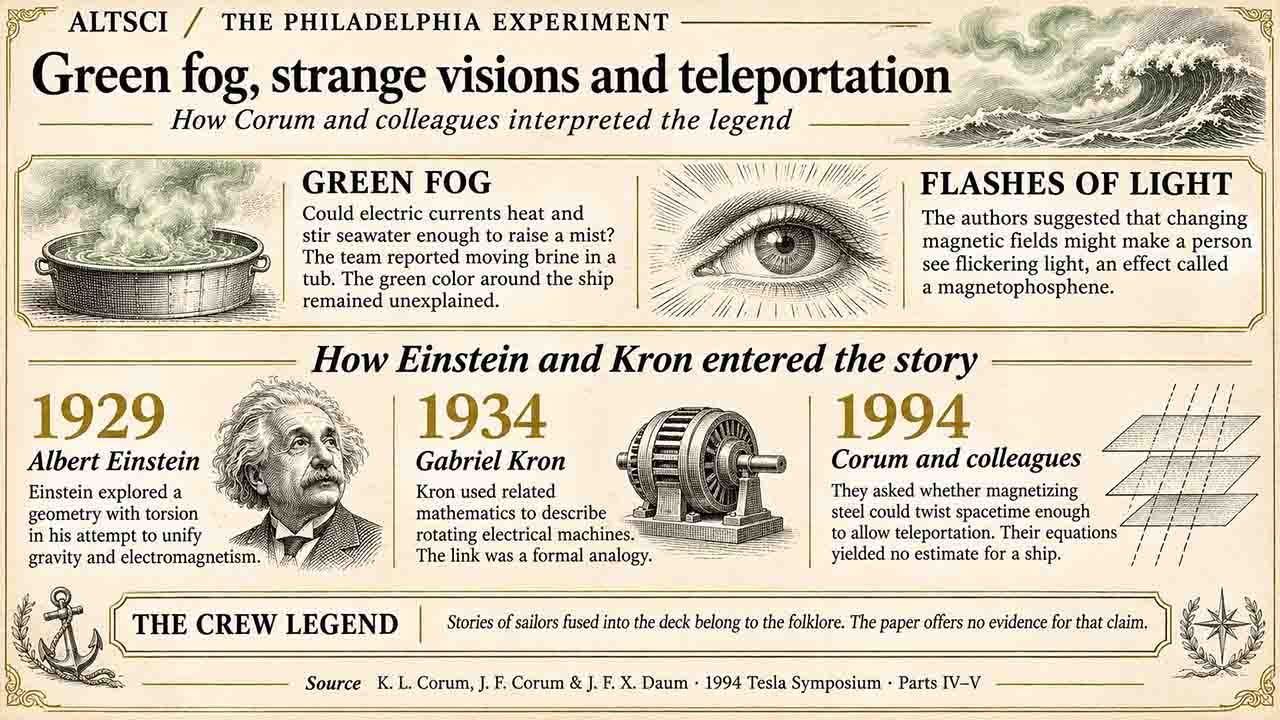
During the late 1920s and early 1930s, Einstein investigated a mathematical framework known as distant parallelism, or teleparallelism. The approach used local reference frames and a geometrical connection that could contain torsion while having zero curvature. Einstein hoped this structure might help unify gravitation and electromagnetism, but the historical program didn’t produce an experimentally established unified theory. Later theories developed different relationships between torsion and matter. In Einstein–Cartan theory, intrinsic particle spin can act as a source of torsion. In its minimal form, however, torsion is locally related to spin density and doesn’t behave like a freely propagating long-range electromagnetic field. A magnetized object therefore doesn’t automatically generate a substantial torsion field extending into the surrounding laboratory.
The Corum researchers considered whether ferromagnetic materials might provide a practical source of spin-related torsion. Ferromagnetism involves the collective alignment of microscopic magnetic moments, many associated with electron spin. The Einstein–de Haas and Barnett effects demonstrate that magnetization and mechanical angular momentum can influence one another. But a magnetic field, magnetization, intrinsic electron spin, and bulk mechanical rotation aren’t identical quantities. Their relationships must be specified by the relevant physical theory. Under minimal Einstein–Cartan assumptions, gravitational spin–torsion effects from ordinary laboratory materials are extraordinarily weak. Producing a measurable long-range effect would require additional interactions or coupling strengths beyond those established by conventional electromagnetism.
The distinction becomes especially important when discussing time displacement or teleportation. A mathematical model containing torsion doesn’t automatically permit an object to disappear from one location and appear at another. Such a claim would require a consistent gravitational theory, a specified distribution of matter and energy, appropriate boundary conditions, and a calculated solution demonstrating the proposed change in spacetime geometry. It would also require quantitative predictions for clocks, light beams, particle trajectories, or other measurable observables. The Corum paper’s illustrations of folded or distorted geometry offered a conceptual analogy, not a demonstrated physical mechanism. Its final discussion acknowledged that numerical answers to the time-displacement questions hadn’t been obtained.
Gabriel Kron: The Electrical Engineer Who Connected Machines and Geometry
A particularly intriguing figure in the investigation is Gabriel Kron, an electrical engineer whose work at General Electric transformed the mathematical analysis of complex electrical machinery. Kron developed tensor-based methods for describing motors, generators, transformers, and interconnected electrical networks. His approach represented electrical charges, currents, magnetic couplings, rotor positions, and mechanical motion through generalized coordinates. Instead of analyzing every part of a rotating machine independently, engineers could use transformations between mathematical reference frames to simplify the system. The method was especially valuable for electrical machines in which rotating magnetic fields and mechanical components continuously interact.
Kron’s work attracted attention from physicists because it used mathematical structures associated with differential geometry, including nonholonomic reference frames and non-Riemannian methods. In 1949, physicist Banesh Hoffmann published an examination of Kron’s electrodynamics in Reviews of Modern Physics. The analysis demonstrated that sophisticated geometrical techniques could describe real electrical machinery and produce useful engineering results. Rotating coordinate systems, in particular, can introduce mathematical structures that resemble connections or torsion. These similarities helped motivate the Corum researchers’ attempt to connect Tesla’s electrical machines with Einstein’s geometrical theories.
The critical question is what those mathematical similarities mean physically. Kron’s generalized coordinates describe the electrical and mechanical states of a machine. The resulting geometry belongs to the mathematical space of possible machine configurations, not necessarily to the physical spacetime surrounding the machine. A motor can have a complicated geometrical description without creating a measurable distortion of spacetime. The same mathematical tools can describe systems with very different physical meanings. To establish that an electrical machine modifies spacetime, researchers would need an additional physical law connecting the machine’s currents, magnetic fields, or spin density to the gravitational metric or connection.
The Corum paper recognized this distinction more clearly than many later discussions suggest. It described the relationship between Kron’s mathematics and Einstein’s work as a formal analogy, while acknowledging that the equations of electrical machinery had experimental support that speculative unified-field equations lacked. Kron’s contribution was therefore significant but limited. He demonstrated that differential geometry could be a powerful engineering language for rotating machines. He didn’t establish that such machines could manipulate time. The missing element remained a physically consistent, experimentally testable connection between the geometry used to describe an electrical system and the geometry governing the surrounding universe.
The Experiments That Could Finally Separate Physics From Legend
The Corum researchers proposed two experimental approaches that could, in principle, search for effects beyond conventional electromagnetism. The first involved the Sagnac effect, which produces a measurable difference between light beams traveling in opposite directions around a rotating path. Optical gyroscopes use this phenomenon to detect rotation with extraordinary precision. The researchers suggested that magnetization might produce an additional torsion-related signal resembling mechanical rotation or partially canceling an existing rotational signal. The idea is testable only if a specific theory predicts the magnitude, direction, and behavior of the proposed effect. Conventional magneto-optic phenomena, thermal expansion, vibration, and electronic interference would have to be measured and excluded.
The second proposal involved the Aharonov–Bohm effect, a quantum phenomenon in which charged particles traveling along different paths can acquire an interference-phase difference associated with enclosed magnetic flux. The Corum paper considered whether spacetime torsion might contribute an additional phase and whether rotating the apparatus could alter or cancel it. But mechanical rotation already produces conventional quantum interference effects, making any observed phase change difficult to interpret without a detailed theoretical prediction. The proposed electromagnetic coupling to torsion also raises questions about gauge invariance, a fundamental consistency requirement of electromagnetic theory. In 1978, Sergio Hojman and colleagues developed a modified gauge framework involving propagating torsion. The following year, physicist Wei-Tou Ni showed that the original model conflicted with precision tests of the equivalence principle.
Modern experimental physics offers a more controlled way to investigate related questions. In 2026, researchers reported neutron-spin-rotation measurements using a compensated ferrimagnet, a material that can maintain substantial polarized electron spin while producing nearly zero net magnetization. This arrangement helps suppress ordinary magnetic backgrounds that could obscure a weak exotic interaction. The experiment found a result consistent with zero and established improved limits on particular neutron–electron spin interactions. It wasn’t a replication of the Philadelphia Experiment, and it didn’t demonstrate spacetime torsion. Its significance was methodological: the researchers identified a specific predicted interaction, built an apparatus designed to isolate it, and measured the result with quantified statistical and systematic uncertainties.
More than three decades after the Corum paper appeared, its most useful questions remain experimentally accessible. A calibrated microwave-scattering experiment could determine whether the original toroid’s detector signal reflected genuine magnetic control of radar reflection. A carefully instrumented saltwater experiment could measure the forces responsible for the reported fluid motion. A precision interferometer using a well-defined torsion theory could search for effects that survive conventional electromagnetic and mechanical controls. None of these experiments requires accepting the Philadelphia Experiment legend as historical fact. That may be the most important distinction in the entire investigation. The archival record doesn’t establish that USS Eldridge disappeared, and the 1994 experiments didn’t demonstrate that magnetism can transport matter through spacetime. Yet Tesla’s rotating fields, magnetic resonance, electrical machinery, and the geometry of gravitation remain legitimate subjects of research. The enduring scientific mystery isn’t whether an undocumented warship vanished into a green cloud. It’s whether carefully designed experiments can reveal something new after the legend has been stripped away.
References
Nikola Tesla and the Egg of Columbus
- Mr. Tesla’s Personal Exhibit at the World’s Fair — Contemporary account of Tesla’s exhibit, 1893.
- Tesla’s Egg of Columbus — Electrical Experimenter, March 1919.
- Tesla’s Views on Electricity and War — H. Winfield Secor, Electrical Experimenter, August 1917.
- Experimental Reconstruction of Tesla’s Egg of Columbus — Electrica, modern technical reconstruction.
- Experimental Demonstration of Ampère’s Molecular Currents — A. Einstein and W. J. de Haas, Physical Review, 1915.
The Philadelphia Experiment and Naval History
- Eldridge (DE-173) — Naval History and Heritage Command, Dictionary of American Naval Fighting Ships.
- The Philadelphia Experiment — Naval History and Heritage Command, historical assessment.
- The Case for the UFO — Morris K. Jessup, 1955; digital reproduction.
- USS Slater: Motor Room — USS Slater Museum, Cannon-class destroyer escort propulsion equipment.
- USS Slater: Engine Room — USS Slater Museum, diesel-electric machinery.
- Foss (DE-59) — Naval History and Heritage Command, destroyer escort history.
- Maloy (DE-791) — Naval History and Heritage Command, destroyer escort history.
- Letter from Albert Einstein to Lieutenant Stephen Brunauer, July 30, 1943 — National Archives, wartime naval correspondence.
- Letter from Albert Einstein to Lieutenant Stephen Brunauer, August 13, 1943 — National Archives, wartime naval correspondence.
The Corum Paper and Electrical Engineering
- Kenneth L. Corum: Biographical Information — Tesla Society, professional background.
- 1994 International Tesla Symposium — Tesla Universe, symposium information.
- Tesla Coil Research — James F. Corum and James F. X. Daum, Battelle Memorial Institute, 1992.
- An Examination of the Anholonomic Lorentz Transformation with Applications to Electrodynamics — James Frederick Corum, Ohio State University, 1974.
- Kron’s Non-Riemannian Electrodynamics — Banesh Hoffmann, Reviews of Modern Physics, 1949.
Radar Stealth and Magnetic Materials
- Magnetic Saturation of Iron — National Bureau of Standards, Journal of Research, 1941.
- Magnetically Tunable Microwave Absorption Research — Peer-reviewed experimental study, 2014.
- Radar System Engineering — Louis N. Ridenour, editor, MIT Radiation Laboratory Series, Volume 1, 1947; hosted reproduction.
Einstein, Spacetime Torsion, and Unified Field Theory
- Einstein’s Papers on Distant Parallelism and Unified Field Theory — Historical translations and commentary.
- General Relativity with Spin and Torsion: Foundations and Prospects — F. W. Hehl, P. von der Heyde, G. D. Kerlick and J. M. Nester, Reviews of Modern Physics, 1976.
- Geometrical Foundations of Torsion and Teleparallel Gravity — Modern theoretical review.
- Spin, Rotation, and Gyromagnetic Phenomena — Modern theoretical research.
- Gauge Invariance, Minimal Coupling, and Torsion — S. Hojman, M. Rosenbaum, M. P. Ryan and L. C. Shepley, Physical Review D, 1978.
- Hojman-Rosenbaum-Ryan-Shepley Torsion Theory and Eötvös-Dicke-Braginsky Experiments — Wei-Tou Ni, Physical Review D, 1979.
- Gauge Invariance and Electromagnetic Coupling to Torsion — Friedrich W. Hehl and Yakov Itin, theoretical analysis.
- Modified Torsion Theories and Electromagnetic Coupling — Theoretical follow-up research.
Interferometry and Experimental Tests
- Significance of Electromagnetic Potentials in the Quantum Theory — Yakir Aharonov and David Bohm, Physical Review, 1959.
- Electron Interference Experiments Involving Rotation — Physical Review A, 1993.
- Rotation-Dependent Electron Interference: Theoretical Reanalysis — Physical Review A, 1998.
- The Sagnac Effect and Ring-Laser Gyroscopes — Universe, 2019.
- Magnetic Effects in Optical Interferometry — Applied Optics, 1992.
- Sagnac Interferometry and Magnetic Measurements — Analytical Sciences, 2016.
- Neutron Spin Rotation Using a Compensated Ferrimagnet — Physical Review Letters, 2026.
- Constraints on Torsion and Nonmetricity from Spin-Dependent Measurements — Research preprint, 2026.
Replication Efforts and Related Investigations
- The Philadelphia Experiment 2006 — American Antigravity interview with Ron Milione, April 3, 2006.
- Philadelphia Experiment Replication Investigations — Hutchison Effect archive, project descriptions and preliminary reports.
- Experimental Research on Magnetophosphenes and Magnetic-Field Exposure — Peer-reviewed physiological research, 2024.