

Push Gravity: From Le Sage to Tom Van Flandern

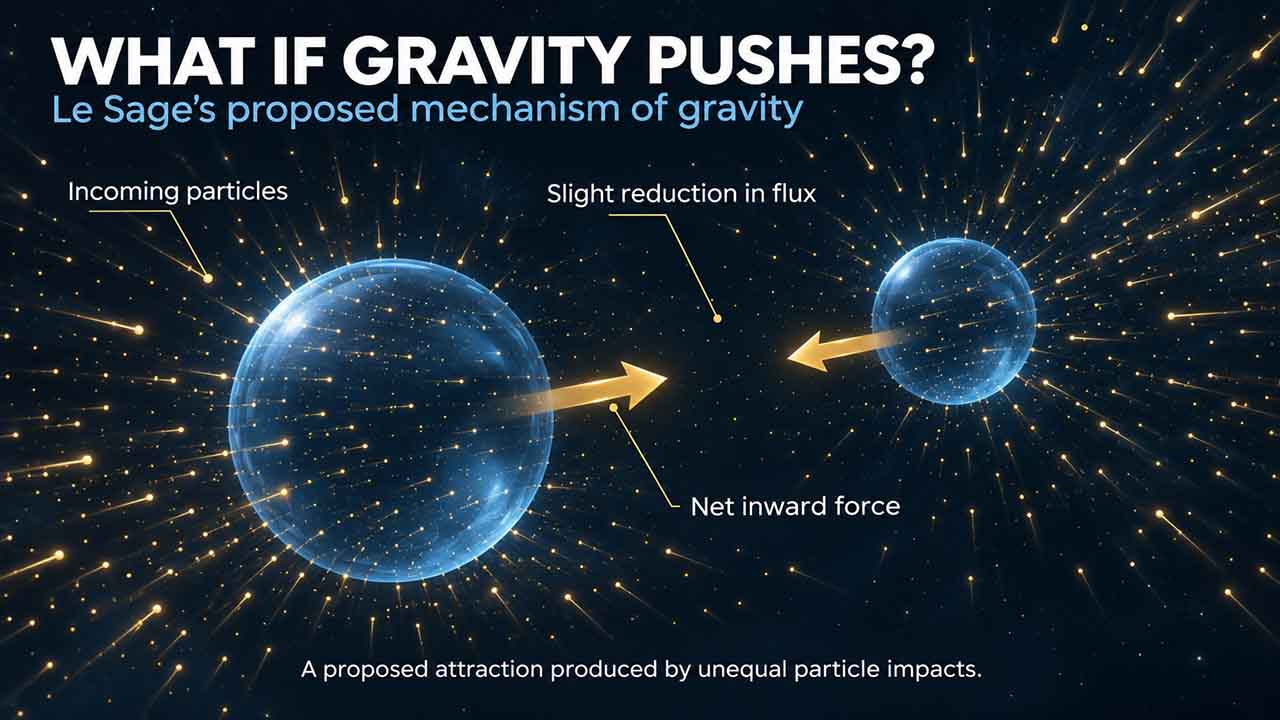
When an object falls, we intuitively think of gravity pulling it toward the ground. In the eighteenth century, Georges-Louis Le Sage proposed a different idea: What if gravity didn’t pull objects together, but unseen particles arriving from every direction pushed them toward one another? Each body would partially shield the other from that bombardment, creating an imbalance that looked like attraction. More than two centuries later, astronomer Tom Van Flandern revisited this “push gravity” mechanism, building a theory that connected it with the speed of gravity and the behavior of light.
The Le Sage Model of Push Gravity
Imagine an object suspended in space and bombarded by particles arriving from every direction. If the distribution is uniform, the impacts balance: each push is matched, on average, by another from the opposite direction. Now place a second object nearby. Each body intercepts some of the particles that would otherwise strike the other, creating a slight deficit along the line between them. More momentum arrives from their outer sides, and the bodies accelerate toward one another. What an observer describes as attraction emerges from an imbalance in external bombardment. This is the central mechanism of Le Sage gravity.
The idea grew out of attempts to explain the cause behind Newton’s successful law of gravitation. Nicolas Fatio de Duillier described an early version in correspondence with Christiaan Huygens around 1690. Georges-Louis Le Sage subsequently developed the proposal in greater detail, presenting it in Lucrèce Newtonien, published in 1784. His hypothetical “ultramundane corpuscles” supplied a physical connection between separated bodies through their motion and collisions. The ambition was to derive the gravitational behavior Newton described from interactions among more fundamental constituents of nature. Van Flandern would return to that ambition more than two centuries later.
The geometry offers an immediate attraction. Seen from twice as far away, a body occupies approximately one-quarter of the solid angle it previously covered. If the reduction in incoming particle momentum follows that shrinking angular shadow, the resulting force has an inverse-square dependence on separation. A familiar gravitational relationship can therefore emerge from straight particle trajectories and interception. But distance is only part of Newton’s law. To reproduce ordinary gravitational attraction, the effect must also scale appropriately with the amount of matter in both bodies. A geometrically plausible shadow doesn’t establish that additional relationship.
That requirement explains why Le Sage’s particles couldn’t simply behave like light striking an opaque wall. An opaque body mainly exposes its exterior area; adding more material behind the surface wouldn’t proportionally increase its interaction with the incoming flux. The proposed corpuscles must instead pass almost freely through matter, encountering its constituents only rarely. Under suitable conditions, each additional constituent then contributes another small chance of interception. The resulting effective interaction can grow approximately with mass. “Shadow” is consequently a potentially misleading word: the model requires a minute reduction in a highly penetrating flux, rather than a region emptied of particles.
The Problem of Heat and Drag
The same collisions that make the idea intuitive create its first major difficulty. A particle that changes the motion of a body transfers momentum, and its interaction can also transfer energy. If incoming particles continually lose energy inside matter, the model has to explain the resulting heat. James Clerk Maxwell examined this problem in his discussion of Le Sage’s theory, considering how outgoing particles would have to differ from incoming ones to maintain the proposed attraction. The issue was quantitative: could the interaction produce the strength of gravity without making ordinary matter much hotter than it is?
Motion through the particle population creates another problem. A body moving relative to an otherwise isotropic distribution encounters a different pattern of impacts from the one experienced by a stationary body. The resulting resistance could drain orbital energy and alter planetary motion. Le Sage recognized the difficulty and considered making his corpuscles extremely fast compared with planetary velocities. He even discussed speeds greater than that of light. Very fast particles and a speed-based response to drag were therefore already part of the historical proposal. Van Flandern’s later argument would give those ideas a particular astronomical interpretation.
Energy disposal is inseparable from maintaining the shadow. If particles rebound in a way that restores the outgoing distribution, the missing flux responsible for attraction can disappear. If they emerge with reduced motion, the lost energy has to enter matter, another form of particle motion, or some other reservoir. Absorption preserves a deficit but raises questions about both heating and the continuing supply of particles. A workable model must describe the incoming population, the interaction, and the outgoing population together. Choosing an attractive force while leaving the rest of that process unspecified doesn’t close the physical account.
William Thomson, later Lord Kelvin, examined Le Sage’s corpuscles in work published during the 1870s, exploring assumptions about their interactions and the constitution of matter. Maxwell likewise treated the proposal as a physical hypothesis whose consequences could be analyzed. General relativity subsequently supplied a different framework, in which spacetime geometry is dynamical and responds to matter and energy. After 1915, a revived particle theory faced a broader task than recovering Newton’s inverse-square law. It also needed to explain relativistic orbital effects, light propagation, clock behavior, and eventually the generation and detection of gravitational radiation.
Van Flandern Returns to Le Sage
Tom Van Flandern approached gravity through astronomy. He worked at the U.S. Naval Observatory from 1963 to 1983, with interests that included lunar occultations, celestial mechanics, and astronomical calculation. Precise orbital behavior was familiar territory, and it became central to his later criticism of conventional accounts of gravitational propagation. He wanted a causal description built from physical constituents and interactions. His professional background helps explain the questions he pursued, while the validity of his proposed answers depends on whether their calculations and predictions survive comparison with observations.
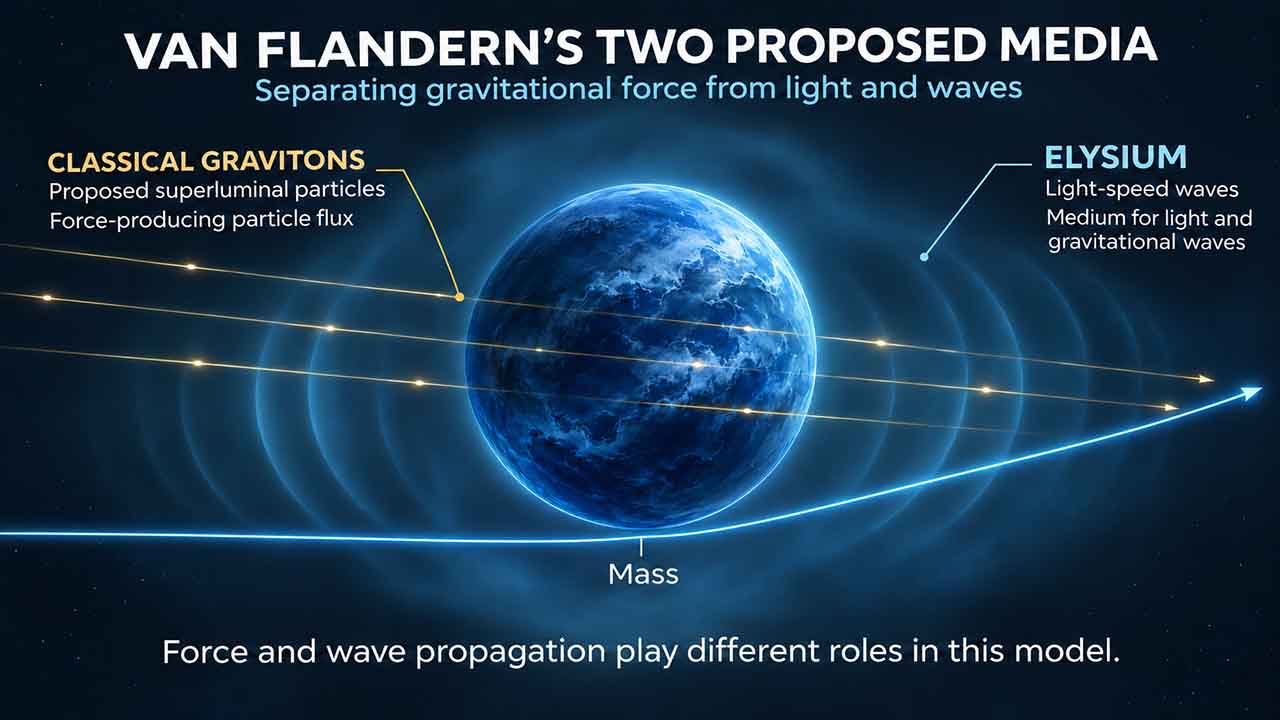
His version of push gravity filled space with what he called classical gravitons: extremely fast particles that interact only rarely with ordinary matter. These differ from the hypothetical spin-two quantum gravitons discussed in conventional quantum-gravity research. Van Flandern assigned his particles the role of a physical flux whose momentum produces acceleration through unequal bombardment. Ordinary matter was composed, at the relevant scale, of microscopic “matter ingredients” that could absorb or scatter them. The familiar objects of astronomy were therefore large collections of possible interaction sites, immersed in a much finer underlying population.
Several properties determine how such a model behaves. Increasing the number of incoming particles can increase the available momentum flux. Changing their speed or momentum alters what each encounter can transfer. Changing the probability of absorption changes both the directional deficit and the energy deposited in matter. Scattering introduces another dependence on how strongly particles are deflected. Van Flandern’s published development treated these processes as a basis for force laws and possible departures from ordinary gravity. Finite range, gravitational shielding, and drag became proposed consequences of the mechanism that could be investigated quantitatively.
The framework developed across several publications and presentations. His 1996 paper, “Possible New Properties of Gravity,” preceded the better-known 1998 paper, “The Speed of Gravity—What the Experiments Say.” The April 1999 COFE presentation offered a visual explanation of the model, with energy applications suited to the conference’s subject. His chapter “Gravity” and Victor Slabinski’s accompanying analysis appeared in Matthew R. Edwards’s 2002 collection Pushing Gravity. In our March 2005 interview, Van Flandern returned to the distinction between the force-producing population and the medium surrounding massive bodies. That distinction became one of his model’s defining features.
Van Flandern’s Argument About Speed
The speed argument begins with gravitational aberration. In a simple delayed-force picture, an orbiting body responds to where its companion was when the influence departed. The resulting force can point away from the direction needed to reproduce the expected orbit, introducing a sideways component that changes angular momentum. Van Flandernern argued that observed orbital behavior rules out the large aberration such a picture would produce at light-speed propagation. He interpreted the force as acting toward an effectively current source position, requiring its carriers to cross the intervening distance extraordinarily quickly.
The lower bound associated with his argument was approximately 20 billion times the speed of light. At astronomical scales, such propagation would be practically instantaneous for many purposes, although a very large finite speed and truly instantaneous action are different claims. The number came from interpreting orbital behavior through a particular description of the interaction. No graviton was emitted at a known time and detected at a second location to establish its flight speed. The result’s significance therefore turns on whether the assumed relationship between propagation delay and orbital aberration correctly describes the competing theories.
Steve Carlip addressed that issue in “Aberration and the Speed of Gravity,” published in 2000. General relativity contains velocity-dependent interactions that are absent when a time delay is simply attached to Newton’s force law. Those terms cancel the leading aberration in the relativistic calculation, allowing light-speed propagation to coexist with the observed orbital behavior. The cancellation is connected with conservation laws and the structure of gravitational radiation. It doesn’t remove all effects of retardation or imply that radiation reaction disappears. It shows why the large speed bound from the simpler treatment can’t be transferred directly to general relativity.
The distinction is easiest to understand by separating a continuing, predictable motion from a new disturbance. A causal field can contain information about a source’s motion that makes its local effect differ from a pull aimed at the source’s old position. That doesn’t mean it communicates an unforeseen change instantaneously. Force direction, the propagation of a disturbance, and the travel of freely radiating waves must be calculated within the same dynamical theory. Rupert Sheldrake and Mark Vernon’s 2024 discussion shows the continuing interest in Van Flandern’s interpretation, but the orbital observations don’t require superluminal propagation within the accepted relativistic account.
Two Media for Force and Light
Van Flandern’s mature proposal wasn’t a single population asked to account for every phenomenon. He separated the fast classical gravitons from a second medium, called “elysium,” whose constituents he called “elysons.” During the COFE question period, he stated that “the graviton medium cannot be the light-carrying medium.” The distinction allowed one population to produce an almost immediate gravitational force while another carried light at its familiar finite speed. It also expanded the theory’s physical commitments: the second medium required its own properties and a description of how it interacts with matter and with the faster particles.
In his account, gravity shapes the distribution of elysium around a massive body. The force establishes a surrounding physical condition through which light propagates. In our 2005 interview, he described this relationship using the analogy of a medium compressed around a mass, with its wave behavior distinct from the force that organized it. This gave him a way to separate gravitational force from what he called the gravitational field. The distinction was part of his proposed physical interpretation; in general relativity, the gravitational field’s dynamical behavior is already contained in the spacetime description.
Changes in the state of the light-carrying medium were intended to explain effects ordinarily calculated using relativistic geometry. Light bending could be associated with how propagation changes near a mass, while gravitational redshift, radar delay, and clock-rate differences were also assigned roles in the physical-medium picture. Such proposals can be investigated, but they require more than an analogy with refraction. The same description must produce the measured relationships among deflection, frequency shift, travel time, and motion. Recovering a selected effect doesn’t establish that the full dynamics and observational content of general relativity have been reproduced.
Gravitational waves occupied the second medium as well. Van Flandern explicitly allowed them to travel at light speed even though his classical gravitons carried the force much faster. This distinction appeared before the first direct detection of gravitational waves. It matters because a measured wave speed doesn’t automatically measure the speed of every hypothetical interaction in a two-medium theory. The separation also creates an obligation: moving masses must excite the wave medium in a calculable way, and the resulting waves must carry the appropriate energy and momentum and interact with detectors as observed.

Absorption, Scattering, and the Energy Balance
The most concrete development of the particle mechanism came through Slabinski’s analysis of force, heat, and drag. His treatment distinguished the interaction that creates the shadow from the interactions that respond to it. Absorption at one body removes particles from the incident population and establishes a directional deficit. At the other body, both absorption and scattering can transfer momentum from the unequal incoming flux. In the idealized isotropic treatment, scattering alone doesn’t produce the required net shadow force. Once absorption creates the imbalance, however, scattering can contribute substantially to the resulting acceleration.
This opens a possibility that a simple absorption-only account misses. If absorption is very rare while scattering is much more probable, substantial momentum transfer can accompany relatively little absorption-related heating. The scattering contribution depends on the angular distribution: a particle that barely changes direction transfers less momentum than one deflected strongly. Under his adopted numerical assumptions, Slabinski found that the scattering-to-absorption coefficient ratio had to exceed approximately 2.9 × 10²⁹. That enormous ratio specifies a requirement of the model. It isn’t a measured property of a known material or a universal condition applying to every conceivable push gravity theory.
The analysis worked within demanding astronomical and thermal constraints. Van Flandern’s related discussion used an Earth-heat figure of 10²⁸ ergs per year, equivalent to about 31.7 terawatts, and a historical orbital-drag ceiling of approximately 7.5 × 10⁻¹⁴ meters per second squared. These were inputs to the argument, rather than present-day universal bounds. A compatible choice of parameters shows that the selected inequalities needn’t contradict one another. It doesn’t establish that nature provides the required particles and interactions. Nor is all of Earth’s measured heat automatically available for an additional source, because conventional geophysics already accounts for substantial contributions.
Van Flandern also proposed a broader energy cycle. Classical gravitons would deposit energy in matter, matter would release energy through radiation or other emissions, and radiation would return energy to the particle population during propagation. He connected the final transfer with cosmological redshift and called the overall process the Meta Cycle. Its purpose was to keep the background from simply losing energy through its interactions. Demonstrating such a cycle requires transfer rates, emission spectra, and an account of entropy and stability. The proposed circulation supplies a conceptual response to the energy-supply problem, but a schematic cycle doesn’t demonstrate a self-consistent steady state.
Gravity with a Finite Range
The particle picture also suggests a way for gravity to change over large distances. If classical gravitons collide with one another, particles scattered into a depleted direction can gradually refill a shadow. The force associated with that deficit would then weaken more rapidly than its geometric inverse-square dependence alone predicts. Van Flandern discussed characteristic distances of roughly one to two kiloparsecs, about 3,300–6,500 light-years. This is an attenuation scale associated with particle transport, rather than a sharp boundary where gravity disappears. The one-to-two-kiloparsec range already appeared in his 1996 discussion.
He tried to connect this proposed change with the apparent need for additional gravitating mass in large astronomical systems. His reasoning involved distributed matter and chains of local interactions among neighboring masses. That detail matters: simply weakening the attraction of a central mass wouldn’t explain why orbital speeds remain high far from a galaxy’s center. His presentation’s mass-to-light-ratio plot concerned systems of different scales; it wasn’t a successful fit to an individual galaxy’s rotation curve. A full assessment would require calculating motions for an extended distribution of stars and gas, together with the lensing behavior assigned to the surrounding elysium.
Incomplete transparency produces a second proposed departure: gravitational shielding. Under Van Flandern’s attenuation law, the influence decreases as it passes through a column of matter. He used an illustrative coefficient of approximately 2 × 10⁻¹⁸ square centimeters per gram, which relates the reduction to the amount of intervening mass per unit area. It’s a concrete numerical choice with consequences for different astronomical bodies. If the law is universal, it must apply consistently when matter lies between interacting objects and when the material inside a body attenuates the influence reaching its own constituents.
Finite range, shielding, and drag thus offer ways to distinguish the model from ordinary gravitational calculations. They also have to be connected to its microscopic assumptions. A given particle population and set of interactions should explain why the shadow refills at one scale, penetrates matter to a particular degree, and produces a certain resistance to motion. Van Flandern acknowledged that further work was needed to connect finite range and shielding to the parameter constraints. The published force laws made these effects discussable and testable, but their coefficients weren’t all demonstrated to follow from one common microscopic derivation.
Satellites and the Lunar Test
Van Flandern found a possible observational opening in the orbits of the LAGEOS laser-ranging satellites. Their precisely tracked motion contained small residual along-track accelerations after the applied orbital models were subtracted. The relevant scale was picometers per second squared, and patterns associated with eclipse conditions attracted his attention. He considered whether shielding could contribute and presented a calculated shielding curve in his wider discussion. His written qualification was important: the data allowed such a contribution but didn’t require it. A residual establishes that a calculation and an observation differ; identifying the physical cause is a separate step.
Eclipse conditions also change ordinary forces acting on a satellite. Direct sunlight, Earth’s reflected light, terrestrial infrared radiation, and the satellite’s rotation determine an evolving temperature distribution. Uneven thermal emission produces a recoil force, and entry into shadow changes that force’s history. In 1991, Scharroo and colleagues reported that adding solar thermal effects and anisotropic reflection reduced the standard deviation of the acceleration residuals by 61 percent. That statistic describes a substantial modeling improvement. It doesn’t show that every residual has been explained, but it supplies a conventional mechanism capable of producing patterns that might otherwise appear anomalous.
The Earth–Moon system offers a stronger comparison with the proposed shielding coefficient. Earth and the Moon have different internal mass columns. If gravitational influence is attenuated within matter according to one universal law, their effective gravitational responses can differ relative to their inertial masses, altering their relative motion in the Sun’s field. Donald H. Eckhardt’s 1990 lunar-ranging analysis placed an upper bound near 1 × 10⁻²¹ square centimeters per gram. Under matching assumptions, Van Flandern’s illustrative value is about 2,000 times larger. The comparison directly challenges that parameter choice in the universal attenuation model.
A later analysis by James Williams, Slava Turyshev, and Dale Boggs reported a fitted shielding coefficient of approximately 3 × 10⁻²³ square centimeters per gram, with an uncertainty of about 5 × 10⁻²³, consistent with zero. The central value isn’t a detection, and the uncertainty shouldn’t be relabeled as a separate upper confidence bound. These constraints apply when the same attenuation law governs intervening matter and internal self-shielding without a compensating change in inertial response. A revised interaction could be proposed, but its behavior would need to be specified and tested. The lunar evidence constrains a defined physical model rather than every imaginable particle theory.
A Theory Confronted by Modern Observations
Gravitational-wave astronomy has added observations unavailable during Van Flandern’s lifetime. In 2017, the neutron-star merger GW170817 was detected through gravitational waves and electromagnetic radiation from a source about 130 million light-years away. The gamma-ray signal arrived 1.74 seconds after the gravitational-wave signal, with a reported timing uncertainty of 0.05 seconds. Constraints on their relative propagation speeds depend on assumptions about when the two signals were emitted. Van Flandern’s light-speed wave medium could accommodate that speed in isolation. Agreement on propagation speed, however, doesn’t establish that the model can reproduce the observed wave generation, evolution, or interaction with detectors.
Binary-pulsar observations connect radiation with the dynamics of the source. The Double Pulsar has an orbital period of roughly 2.45 hours, and a 2021 analysis drew on about 16 years of observations. Its test of general relativity’s quadrupolar description of gravitational radiation reached an agreement level of 0.013 percent at 95 percent confidence. This is a precision statement about a particular radiation test, rather than every aspect of gravity. A competing model must calculate the coupled orbital motion, energy loss, and signal propagation needed to make the same comparison. Assigning different speeds to force carriers and waves doesn’t provide those calculations by itself.
Van Flandern’s work can therefore be assessed at several levels. The shadowing mechanism is explicit, and Slabinski’s treatment demonstrates a conditional way to reconcile selected force, heating, and drag requirements. The two-media picture gives a defined role to phenomena that Van Flandern believed should be physically distinguished. Its larger completion remains unresolved: the published construction doesn’t establish a common microscopic derivation of all these effects or a comparably developed account of binary timing and gravitational-wave observations. The proposed classical-graviton population and elysium lack independent experimental confirmation, while the universal shielding coefficient faces the quantitative lunar constraint.
The question that drew Le Sage and Van Flandern to push gravity remains understandable: can gravitational attraction emerge from interactions among underlying constituents of nature? Van Flandern pursued that question far enough to make specific physical assumptions and numerical predictions. Some of those predictions can be tested directly; other parts need further development before an observational comparison is possible. General relativity already explains the orbital behavior he considered evidence for extraordinarily fast gravity, and modern measurements give any alternative a demanding standard. His model’s scientific value must ultimately rest on whether its proposed interactions explain those measurements consistently and produce a distinctive prediction that survives testing.
Historical Foundations and Classical Objections
- The Le Sage Theory of Gravitation — Georges-Louis Le Sage; English translation of Lucrèce Newtonien (1784), with an introduction by S. P. Langley.
- Fatio de Duillier to Christiaan Huygens — Nicolas Fatio de Duillier, letter dated March 6, 1690, documenting an early corpuscular theory of gravitation.
- Atom — James Clerk Maxwell, Encyclopædia Britannica, ninth edition; includes his analysis of Le Sage’s theory and its energy-transfer difficulties.
- On the Ultramundane Corpuscles of Le Sage — William Thomson, later Lord Kelvin; his examination of the particle mechanism and its physical assumptions.
Tom Van Flandern’s Life and Gravity Model
- Tom C. Van Flandern, 1940–2009 — David W. Dunham and Victor J. Slabinski, American Astronomical Society obituary covering his career and astronomical research.
- Possible New Properties of Gravity — Tom Van Flandern, Astrophysics and Space Science 244, 249–261 (1996); author’s archived text.
- The Speed of Gravity—What the Experiments Say — Tom Van Flandern, Physics Letters A 250, 1–11 (1998); archived text of his argument for superluminal gravitational-force propagation.
- Pushing Gravity: New Perspectives on Le Sage’s Theory of Gravitation — Matthew R. Edwards, editor, Apeiron (2002); collected historical studies and modern developments of Le Sage-type gravity models.
- Gravity — Tom Van Flandern, in Pushing Gravity, pp. 93–122 (2002); link opens the collected volume containing his chapter.
- Force, Heat and Drag in a Graviton Model — Victor J. Slabinski, in Pushing Gravity, pp. 123–128 (2002); link opens the collected volume containing his quantitative analysis.
- The Meta Cycle — Tom Van Flandern, Meta Research; discussion of the proposed energy cycle and numerical constraints associated with his graviton model.
Presentations and Interviews
- Complete Gravity Model and Free Energy — Tom Van Flandern, First International Conference on Future Energy (1999); conference program listing for the presentation, whose slides and speaking transcript were supplied for this article.
- American Antigravity Interview with Tom Van Flandern — Interview with Tim Ventura, March 2005; link points to Van Flandern’s event archive documenting the interview, rather than the recording or transcript.
- The Speed of Gravity: Sheldrake–Vernon Dialogue 84 — Rupert Sheldrake and Mark Vernon, January 26, 2024; discussion of gravity and Van Flandern’s interpretation of its propagation speed.
Relativistic Analysis and Observational Tests
- Aberration and the Speed of Gravity — Steve Carlip, Physics Letters A 267, 81–87 (2000); analysis of gravitational aberration and its cancellation in general relativity.
- On the Along-Track Acceleration of the LAGEOS Satellite — Remko Scharroo and colleagues, Journal of Geophysical Research (1991); analysis of thermal and radiation effects on satellite acceleration.
- Gravitational Shielding — Donald H. Eckhardt, Physical Review D 42, 2144–2145 (1990); lunar-ranging constraints on gravitational attenuation.
- Lunar Laser Ranging Tests of the Equivalence Principle with the Earth and Moon — James G. Williams, Slava G. Turyshev, and Dale H. Boggs, revised manuscript (2009); includes gravitational-shielding constraints in section 7.1.
- Gravitational Waves and Gamma-rays from a Binary Neutron Star Merger: GW170817 and GRB 170817A — B. P. Abbott and colleagues, Astrophysical Journal Letters 848, L13 (2017); joint gravitational-wave and gamma-ray observations constraining relative propagation speeds.
- Strong-Field Gravity Tests with the Double Pulsar — Michael Kramer and colleagues, Physical Review X 11, 041050 (2021); precision tests of relativistic orbital dynamics and gravitational radiation.