

Fleischmann & Pons: The 1985 Cold Fusion Meltdown
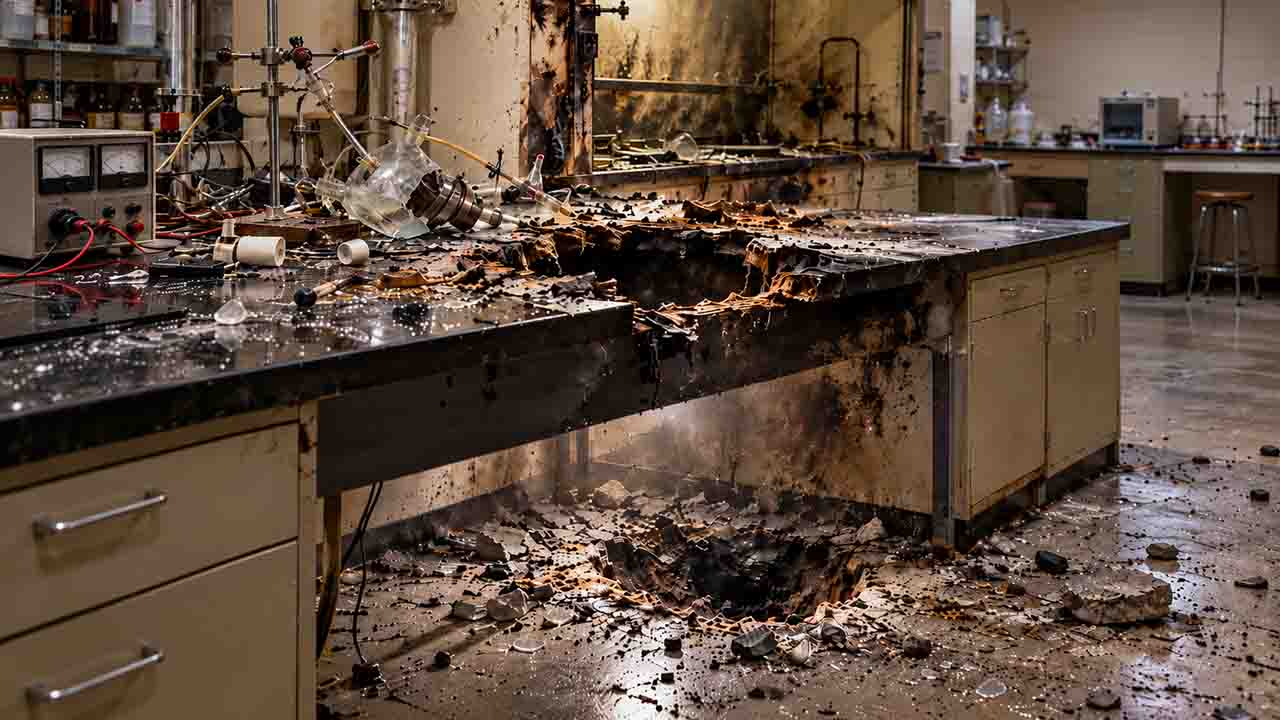
Four years before cold fusion made headlines around the world, an experiment at the University of Utah destroyed its own apparatus, burned through a laboratory bench, and damaged the concrete beneath it. At its center was a palladium cube just one centimeter across. For electrochemists Martin Fleischmann and Stanley Pons, the wreckage became a compelling reason to pursue an extraordinary possibility: that loading a metal with heavy hydrogen could release an unexpected source of nuclear energy.
The Morning After The 1985 Cold Fusion Meltdown
The experiment had been running for months. According to the reconstruction in Charles Beaudette’s Excess Heat, it occupied Room 1113 in the university’s north Henry Eyring chemistry building, where Pons’s son Joey helped monitor the work. Sometime in early 1985, Joey returned to find the apparatus in shambles. The discovery wasn’t a subtle change on a temperature chart. Something had destroyed the cell, breached the surface supporting it, and left damage underneath. What had happened during the unattended interval would become one of the most consequential—and least completely investigated—episodes in the history of cold fusion.
Kevin Ashley, then a chemistry graduate student working with Pons, remembered entering the laboratory and encountering the aftermath. “The lab is a mess and there is particulate dust in the air,” he recalled in testimony recorded by Beaudette. He described a hard, black laboratory benchtop with an opening roughly a foot across, and a substantial pit in the concrete below. The experiment had stood over an open area rather than directly above the cabinets at one end of the bench. Ashley also remembered something unexpected about the researchers’ reaction: they appeared pleased with what had happened, despite the destruction.
Fleischmann’s own recollection combined excitement with alarm. In a recorded interview with science journalist Steven Krivit, he described the discussion around the wreckage: “Do we stop? Do we get the bits and pieces out of this and analyze it?” The experience changed how they approached the work. “We said, we have to scale it down so that it doesn’t make a hole in the floor,” he explained. He called it a “potentially lethal experiment.” Whatever its mechanism, Fleischmann remembered an event serious enough to require a deliberate reduction in experimental severity.
Pons’s interpretation appeared in contemporary reporting, not merely in accounts written decades later. Speaking to TIME in 1989, he said the accident “told us we had much more energy than could be attributed to a chemical reaction.” That was the conclusion of an experienced electrochemist confronted with an unexpected result. It wasn’t a measured energy balance of the accident, but it explains its importance to the developing research program. The damaged apparatus had persuaded Pons that something worth pursuing lay beyond the ordinary behavior he expected from an electrochemical cell.
Why Look for Fusion Inside a Metal?
Fleischmann brought substantial scientific standing to that judgment. He had held the electrochemistry professorship at the University of Southampton, received the Royal Society of Chemistry’s medal for electrochemistry and thermodynamics in 1979, and would be elected a Fellow of the Royal Society in 1986. Pons was an established electrochemist who became chairman of Utah’s chemistry department in 1988. These credentials didn’t settle the mechanism of the accident. They did make the underlying question more interesting: what had two specialists in electrode reactions encountered that seemed so far outside their expectations?
Their interest began with palladium’s unusual relationship with hydrogen. Hydrogen isotopes can enter the metal and occupy sites within its crystal structure, rather than remaining only on its surface. Fleischmann’s earlier work on hydrogen–deuterium separation had produced behavior he considered worth investigating further. He and Pons wondered whether electrochemical loading could create a sufficiently unusual environment for nuclear reactions to become observable. They weren’t simply performing an ordinary electrolysis demonstration and inventing a nuclear interpretation afterward. The possibility of nuclear behavior was part of the question that led them to the experiment.
The basic arrangement was deceptively simple: a palladium cathode immersed in heavy water, a counter-electrode, and a direct-current supply. Heavy water contains deuterium, whose nucleus carries a neutron as well as a proton. Electrolysis generates deuterium at the cathode; some escapes as gas, while some enters the palladium. Fleischmann identified the destructive experiment as an open cell. The broader program described in the researchers’ 1989 paper used platinum counter-electrodes and a solution of 0.1-molar lithium deuteroxide in 99.5-percent heavy water. Those published specifications describe the research program, however, rather than supplying a complete construction drawing of the lost 1985 apparatus.
The cube was small enough to balance on a fingertip, but substantial by the standards of later thin-wire experiments. A cubic centimeter of palladium weighs approximately 12 grams. At an assumed loading of one deuterium atom per palladium atom, it could contain roughly 0.23 grams of deuterium—a calculated inventory, not a measured value for this particular cathode. The scientific proposition concerned how that deuterium behaved within the surrounding solid. Electrochemical loading changes its chemical potential, or thermodynamic tendency to move and react. It doesn’t mean the metal is literally subjected to the mechanical pressure or temperature inside a star.
Months of Loading, Then a Change in Current
The long operating history is one of the experiment’s most important features. Beaudette’s account describes a cell that had already been running for several months by late 1984. During that time, the palladium wasn’t necessarily an unchanging piece of metal. Loading hydrogen isotopes can alter its dimensions, internal stresses, and distribution of dissolved material. The distinction matters when comparing the cube with later replication attempts: placing fresh palladium in heavy water for a short run doesn’t automatically recreate the condition of a sample that has experienced months of electrochemical treatment.
The reported intervention was a doubling of current. In the account reproduced in the supplied transcript, Pons increased it from approximately 0.75 amperes to 1.5 amperes, then sent Joey to switch it off at the end of the day. For a one-centimeter cube with all six faces exposed, those currents correspond to 125 and 250 milliamperes per square centimeter. That calculation gives the story a useful engineering scale. It also highlights what needs to be known: the actual exposed surface, the voltage, the loading state, and whether the requested shutdown occurred before the destructive event.
The published record complicates the sequence. An erratum to the 1989 paper specifies that the cube’s results entry should contain an arrow running from 250 to 125 milliamperes per square centimeter—a reduction rather than an increase. The two accounts could describe successive stages, but the available documentation doesn’t establish that complete history. This isn’t a trivial discrepancy. Increased current, decreased current, and complete interruption create different conditions at the electrode surface. A theory that depends on one of those transitions needs more than the knowledge that the experiment eventually failed.
Even the discovery sequence has unresolved details. TIME reported that Pons telephoned Fleischmann, who had returned to England, whereas Ashley’s later recollection places both researchers in the damaged laboratory. Those descriptions could concern different moments, but they can’t be confidently combined into a single shared morning. What survives is a sequence with a firm beginning and ending—a long-running palladium experiment followed by destructive damage—and an uncertain interval between them. That interval contains the crucial information: what changed, how quickly the temperature rose, and whether the electrical supply was still delivering energy.
Reading the Wreckage
The bench is central to the mystery. Ashley described a very hard, black laboratory work surface, not an ordinary wooden table. Its exact composition and thickness haven’t been established in the sources examined here. That leaves an important engineering distinction unresolved. Slate, mineral-filled resin, and other laboratory-surface materials respond differently to localized heat, mechanical impact, and pressure. Calling the opening a “melted hole” assumes a failure mechanism that the description alone can’t identify. What the account establishes is a breach through a work surface that a chemistry graduate student considered exceptionally resistant.
The floor damage attracted another notable account from Chase Peterson, the physician who served as president of the University of Utah. In his memoir, as quoted in David Nagel and Alex Moser’s later technical review, Peterson described an approximately eight-inch-wide cavity extending three or four inches into the concrete, with “no evidence of an explosion.” A substantially smaller description came through experimental physicist and LENR researcher Lawrence Forsley, who reported that Fleischmann told him in 2007 of a fist-sized opening in the bench and a thumb-tip-sized depression about half an inch deep below it. These recollections support damage beneath the apparatus, but not a single reliable set of dimensions.
The palladium itself provides a different kind of evidence. Fleischmann and Pons wrote in their original paper that “a substantial portion of the cathode fused” and that “part of it vapourised.” Here, fused meant melted metal, not the fusion of atomic nuclei. Palladium’s melting point is approximately 1,555°C, so the reported condition of the cathode implies a severe thermal event. Yet the account doesn’t provide a recovered-metal mass balance. Without one, missing palladium can’t automatically be assigned to vaporization rather than dispersed droplets, fragments, or fine particles. Ashley’s airborne dust is a vivid observation, but its composition wasn’t established by the testimony.
There was apparently some effort to check radiation afterward. Beaudette reports that the researchers surveyed the area with an unspecified detector and thought they saw an increase above background. His account supplies neither the instrument, readings, calibration, nor timing needed to evaluate that impression. Nor do the available accounts provide an isotope analysis identifying tritium, helium, or unusual nuclear products in the wreckage. The distinction is important: a radiation check was reported, but a quantitative post-accident nuclear investigation hasn’t been documented. Fleischmann’s recollection of considering—and postponing—the analysis of the fragments helps explain why the evidence remains so difficult to interpret.
How Much Energy Does a Hole Represent?
The simplest calculation starts with the metal. Nagel and Moser estimated that heating palladium from room temperature through melting requires roughly 0.53 kilojoules per gram. Applied to an approximately 12-gram cube, that gives about 6.3 kilojoules to melt the entire sample. It’s a useful benchmark, not a measured yield: the original paper says a substantial portion melted, and the heat transferred elsewhere must be considered separately. Still, it puts the incident on a physical scale. Thousands of joules concentrated in a tiny object can produce extraordinary temperatures without requiring an enormous total energy release.
The surroundings are harder to reconstruct. Taken literally as a cylinder, Peterson’s larger description would represent about 2.5–3.3 liters of missing concrete, but that’s a geometric illustration rather than a measured crater volume. More importantly, concrete can fracture and spall when heated; the missing material needn’t all have melted. Against the damage must be set every plausible energy source. Nagel and Moser estimated approximately 13 kilojoules from oxidation of the deuterium inventory of a fully loaded cube, while explicitly simplifying the energy required to release that deuterium. That comparison means palladium melting alone doesn’t settle the nuclear question. The decisive issue is whether an actual chemical pathway could concentrate sufficient heat and account for the surrounding damage.
Jacques Ruer, David French, and Douglas Yuill examined such a pathway in a 2019 paper. Their model considered loaded palladium exposed to air: escaping hydrogen or deuterium reacts with oxygen at the catalytic metal surface, heating the sample and accelerating further release. They proposed a speculative sequence combining a gas event, exposure of the cathode, catalytic self-heating, and concrete damage. A modeled one-centimeter sphere loaded to 0.9 deuterium atoms per palladium atom reached approximately 982°C—intense heat, but below palladium’s melting point. Their analysis therefore identified a conventional mechanism worth investigating, not a demonstrated reproduction of the reported accident.
Power introduces another uncertainty: duration. An illustrative release of 10 kilojoules would average 10 kilowatts over one second, about 167 watts over one minute, or approximately 17 watts over ten minutes. None is an estimate of the Utah cell’s actual output; the example shows why damage discovered the next morning can’t establish peak power. The reverse comparison is equally revealing: half a watt sustained for a day delivers 43.2 kilojoules, considerably more than the rough energy required to melt the cube, but spread through a functioning calorimeter rather than concentrated destructively. Spectacular damage and sustained excess heat are different experimental signatures, not interchangeable measures of total energy.
Why the Later Experiments Looked Different
Fleischmann’s response to the accident was to make the work less hazardous. His recorded account describes experiments conducted under “much milder conditions,” while Beaudette describes a move toward sheets and smaller-diameter rods. That change offers a practical answer to part of the reproducibility question. The researchers weren’t necessarily trying to recreate a hole in the floor; they were trying to produce an effect they could measure without destroying the instrument. A dramatic accident can motivate a research program while being poorly suited to serve as its standard experiment.
The geometric differences are substantial. A palladium rod one millimeter in diameter and ten centimeters long contains about 0.079 cubic centimeters of metal and weighs roughly 0.94 grams—about thirteen times less than the cube. Its surface-area-to-volume ratio is approximately 40 inverse centimeters, compared with six for the cube. In straightforward terms, the thin rod has much more surface through which to exchange heat and material for each unit of its interior. Even when two samples are made from the same metal and receive comparable current densities, their temperature histories needn’t resemble one another.
Total mass isn’t the only issue. A full rod four millimeters in diameter and ten centimeters long would contain approximately 1.26 cubic centimeters of palladium, slightly more than the cube, yet its axis would be only two millimeters from the cylindrical surface. The cube’s center is five millimeters from its nearest face. Heat transport and deuterium redistribution depend on these distances as well as material properties, temperature, and boundary conditions. The comparison shows why “they used less palladium” is an incomplete explanation. Shape, thermal contact, internal gradients, and the way the current changed may have mattered as much as the inventory.
Some LENR researchers argue that the decisive differences lie at a far smaller scale. Edmund Storms’s proposed explanation places the reaction in a specialized “nuclear-active environment,” associated with nanoscale cracks rather than an undifferentiated bulk lattice. In that model, samples that look identical macroscopically can contain very different populations of active sites. It offers a hypothesis for intermittent behavior and sensitivity to material preparation. But the lost Utah cathode can’t be examined to test whether it possessed those structures. Geometry supplies a credible reason for different thermal behavior; a specific nuclear mechanism for the 1985 event remains a proposition to establish.
Four Years Before the Announcement
The interval between the accident and the public announcement wasn’t empty. The University of Utah’s press release described approximately five and a half years of work, initially financed by the researchers themselves. Pons told TIME that their personal investment ultimately approached $100,000. The destructive event helped convince them that the investigation deserved that commitment, but conviction wasn’t the same as a controlled result. They still needed to characterize the behavior, develop a reliable energy balance, and determine whether the heat had an identifiable nuclear origin.
Their later cells were designed to make smaller effects measurable. The published arrangements included insulated Dewar vessels, controlled water baths, calibrated temperature sensors, and electrical heaters used to characterize heat losses. Such instrumentation transformed the question. Instead of asking what might have destroyed a bench, they could ask whether a cell consistently released more heat than its electrical and chemical accounting allowed. That required tracking gas evolution, changing liquid levels, and energy transfer to the surroundings. A small apparent surplus could be meaningful only if the ordinary contributions were measured accurately enough to distinguish it.
The work was still changing in 1988. Fleischmann recalled a major operation that March and a conversation with Pons about stopping an experiment until it could be redesigned. Meanwhile, the research was approaching an institutional turning point. Steven Jones at Brigham Young University was investigating low-level nuclear signatures in related systems, creating a competing claim to priority. Utah also had an interest in protecting intellectual property. The eventual disclosure emerged from that mixture of ongoing experimentation, personal conviction, scientific competition, and patent considerations—not simply from a decision to announce an accident four years after it happened.
On March 23, 1989, the university presented the work to the world. The preliminary paper subsequently published in the Journal of Electroanalytical Chemistry included the destructive cube experiment in an unusually memorable way: its results entry read “WARNING! IGNITION?” That placement matters. The incident wasn’t merely an anecdote that accumulated around cold fusion after the controversy began; the researchers included it in their original scientific presentation. But it was the later calorimetry and nuclear-product claims that other laboratories could attempt to test. The destroyed cube had helped shape the researchers’ expectations without leaving the measurements needed to settle them.
Searching for the Nuclear Fingerprints
One important line of subsequent work came from electrochemist Melvin Miles and colleagues associated with the Navy’s China Lake laboratory and the University of Texas at Austin. Their 1993 paper reported excess power reaching 0.52 watts, up to 27 percent above the relevant input accounting. Eight electrolysis-gas samples collected during excess-power episodes showed helium-4 by mass spectrometry, while ordinary-water controls did not show the same effects. The team described a qualitative relationship between heat and helium, with the measured helium within an order of magnitude of their fusion-based estimate. This attempted to connect an energy anomaly with a possible nuclear product, rather than relying on heat alone.
A different approach emerged from Pamela Mosier-Boss, Stanislaw Szpak, Frank Gordon, and Lawrence Forsley’s work with palladium–deuterium co-deposition. Their 2009 paper described triple tracks in CR-39, a plastic detector that records damage from energetic particles. The researchers interpreted the three-pronged patterns as carbon nuclei breaking into three alpha particles after neutron interactions, implying neutron energies of at least 9.6 million electron-volts. It was a specific nuclear interpretation of detector morphology, not simply a claim that a sample became hot. Its evidential strength depended on demonstrating the origin of those tracks and excluding competing explanations.
The investigation was international from the outset. At India’s Bhabha Atomic Research Centre, teams reported neutron and tritium observations in experiments initiated after the 1989 announcement. Fleischmann and Pons’s own early work also included a claimed neutron-capture gamma signature, corrected in their erratum to 2.225 million electron-volts. Each measurement addressed a different question. Tritium is radioactive hydrogen and requires careful accounting for initial contamination and concentration during electrolysis. Gamma and neutron measurements require calibrated instruments and defensible backgrounds. These later reports expanded the experimental case researchers sought to make, but none constituted an isotope or radiation measurement of the destroyed 1985 cube.
The central challenge has always been to make the observations agree quantitatively: heat, reaction products, detector signals, and controls must support the same physical process. That’s why the field’s positive reports haven’t ended the dispute, and why null results remain consequential. A Google-supported, multi-institution collaboration reported in Nature in 2019 that its investigation had produced no evidence of the cold-fusion effect it sought, while also uncovering worthwhile questions about highly hydrogen-loaded metals. The enduring scientific problem isn’t whether an isolated unusual observation can be found. It’s whether a defined apparatus can reliably produce a measured effect with a convincing explanation.
The Experiment’s Long Afterlife
Cold-fusion research did not disappear after the first wave of controversy. The Naval Research Laboratory in Washington, the Naval Air Warfare Center Weapons Division at China Lake, and the Space and Naval Warfare Systems Center in San Diego pursued related investigations. Their work was collected in the 2002 technical report Thermal and Nuclear Aspects of the Pd/D₂O System: A Decade of Research at Navy Laboratories. That record establishes sustained work by three Navy laboratories, not a uniform institutional verdict. Researchers continued examining the question that the Utah experiment had made urgent: could hydrogen-loaded metals produce energy or nuclear signatures that existing explanations failed to account for?
NASA’s involvement also extends beyond a passing interest. A 2012 NASA Glenn presentation described small-scale investigations dating to 1989, including temperature effects in hydrogen- and deuterium-loaded palladium. Later, NASA’s lattice-confinement-fusion work used an external photon beam of approximately 2.9 million electron-volts to create energetic particles within deuterated metals and initiate nuclear reactions. That is a different experiment from an unattended electrolysis cell. DARPA’s MARRS program now likewise investigates mechanisms that might amplify fusion rates in solids. These efforts demonstrate that nuclear reactions in metal-hosted systems remain a serious research subject, while preserving the distinction between externally driven fusion and the unexplained Utah event.
The Department of Energy’s ARPA-E supplied another concrete measure of continuing interest on February 17, 2023, when it announced $10 million for eight LENR projects. Participants included MIT, Stanford, Lawrence Berkeley National Laboratory, Texas Tech, and the University of Michigan. Their proposed work combined materials preparation with calorimetry, radiation detection, and analysis of possible nuclear products. The objective was investigation, not retrospective endorsement. Yet the choice of tools is revealing: these programs were designed to obtain the correlated measurements that the 1985 accident lacked, replacing an inference from damaged apparatus with experiments capable of identifying what happened while it happened.
Forty-one years after the reported accident, and thirty-seven after the public announcement, the small palladium cube still occupies an outsized place in this history. Its importance lies partly in the damage described by recognizable witnesses, and partly in what that damage persuaded two accomplished scientists to do next. The surviving record supports a destructive event and a profound effect on their research; it doesn’t establish a definitive energy release or nuclear cause. Fleischmann’s recollection brings the story back to the choice made over the wreckage: continue, but under milder conditions. The apparatus was gone. The question it left behind was not.
References
The 1985 experiment, witness accounts, and the 1989 announcement
- Electrochemically Induced Nuclear Fusion of Deuterium — Original Paper and Errata — Martin Fleischmann and Stanley Pons, with Marvin Hawkins added in the errata. Journal of Electroanalytical Chemistry, 261, 301–308 (1989). Includes the published description of the destructive palladium-cube experiment and the correction to its current-density entry.
- Excess Heat: Why Cold Fusion Research Prevailed, Second Edition — Charles G. Beaudette. Oak Grove Press, 2002. Full-book PDF. Chapter 3, particularly printed pages 35–37, contains the experimental chronology, Kevin Ashley’s testimony, and the account of the post-event radiation check.
- Martin Fleischmann Recounts the 1985 “Hole in the Floor” Palladium Electrolysis Experiment — Video supplied for this story. Includes Fleischmann’s recorded answers to interviewer Steven Krivit, followed by additional narration and historical material.
- Tom Wind Discusses the 1985 Fleischmann and Pons Cold Fusion Hole-in-the-Floor Experiment — Video supplied for this story. A retrospective presentation describing the experiment and its place in cold-fusion history.
- Science: Fusion Illusion? — Michael D. Lemonick. TIME, May 8, 1989. This page of the archived article discusses the early destructive experiment and Pons’s interpretation of its energy release.
- High Energy Density and Power Density Events in Lattice-enabled Nuclear Reaction Experiments and Generators — David J. Nagel and Alex E. Moser. Journal of Condensed Matter Nuclear Science, 19, 219–229 (2016). Section 2, “Fleischmann–Pons Meltdown,” collects the differing damage accounts and develops preliminary energy estimates.
- The Guardian Poplar: A Memoir of Deep Roots, Journey, and Rediscovery — Chase Nebeker Peterson. University of Utah Press, 2012. Publisher’s book page. Peterson’s description of the laboratory damage is quoted in the Nagel–Moser paper above; that paper was the source used for his quotation in the story.
- “Simple Experiment” Results in Sustained N-Fusion at Room Temperature for First Time — University of Utah, March 23, 1989. Archived text of the original press release, including the researchers’ stated motivations, research history, and public claims.
- Martin Fleischmann. 29 March 1927—3 August 2012 — David E. Williams. Biographical Memoirs of Fellows of the Royal Society, 74, 161–184 (2023; first published online November 9, 2022). Documents Fleischmann’s career, scientific contributions, and professional honors.
Engineering, material properties, and proposed explanations
- Reaction of the Hydrogen with Air During the Desorption of Palladium Hydride — Jacques Ruer, David J. French, and Douglas Yuill. Journal of Condensed Matter Nuclear Science, 29, 286–297 (2019). Examines catalytic self-heating of hydrogen-loaded palladium and proposes a possible conventional sequence for the destructive cube experiment.
- Explaining Cold Fusion — Edmund Storms. Journal of Condensed Matter Nuclear Science, 15, 295–304 (2015). Presents the proposed nuclear-active environment, nanoscale-crack mechanism, and suggested experimental tests.
- Palladium: Element Information, Properties and Uses — Royal Society of Chemistry. Reference data for palladium’s density, atomic mass, melting point, and other material properties.
Subsequent experimental investigations
- Correlation of Excess Power and Helium Production During D₂O and H₂O Electrolysis Using Palladium Cathodes — M. H. Miles, R. A. Hollins, B. F. Bush, J. J. Lagowski, and R. E. Miles. Journal of Electroanalytical Chemistry, 346 (1993). Full-text PDF of the heat–helium investigation discussed in the story.
- Triple Tracks in CR-39 as the Result of Pd–D Co-deposition: Evidence of Energetic Neutrons — Pamela A. Mosier-Boss, Stanislaw Szpak, Frank E. Gordon, and Lawrence P. G. Forsley. Naturwissenschaften, 96, 135–142 (2009; published online in 2008). The original paper interpreting triple tracks in CR-39 detectors.
- BARC Studies in Cold Fusion, April–September 1989 — Edited by P. K. Iyengar and M. Srinivasan. Bhabha Atomic Research Centre, Report BARC-1500, December 1989. Archive page containing the report’s contents, links to source material, and a later retrospective by participating researchers.
- Revisiting the Cold Case of Cold Fusion — Curtis P. Berlinguette and colleagues. Nature, 2019. Google Research’s publication page and abstract for the multi-institution investigation discussed in the story.
Navy, NASA, ARPA-E, and DARPA research
- Thermal and Nuclear Aspects of the Pd/D₂O System, Volume 1: A Decade of Research at Navy Laboratories — Edited by Stanislaw Szpak and Pamela A. Mosier-Boss. Space and Naval Warfare Systems Center, San Diego, Technical Report 1862, February 2002. Full-report PDF documenting the Navy laboratories’ investigations.
- NASA Glenn Research Center Experience with LENR Phenomenon — Susan Y. Wrbanek, Gustave C. Fralick, John D. Wrbanek, and Janis M. Niedra. NASA presentation, May 1, 2012. Official NASA record with a downloadable presentation reviewing earlier hydrogen- and deuterium-loaded palladium experiments.
- Lattice Confinement Fusion — NASA Glenn Research Center. Official explanation of NASA’s externally driven lattice-confinement-fusion experiments, with links to the associated research papers.
- U.S. Department of Energy Announces $10 Million in Funding to Projects Studying Low-Energy Nuclear Reactions — ARPA-E, February 17, 2023. Official announcement of the eight-project LENR funding round.
- Mechanisms for Amplification of Fusion Reaction Rates in Solids — MARRS — DARPA, 2026. Official program description, research objectives, and links to solicitation and presentation materials.