

Cold Fusion & The Hype Cycle
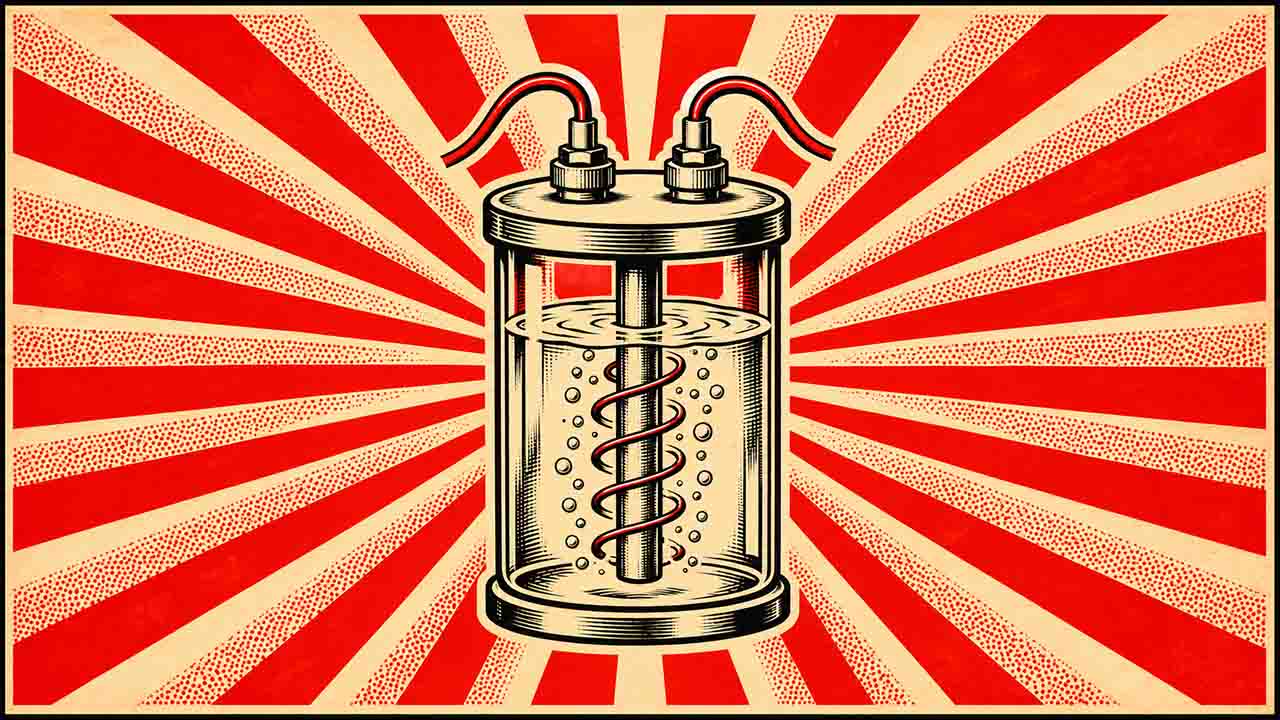
Cold fusion promised an energy revolution in 1989. What followed was a familiar human drama: excitement, competition, disputes over authority, public embarrassment, and difficulty reconsidering earlier judgments. Gartner’s Hype Cycle and Thomas Kuhn’s model of scientific change offer different ways to understand those responses. Whether cold fusion ultimately works is one question. How people and institutions behaved when confronted with it is another—and that story matters either way.
The Rush to Join the Cold Fusion Revolution
On March 23, 1989, Martin Fleischmann and Stanley Pons announced a result whose apparent simplicity made its implications irresistible. Their experiment used palladium electrodes, platinum counterelectrodes, and heavy water containing 0.1-molar lithium deuteroxide. Their preliminary paper described palladium rods just 1, 2, and 4 millimeters in diameter and reported heat generation exceeding 10 watts per cubic centimeter of palladium for more than 120 hours. These were the investigators’ reported findings, not independently established performance figures. But the proposition was extraordinary: an apparatus small enough for a laboratory bench might accomplish something associated with enormous fusion facilities.
The excitement reached institutions that would soon become prominent critics. At Caltech, postdoctoral researchers Reginald Penner and Michael Sailor began investigating the day after the announcement. They purchased a 100-gram bottle of heavy water for $60. What began as a small experiment eventually involved about 20 people. The early response wasn’t simply an establishment refusing to look. Researchers inside that establishment wanted to participate.
There was an engineering reason for the attraction. A tabletop electrochemical cell appears accessible in a way that a magnetic-confinement machine doesn’t. Its visible components suggest a short path from announcement to replication: obtain the metal, prepare the electrolyte, connect the power supply, and measure the temperature. But assembling a cell and establishing an accurate energy balance are different tasks. Heat can leave through conduction, evaporation, and escaping gases; calibration can change with operating conditions. An apparatus can be easy to build and difficult to interpret. Its simplicity can encourage confidence before the measurement problem is fully understood.
That gap between visible simplicity and hidden difficulty helped create the conditions for overreaction. The claim invited people to imagine applications before they had a dependable experimental result. For a scientist, participation offered the possibility of discovery. For a university, it offered recognition and commercial opportunity. For policymakers, it offered a potential answer to energy insecurity. None of those interests was inherently improper. The danger was that the promise could begin organizing decisions before the evidence had caught up. Cold fusion wasn’t only entering laboratories. It was entering ambitions, budgets, and public expectations.
When the Stakes Became Institutional
The potential disruption quickly became a matter of funding. At an April 26, 1989, congressional hearing, Representative Robert Walker described an amendment accepted during an April 6 subcommittee markup authorizing the redirection of $5 million from magnetic-fusion research toward room-temperature fusion. Utah sought $25 million in federal support. The record establishes a proposed funding shift, not a completed transfer. Even so, the competition was already concrete: the new claim had reached the allocation of resources.
Conventional fusion research had accumulated more than machinery. Its facilities embodied specialized knowledge: vacuum engineering, plasma heating, magnetic confinement, radiation detection, materials testing, and complex control systems. A successful electrochemical alternative would raise questions about which capabilities deserved expansion and which development paths should take priority. That doesn’t tell us what any individual scientist privately feared. It explains why the announcement couldn’t remain an emotionally neutral proposition for every institution involved. When a claim appears capable of changing the value of existing expertise, evaluating it becomes both a scientific responsibility and an organizational problem.
The proponents had competing institutional obligations of their own. In written responses associated with the hearing, the University of Utah explained that patent advice prevented it from sharing research results—including with national laboratories—until the information had been incorporated into a filed application. After filing, dissemination could proceed. The university explicitly recognized a conflict between scientific and commercial interests. Protecting ownership could therefore delay information needed for independent examination, even as public interest increased the demand for rapid verification.
Commercial urgency also shaped the proposed response. Utah adviser Ira Magaziner urged Congress to begin moving as though the effort would succeed rather than wait for a lengthy confirmation process. That position reveals a recurring dilemma: move cautiously and risk missing an opportunity, or move quickly and risk committing to an illusion. Cold fusion brought that dilemma into unusually sharp focus. No coordinated conspiracy was necessary for institutions to pull in different directions. Patent procedures, appropriations, competitive advantage, and scientific verification each had their own priorities—and their own schedules.
From Doubt to Public Verdict
By May 1, at the American Physical Society meeting in Baltimore, the public tone had changed dramatically. Steven Koonin’s assessment included “incompetence and perhaps delusion,” according to Caltech’s contemporary account. The same account describes his earlier encouragement of the investigation. The contrast matters. A researcher could move from hope to rejection as evidence accumulated; the public language could also move from judging measurements to judging people.
The scientific objections were substantial. Conventional deuterium–deuterium fusion produces recognizable products, including approximately 2.45-MeV neutrons or 3.02-MeV protons, accompanied by helium-3 or tritium. These particles aren’t incidental to the reaction; they help account for its energy. DOE’s 1989 review found reported neutron levels roughly a trillionfold below those needed to explain claimed heat through ordinary D–D fusion. Calorimetry raised additional concerns. In an illustrative apparatus consuming 50 watts, a 1 percent systematic error corresponds to half a watt—enough to overwhelm a claimed 100-milliwatt surplus. Such objections provided strong reasons to challenge the original interpretation.
But the response also acquired political urgency. Caltech’s account says the congressional funding push helped displace the team’s intended sequence of journal publication followed by public announcement. It describes Nathan Lewis becoming agitated after watching the hearing. The group’s earliest experiments had themselves relied on incomplete newspaper descriptions, initially leading to the wrong electrolyte. Both replication and public communication were proceeding under pressure.
The important distinction isn’t between criticism and politeness. Scientific criticism can properly be severe when claims outrun evidence. It’s between a judgment that remains attached to a particular experiment and one that becomes attached to a subject’s identity. A calibration objection can be answered with a better calibration. A missing-particle objection can define a new measurement. A reputation for incompetence is harder to test and harder to escape. Once a controversy reaches that point, later investigators may inherit the social consequences of an announcement they didn’t make.

Gartner’s Expectations, Kuhn’s Commitments
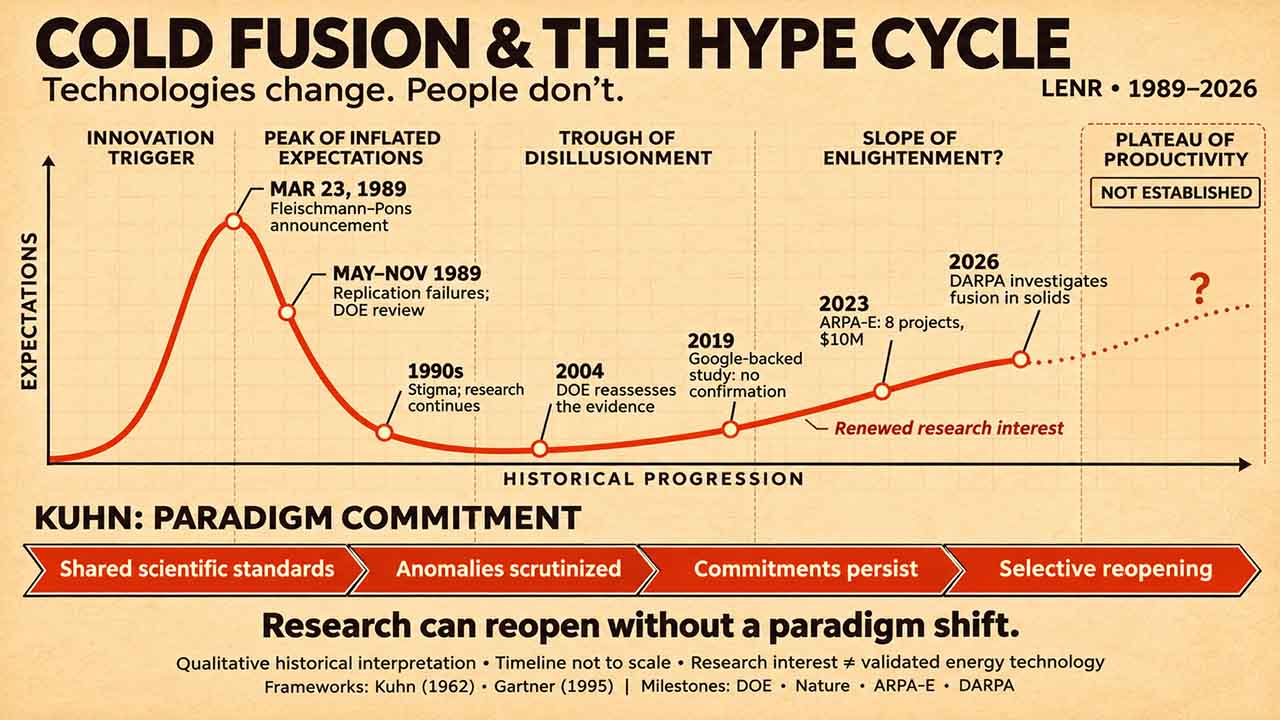
Six years after the Utah announcement, Gartner analyst Jackie Fenn introduced the Hype Cycle. Its familiar progression—from extraordinary expectations through disappointment and potentially toward more realistic understanding—describes more than the development of machinery. In her 2022 account of its origins, Fenn explained: “It’s about the human reaction to novelty when faced with any innovation or new experience.” That observation is particularly useful for cold fusion. The rapid rise and collapse of expectations can be studied without assuming that an energy technology will eventually emerge. A failed innovation can still reveal a great deal about the people who celebrated and rejected it.
Thomas Kuhn’s The Structure of Scientific Revolutions, published in 1962, examines a different dimension of that response. Scientific communities share more than conclusions. They inherit exemplary experiments, preferred methods, and expectations about what constitutes a significant problem or a persuasive solution. Kuhn called much of the work conducted within those commitments normal science. This organization makes sustained, precise research possible: scientists don’t have to reopen every foundational assumption whenever an instrument behaves unexpectedly. The difficulty arises when a useful commitment becomes so protective that an unfamiliar observation struggles to receive serious examination.
Cold fusion exposed differences between disciplinary habits as well as theoretical expectations. In his 1992 study, Competition Among Scientific Disciplines in Cold Nuclear Fusion Research, James W. McAllister interpreted the controversy partly as professional competition between physics and chemistry. The practical divide is easy to illustrate. An electrochemist may emphasize surface preparation, current density, and deuterium loading. A nuclear physicist may emphasize particle energies, background counts, and reaction products. A deuterium-to-palladium ratio of 0.9 means approximately nine deuterium atoms per ten palladium atoms, but that bulk ratio doesn’t specify local defects or surface conditions. Conversely, an unusual material state doesn’t by itself establish a nuclear reaction. The measurements must eventually meet.
Gartner and Kuhn therefore illuminate different parts of the same human problem. One concerns changing expectations; the other concerns the commitments through which expert communities interpret challenges. Neither framework makes resistance evidence that a disputed claim is correct. Their value here is explanatory: they help us ask why enthusiasm can outrun verification, why disappointment can expand into dismissal, and why reconsideration can become socially difficult. The behavioral question isn’t whether scientists possess standards. It’s whether their standards remain responsive to evidence when the dispute also involves authority, identity, and reputation.
When Reputation Becomes Part of the Experiment
Philosopher Huw Price calls one possible outcome a “reputation trap.” In Risk and Scientific Reputation: Lessons from Cold Fusion, circulated in 2022, he argues that a subject can become so disreputable that approaching it with an open mind carries a professional cost. The proposed mechanism is self-reinforcing: capable researchers avoid the field, fewer well-supported investigations occur, and the continued absence of broadly persuasive evidence sustains the avoidance. Price advocates renewed examination of LENR. His argument concerns the social conditions of inquiry, not an independent demonstration of the underlying physics.
An earlier account by Caltech physicist David Goodstein shows how that division could affect both sides. Writing in 1994, he described a cold-fusion conference attended by 250 scientists, with more than 150 papers presented in December 1993. Research hadn’t disappeared, but communication with mainstream science had badly deteriorated. Goodstein also argued that a community feeling under siege could become reluctant to criticize its own work. His diagnosis wasn’t simply that outsiders were unfair. Isolation could deprive investigators of external scrutiny while discouraging internal correction—the very processes needed to distinguish a discovery from a mistake.
ARPA-E later described a related problem in institutional terms. Its 2021 LENR workshop identified a stalemate in which insufficient accepted evidence restricted access to funding, while inadequate funding restricted the work needed to establish convincing evidence. That is more specific than saying that scientists dislike unconventional ideas. It identifies a problem in how research is supported: the resources needed to resolve uncertainty may depend on already possessing the credibility that the proposed work is intended to establish. Whether the underlying claim ultimately succeeds or fails, that circularity deserves attention.
The consequences are practical. A serious investigation may need multiple calorimetric methods, controlled gas handling, characterized materials, isotope analysis, and long detector-background measurements. Those requirements consume instrument time, specialist labor, and money. Independent replication also requires willing collaborators. None of this means that every unfunded proposal deserved support or that resources alone would have solved LENR’s difficulties. It means that evidence doesn’t emerge independently of the conditions under which people produce it. A subject’s reputation can become an experimental variable by influencing who participates, what equipment is available, and how extensively an uncertain result is tested.
The Establishment Was Never One Thing
The formal government record was less categorical than cold fusion’s popular reputation. DOE’s November 1989 review opposed special programs but supported modest, focused experiments. Its 2004 reassessment received comments from 18 reviewers, who were approximately evenly divided over the excess-power evidence. Only one considered LENR demonstrated, yet nearly all supported considering well-designed individual experiments. Those positions weren’t contradictory. They separated belief in an explanation from willingness to investigate a question. The institutional issue was whether that distinction remained effective outside the language of a report.
Other organizations maintained their own lines of inquiry. The Navy’s 2002 Thermal and Nuclear Aspects of the Pd/D₂O System documented a decade of collaborative laboratory research. Japan’s Atomic Energy Research Institute issued a 90-page review in March 1995. Italy’s ENEA published Cold Fusion: The History of Research in Italy in 2009. These records don’t supply a single verdict, but they undermine the notion of one scientific establishment acting with one mind. Different laboratories, agencies, and national research systems continued to assign the question different levels of importance.
NASA’s later lattice-confinement fusion work demonstrates another route into the subject. Its 2020 publications examined deuterated metals under energetic irradiation. Photons near the 2.9-MeV scale could break apart deuterons, producing particles that helped drive subsequent nuclear reactions within the material. This was externally stimulated nuclear research, not a demonstration of spontaneous electrochemical nuclear heat. Institutionally, however, the distinction was productive: researchers could investigate a defined interaction between nuclear processes and a solid-state environment without first resolving the whole historical controversy. A narrower experimental question created room for participation.
The Google-supported collaboration that published Revisiting the Cold Case of Cold Fusion in Nature in 2019 offered another useful example. Its researchers reported no evidence establishing the claimed cold-fusion effect, while arguing that highly loaded metal hydrides remained scientifically interesting. That combination deserves emphasis. A negative result didn’t require declaring every related question unworthy of study. The investigation demonstrated a behavioral alternative to the usual contest between vindication and debunking: examine the claim seriously, publish what happened, and distinguish the failed expectation from the research opportunities that remain.
Making Investigation Possible Again
On February 17, 2023, ARPA-E selected eight projects totaling $10 million. MIT received $2 million for work on neutron emission from laser-stimulated metal hydrides, emphasizing nuclear and materials diagnostics, including emitted neutrons and unusual isotope ratios. The operational change was significant. An agency wasn’t simply telling researchers that strong proposals ought to receive ordinary consideration; it was assembling a portfolio intended to make disputed questions experimentally tractable. Funding could provide equipment, collaboration, and a legitimate institutional setting in which to ask those questions. Participation no longer had to imply confidence that a revolution was imminent.
A narrower measurable result appeared in Nature in August 2025. In the Thunderbird Reactor, electrochemical loading supplied additional deuterium to a palladium target while energetic deuterium ions drove fusion from the other side. The researchers reported an average fusion-rate increase of 15 percent, with an uncertainty of 2 percentage points. In one measurement, neutron production increased from approximately 135.5 to 156.7 neutrons per second. The reported neutron yield corresponded to roughly one billionth of a watt against 15 watts of input power. This was a controlled research result, not an energy breakthrough—and it could be discussed as such.
DARPA’s MARRS program similarly defines the opportunity in terms of mechanisms and measurements. The program investigates amplification of fusion reaction rates in solids below approximately 2,000 kelvin, emphasizing quantitative models and progressively higher rates. DARPA explicitly acknowledges that absolute rates remain low despite large enhancements over some earlier predictions. It also describes the work as complementary to plasma fusion and considers resolving its potential relevant to national security. Strategic concern, in this case, provides a reason to investigate rather than a reason to make the subject disappear.
Viewed as institutional behavior, these developments matter before any generator succeeds. They create ways to revisit uncertainty without demanding that participants first defend the entire history of cold fusion. The risk isn’t eliminated; it’s bounded by specific hypotheses, measurements, and decisions about further work. That’s a different response from both announcing an energy revolution prematurely and treating an old controversy as a permanent instruction not to look. The most consequential rehabilitation may be the restoration of an ordinary scientific permission: a researcher can ask a difficult question without being required to endorse its most extraordinary possible answer.
Technologies Change. People Don’t.
The history is most revealing when neither the excitement nor the backlash is treated as something that happened only to other people. The enthusiasts weren’t necessarily foolish for seeing enormous potential. The critics weren’t necessarily threatened simply because they identified serious defects. But hope, competition, frustration, and loyalty can become entangled with sound technical judgment. Once people have made public commitments, the next piece of evidence can arrive not only as information but as a challenge to what they’ve already said and done. Cold fusion makes that interaction unusually visible because the stakes became spectacular before the experiment became dependable.
The behavioral lesson survives either possible scientific outcome. If the original energy claims ultimately fail, that won’t make every instance of ridicule or blanket dismissal proportionate. If some related process eventually becomes useful, that won’t invalidate every early objection or authenticate every reported result. Scientific correctness and responsible conduct aren’t identical measures. Someone can identify a real experimental error and still overreach in condemning a field. Someone can be treated unfairly and still be mistaken. Keeping those judgments separate is essential to understanding the controversy rather than merely choosing a side in it.
Institutions can’t remove those human pressures, but they can make decisions less dependent on them. Rejections can identify correctable weaknesses rather than rely on labels. Funding can support bounded replication efforts with explicit stopping criteria. Journals can distinguish informative negative findings from uninformative repetition. Researchers can be rewarded for changing their assessment when the evidence changes. These aren’t demands that science become credulous. They’re ways of keeping skepticism useful: attached to methods, measurements, and propositions that can be examined, rather than to reputations that become increasingly difficult to challenge.
“Technologies change. People don’t” isn’t an argument that learning is impossible. It’s a reminder that unfamiliar inventions encounter familiar motives. The apparatus will change, and so will the theory that describes it. The temptation to mistake excitement for evidence, disagreement for disloyalty, and reconsideration for weakness will remain. Cold fusion’s most durable lesson may therefore have less to do with palladium than with ourselves: we need to recognize those reactions while we’re having them, not only after history has made somebody else’s mistakes easy to see.
References
The Original Announcement and Early Controversy
- Electrochemically Induced Nuclear Fusion of Deuterium — Martin Fleischmann, Stanley Pons, and Marvin Hawkins; Journal of Electroanalytical Chemistry and Interfacial Electrochemistry, 261, 301–308, 1989.
- Recent Developments in Fusion Energy Research — U.S. House Committee on Science, Space, and Technology; congressional hearing, April 26, 1989; 101st Congress, first session, No. 46. Original transcript archived by New Energy Times.
- Quest for Fusion — Douglas L. Smith; Engineering and Science, 52(4), 2–15, Summer 1989; California Institute of Technology.
- Whatever Happened to Cold Fusion? — David L. Goodstein; Engineering and Science, 58(1), 14–25, Fall 1994; California Institute of Technology.
Scientific Paradigms, Institutional Behavior, and the Hype Cycle
- The Structure of Scientific Revolutions — Thomas S. Kuhn; University of Chicago Press; first published in 1962. Link points to the 50th Anniversary Edition, 2012, with an introductory essay by Ian Hacking.
- Objectivity, Value Judgment, and Theory Choice — Thomas S. Kuhn; chapter 13 in The Essential Tension: Selected Studies in Scientific Tradition and Change, University of Chicago Press, 1977. Link points to the containing book.
- Competition Among Scientific Disciplines in Cold Nuclear Fusion Research — James W. McAllister; Science in Context, 5(1), 17–49, Spring 1992.
- Gartner Hype Cycle Research Methodology — Gartner; official explanation of the framework and its five stages.
- The First Hype Cycle: An Origin Story — Jackie Fenn; first-person account of the framework’s development and its initial publication in 1995; January 29, 2022.
- Risk and Scientific Reputation: Lessons from Cold Fusion — Huw Price; arXiv:2201.03776; January 2022, revised January 28, 2022.
Government Reviews, Laboratory Reports, and Research Histories
- Cold Fusion Research — Energy Research Advisory Board, U.S. Department of Energy; DOE/S-0073; November 1989.
- Report of the Review of Low Energy Nuclear Reactions — U.S. Department of Energy, Office of Science; December 1, 2004. Original DOE report archived by New Energy Times.
- Thermal and Nuclear Aspects of the Pd/D₂O System, Volume 1: A Decade of Research at Navy Laboratories — S. Szpak and P. A. Mosier-Boss, editors; Space and Naval Warfare Systems Center San Diego; Technical Report 1862; February 2002. Navy research compilation archived by LENR-CANR.org.
- Review of “Cold Fusion” — Review Group on “Cold Fusion,” Japan Atomic Energy Research Institute; JAERI-Review 95-003; March 1995.
- Cold Fusion: The History of Research in Italy — Sergio Martellucci, Angela Rosati, Francesco Scaramuzzi, and Vittorio Violante, editors; ENEA; English edition, 2009.
- Technology Forecast: Worldwide Research on Low-Energy Nuclear Reactions Increasing and Gaining Acceptance — Defense Intelligence Agency, Defense Warning Office; Defense Analysis Report DIA-08-0911-003; November 13, 2009. Original technology forecast archived by New Energy Times.
Renewed Government Funding and Research Programs
- Low-Energy Nuclear Reactions Workshop — Advanced Research Projects Agency–Energy, U.S. Department of Energy; October 21–22, 2021. Includes the workshop rationale, agenda, and presentation materials.
- U.S. Department of Energy Announces $10 Million in Funding to Projects Studying Low-Energy Nuclear Reactions — ARPA-E; February 17, 2023. Announcement identifying eight selected projects and their research objectives.
- ARPA-E Fiscal Year 2023 Annual Report — U.S. Department of Energy; report to Congress published in August 2025, including the 2023 LENR project selections.
- Mechanisms for Amplification of Fusion Reaction Rates in Solids (MARRS) — Defense Advanced Research Projects Agency, Defense Sciences Office; program overview and links to solicitation HR001126S0007 and supporting materials, 2026.
Modern Experimental Research and Scientific Reassessment
- Revisiting the Cold Case of Cold Fusion — Curtis P. Berlinguette et al.; Nature, 570, 45–51, 2019. Report on the Google-supported, multi-institution investigation.
- Nuclear Fusion Reactions in Deuterated Metals — Vladimir Pines et al.; Physical Review C, 101, 044609, April 20, 2020. Theoretical analysis associated with NASA Glenn’s lattice-confinement fusion research.
- Novel Nuclear Reactions Observed in Bremsstrahlung-Irradiated Deuterated Metals — Bruce M. Steinetz et al.; Physical Review C, 101, 044610, April 20, 2020. Experimental results from NASA Glenn and collaborating researchers.
- Electrochemical Loading Enhances Deuterium Fusion Rates in a Metal Target — Kuo-Yi Chen et al.; Nature, 644, 640–645, 2025; published online August 20, 2025.