

The Rise and Fall of Einstein–Cartan–Evans Theory

Energy drawn from spacetime. Gravity brought under human control. Myron Evans believed his theory could complete Einstein’s unfinished work and launch an engineering revolution. Collaborators rallied, papers reached scientific journals, and the possibilities seemed boundless. Then mathematical flaws emerged, an experiment failed to detect the predicted field, and a theory that promised to transform physics began to unravel.
The Revolution Had Already Begun
“Reproducible gain factors of over one hundred thousand were observed experimentally,” Myron Evans told me in our December 2005 interview, and he was talking about turning spacetime into a source of power. His proposed unification of gravity and electromagnetism had become the basis for claims about new generators, gravitational control, and advanced propulsion. He believed the same geometry that described the universe could become an engineering tool. With the right electromagnetic excitation, he argued, researchers could amplify effects that ordinary physics offered no practical way to exploit. The revolution, in his telling, had already begun.
In our December 8, 2005 interview, Evans described a universe in which curvature and torsion connected gravity and electromagnetism. Resonance would provide the amplification: a relatively weak electrical or magnetic excitation might produce a much larger response, potentially including changes in gravitation. He spoke of experimental work by researchers associated with his institute and anticipated commercial prototypes. His answers moved readily from the language of differential geometry to the prospect of machines that could change how civilization generated energy and traveled.
He brought a substantial scientific résumé to those claims. Evans had worked in molecular dynamics, spectroscopy, and nonlinear optics. He became a junior research fellow at Wolfson College, Oxford, in 1975, won the Harrison Memorial Prize in 1978 and the Meldola Medal in 1979, and received a Civil List pension in 2005. Between 2003 and 2005, Foundations of Physics Letters published 15 papers in his developing unified-field program. He had collaborators, books, an expanding online archive, and a foothold in academic publishing.
The interview captures the confidence of a researcher who believed a theoretical breakthrough was becoming a technological program. But specialists were already questioning whether the mathematics could support that transition. Could his equations reproduce established electromagnetic behavior? Did the proposed resonance actually follow from those equations? And where were the measurements demonstrating a new source of energy? The answers would determine whether Einstein–Cartan–Evans theory became the foundation of a new physics or the record of an ambition its mathematics couldn’t sustain.
The Magnetic Secret in Light
Evans’s route into unification began in chemical physics. He trained under Mansel Davies at the University of Wales, Aberystwyth, earning a PhD and subsequently a higher doctorate in science. His research interests included how molecules and materials respond to electromagnetic fields. One phenomenon became particularly important: the inverse Faraday effect, in which circularly polarized light induces magnetization in matter. An experimental paper by J. P. van der Ziel, P. S. Pershan, and L. D. Malmstrom had appeared in Physical Review Letters in 1965, decades before ECE.
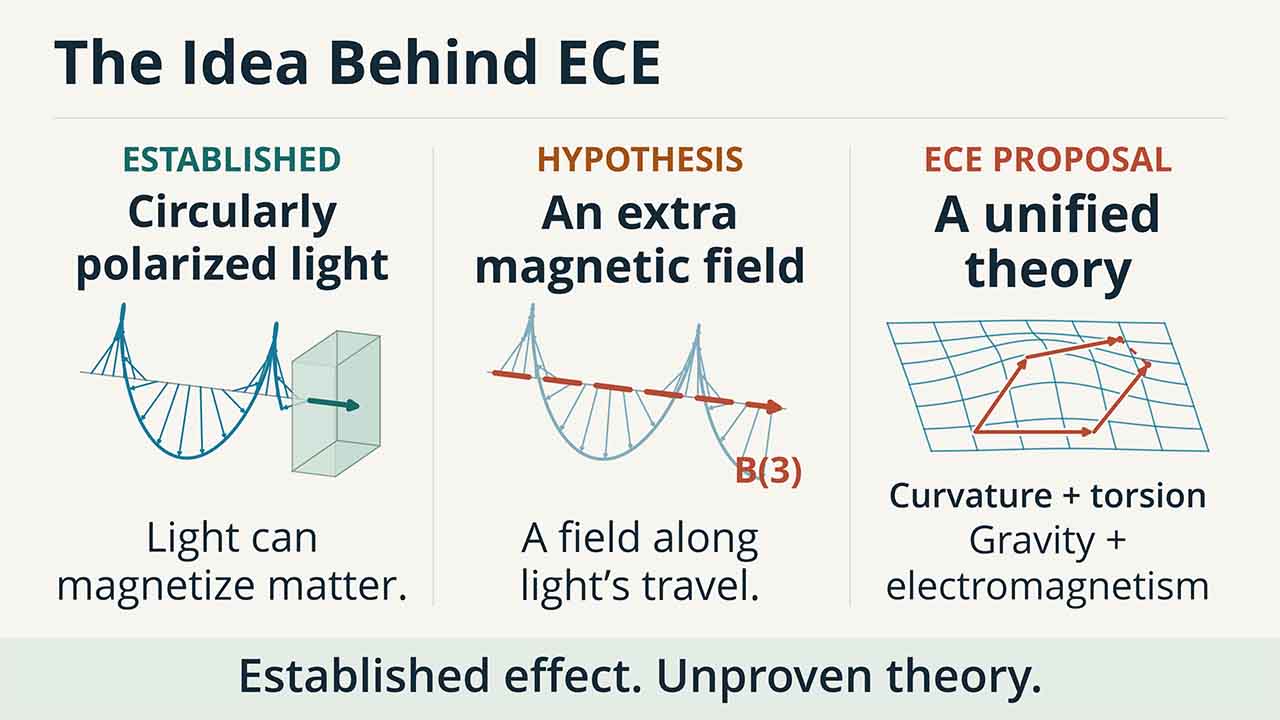
Evans traced his conceptual breakthrough to work at Cornell in 1992. In “The Elementary Static Magnetic Field of the Photon,” published that year in Physica B, he proposed that the photon possessed an intrinsic static magnetic field. The proposed longitudinal component, which became known as B(3), pointed along the direction of propagation. He also suggested a test involving circularly polarized laser light and an electron beam, with a frequency shift in the scattered light that would depend on the incident intensity.
The proposal went beyond the familiar description of a plane electromagnetic wave traveling through vacuum. In Maxwell’s theory, the wave’s electric and magnetic fields are transverse: they point perpendicular to its direction of travel. Circular polarization describes the rotation of the field orientation as the wave advances. It doesn’t require an additional static magnetic field along the propagation axis. Likewise, light-induced magnetization in matter doesn’t by itself demonstrate that a free photon carries the additional field Evans proposed. The observed effect and his interpretation of it were separate scientific questions.
During the 1990s, B(3) became central to Evans’s O(3) electrodynamics, developed through papers and books and pursued with collaborators including Jean-Pierre Vigier. Their work appeared in The Enigmatic Photon series. For Evans, the attraction extended beyond explaining an optical effect: polarization, angular momentum, and magnetism seemed to point toward a deeper rotational structure in nature. An overlooked field in light might be the clue to a larger theory. The next step carried that hypothesis from optics into the geometry of spacetime.
Einstein’s Unfinished Business
General relativity had already demonstrated the power of a geometric description of nature. Einstein connected gravitation with spacetime curvature, but the mathematics also permits another property called torsion. Curvature describes how parallel transport around a loop can change a vector’s direction; torsion can be pictured through the failure of an infinitesimal parallelogram to close. Élie Cartan developed this geometry, and Einstein–Cartan gravity later connected torsion with intrinsic spin. These are precise mathematical structures. The question for Evans was whether torsion could carry an entirely different physical meaning.
ECE’s central claim was that gravitation was associated with curvature while electromagnetism was associated with torsion. Evans tied an extended electromagnetic potential to the coframe, a mathematical description of a local spacetime reference frame. A spin connection described how such frames changed from place to place. His proposal attempted to turn the relationships among these geometrical objects into the relationships among physical fields. Identifying electromagnetic quantities with geometrical ones was the decisive assumption; its validity had to be established through the resulting physics.
The program began appearing in 2003 and soon reached beyond gravity and electromagnetism. Evans introduced a lemma and a generalized wave equation that he said could yield familiar equations, including the Dirac and Schrödinger equations, as limiting cases. He also invoked experiments associated with José R. Croca to argue that the uncertainty principle itself was experimentally wrong. ECE, in his account, would replace quantum indeterminacy with a causal description rooted in geometry. These were Evans’s claims about what the framework could accomplish.
The appeal was the prospect of extraordinary explanatory economy. Einstein had spent decades searching for unification; Evans believed an established branch of geometry supplied the missing structure. He presented the theory as accessible to engineers willing to learn its mathematical language. “One need only master differential geometry.” The confidence was unmistakable. Yet a compact formulation still had to recover measured electromagnetic behavior, supply consistent dynamics and conservation laws, and produce predictions that distinguished it from the theories it aimed to replace.

The Torsion Connection
That emphasis on geometry connected Evans’s ambitions with a wider world of unconventional propulsion research. Russian physicist Gennady Shipov pursued a theory of the physical vacuum involving rotating reference frames, Ricci rotation coefficients, and absolute-parallelism geometry. His work explored relationships among rotation, inertia, and gravitation, attracting interest from researchers seeking new propulsion mechanisms. To readers encountering both programs, the shared language of torsion and moving frames could make Shipov and Evans appear to be pursuing essentially the same theory.
The resemblance required closer examination. Torsion has a precise meaning only after the relevant connection and geometric framework have been specified. Ricci rotation coefficients describe relationships among local frames; their appearance in a calculation doesn’t establish a new physical interaction. A claim that two theories are equivalent requires an explicit correspondence between their fields, equations, sources, and observable predictions. Shared terminology alone can’t supply that correspondence, particularly when the theories assign different physical roles to the structures they use.
In the interview, Evans asserted that the geometrical basics of Shipov’s theory were contained within ECE. Then he acknowledged the limits of his familiarity: “Shipov’s theory appears to be interesting although I know little about it at present,” he said. Elsewhere in the exchange, he again indicated that he hadn’t studied Shipov’s work sufficiently to do it justice. The interview therefore documents Evans’s claim of a connection, together with his own substantial qualification. It doesn’t establish a demonstrated equivalence, a direct collaboration, or Shipov as the original inspiration for ECE.
For propulsion, the distinction between describing rotation and producing an external force is fundamental. Gyroscopes exhibit precession and nutation, and their interactions with bearings, supports, and applied torques can be counterintuitive. Demonstrating propulsion requires accounting for the momentum exchanged with the surroundings. A rotating apparatus must produce a force that survives that accounting before a new theory is needed to explain it. Evans’s interest in Shipov helped connect ECE with these engineering ambitions, but the interview supplied no experimentally established route from their shared geometrical interests to a working propulsion system.
The Generator That Never Arrived
The most recognizable energy device associated with Evans’s earlier work was the Motionless Electromagnetic Generator, or MEG, promoted by Thomas Bearden and collaborators. It used a permanent magnet, a magnetic core with alternative flux paths, input windings, output windings, and electronic switching. The intended operation redirected magnetic flux through the core without moving its physical components. Changes in flux would induce electrical output in the windings. The extraordinary claim concerned the energy balance: the device was supposed to deliver more electrical energy than its external drive supplied.
U.S. Patent 6,362,718 was filed on September 6, 2000, and granted on March 26, 2002. It named Stephen Patrick, Thomas Bearden, James Hayes, Kenneth Moore, and James Kenny as inventors; Evans wasn’t listed. The patent described an oscillator operating at 87.5 kilohertz and reported tests at input voltages between 10 and 75 volts. Its performance figures at 100 volts came from extrapolation. Those details document the proposed apparatus and its inventors’ claims, but the patent provides no independent confirmation of sustained excess-energy production.
Evans helped supply theoretical explanations before the development of ECE. In 2001, he coauthored an explanation using O(3) electrodynamics, while another paper invoked Mendel Sachs’s framework. The chronology places the MEG within the intellectual background of his later energy claims. It also illustrates the importance of the experimental premise. Pulsed magnetic circuits can contain large voltage spikes, circulating reactive energy, and complicated current waveforms. Establishing net output requires measuring real power across every input and output, including the switching electronics, while accounting for changes in stored energy.
By our 2005 interview, Evans was expressing reservations. He said the MEG hadn’t been commercialized and inferred that its reported performance must have been an artifact. “I can only apply ECE theory to data free of artifact,” he added. He didn’t identify a particular measurement error or cite a failed independent test; the absence of commercialization was the reason he gave for his doubt. The passage records his recognition that unreliable experimental premises could undermine a theoretical explanation, even as he continued making much larger claims for ECE’s own technological possibilities.
The Promise of Resonance
Resonance offered a familiar engineering mechanism through which those possibilities might seem attainable. In an electrical resonator, energy moves between the magnetic field of an inductor and the electric field of a capacitor. When the drive matches the system’s resonant behavior, internal voltages or currents can greatly exceed the corresponding drive amplitude. Damping, resistance, loading, and nonlinear behavior constrain the response. The resonator’s quality factor helps characterize its energy storage and losses. Large amplitude magnification is entirely compatible with an ordinary energy balance.
Evans proposed extending that reasoning into spacetime geometry. His UFT paper 52, “Resonance Solutions of the ECE Field Equations,” and paper 53, “Resonant Counter Gravitation,” explored the claimed consequences. He argued that rewriting the field equations as driven differential equations revealed a resonance involving the spin connection. Under the proposed coupling, electromagnetic excitation might generate a greatly amplified gravitational response. That was the theoretical bridge from an abstract unification to gravity control: a modest laboratory drive would supposedly access an effect far larger than conventional gravity calculations suggested.
The experimental claim he offered was startling. Evans said a Mexican group associated with AIAS had observed reproducible gain exceeding 100,000 and that an unnamed party within the U.S. government and military had confirmed it. But the interview didn’t identify the apparatus or define the gain. It could not establish whether the number referred to voltage, current, field amplitude, power, or delivered energy. Nor did it provide the evaluator’s name, test protocol, or measurement records. The figure documented the scale of Evans’s confidence while leaving the underlying engineering result unresolved.
Evans also said his analysis allowed the gain to become infinite. Idealized resonant models can exhibit unbounded growth when damping is omitted, but the driving source still supplies energy. Real devices introduce losses, saturation, heating, and limits on voltage or current. Extracting net energy from spacetime would require a defined physical source and an energy balance showing how the apparatus accessed it. ECE faced an additional hurdle before any of those engineering questions could be settled: critics were asking whether the claimed resonance existed in the equation Evans had actually written.
The Mathematics Begins to Unravel
The objections reached into the theory’s foundations. In a critique first posted in November 2004 and published in 2005, Waldyr A. Rodrigues Jr. and Quintino A. Gomes de Souza challenged the derivation of the Evans lemma. Their analysis concerned the tetrad postulate and the treatment of derivatives acting on different mathematical objects. This mattered because Evans used the lemma to build his generalized wave equation. If that derivation failed, the claim that established quantum equations emerged naturally from ECE lost a central part of its mathematical support.
Friedrich Hehl examined the proposed identification of electromagnetism with torsion. An ordinary electromagnetic field has six independent components in four-dimensional spacetime; a general torsion tensor has 24. Those are algebraic component counts, not counts of independently propagating physical degrees of freedom. Adding components isn’t automatically inconsistent, but a theory must explain their physical meaning and recover the fields that experiments measure. Hehl argued that Evans’s construction failed to provide a consistent account of ordinary electric charge and an appropriate limit reproducing Maxwell electrodynamics.
Gerhard Bruhn also challenged the claimed Lorentz behavior of the earlier O(3) relations. Hehl and Yuri Obukhov took a further step by constructing a variational formulation of Evans’s proposal and deriving its dynamics. In the source-free case, under the action and physical coupling assumptions they specified, torsion vanished and the model reduced to Einstein’s vacuum equations. The result concerned that reconstruction and those assumptions; their discussion allowed spin-carrying matter to produce torsion. Even with that qualification, the proposed geometrical carrier of electromagnetism had disappeared in the vacuum model they analyzed.
The resonance claim received its own direct challenge. In a 2008 paper in Acta Physica Polonica B, Bruhn, Hehl, and Arkadiusz Jadczyk obtained an exact solution of the particular differential equation Evans used and showed that it didn’t contain the infinite resonance peaks he claimed. The criticism struck at the mechanism supporting his energy and gravity proposals. Evans and AIAS disputed the analyses and published rebuttals. But ECE now faced explicit objections to its foundational derivation, its electromagnetic interpretation, and the mathematical behavior invoked to justify its most dramatic applications.
The Journal Closes the Debate
The publication record gave the dispute unusual significance. Foundations of Physics Letters had provided space for an ambitious series of papers proposing a generally covariant unification. For supporters, that visibility helped establish ECE as a program worth taking seriously. Publication also exposed the work to specialists able to inspect its assumptions and derivations. As their criticisms accumulated, the central issue became whether the published framework could survive the detailed scrutiny that an alternative to established physics required.
Gerard ’t Hooft’s editorial note appeared online on October 18, 2007, and in the January 2008 issue of Foundations of Physics, which had absorbed Foundations of Physics Letters. It referred to the 15 papers published between 2003 and 2005 and introduced critical analyses by Bruhn, Hehl, and Hehl with Obukhov. The technical objections came from those researchers’ work. The editorial gave their findings a formal consequence within the journal that had inherited the earlier publication record.
According to the note, Evans declined an invitation to respond in the journal and referred readers to his website. Taking the critics’ findings into account, ’t Hooft concluded further discussion of ECE unless strong arguments justified reopening it. That was an editorial closure, with an explicit possibility of reconsideration. It wasn’t a formal retraction of the earlier papers. Their continued presence in the literature preserved both the original claims and the record against which the criticisms could be assessed.
AIAS continued to defend ECE and maintain responses to its critics. The divide was becoming entrenched: supporters regarded the geometrical program as a major advance, while the published assessments identified problems with its basic construction. ECE’s rise had been a rise in ambition, output, and academic visibility. The editorial episode damaged its prospects of achieving wider acceptance. The dramatic reversal lay in a theory gaining access to a scientific journal and then confronting a published judgment that its foundations didn’t support its claims.
The Experiment That Looked for B(3)
The original optical hypothesis offered another way to examine the program. Evans’s 1992 paper had proposed an interaction between circularly polarized light and electrons, with a measurable frequency shift in the scattered light. A later electron experiment would address a related B(3) prediction through a different observable. That distinction matters: the proposed optical test and the subsequent microwave experiment weren’t the same procedure. They nevertheless concerned the physical consequences attributed to the additional magnetic field that had helped launch Evans’s work.
In 2009, Karel Jelínek, Jiří Pavlů, Jaromír Havlica, and Jan Wild reported an electron-trajectory test in Foundations of Physics. They used continuous circularly polarized microwaves at 2.45 gigahertz and intensities up to 200 watts per square meter. The frequency corresponds to a free-space wavelength of about 12.2 centimeters. They looked for changes in the motion of free electrons associated with the predicted B(3) interaction. The experiment brought a specific consequence of the theory into contact with a measurable laboratory response.
They detected no B(3) signal. Under their experimental interpretation, the authors concluded that any such field would have to be at least four orders of magnitude smaller than the prediction being tested—a factor of 10,000. This was an upper bound from a null result, rather than a measurement of a weaker field. It challenged the proposed interaction under the tested conditions. Its scope was specific, but its historical significance was considerable: an experimentally accessible prediction associated with the program’s original magnetic-field idea had failed the test.
The current AIAS response disputes the chosen observable, arguing that researchers should look for frequency-tuned microwave absorption rather than changes in electron trajectories. It also describes B(3) as appearing in magnetizable matter rather than in waves traveling through vacuum. That position narrows the physical claim and makes comparison with established material responses essential. Light-induced magnetization remains a real phenomenon. Demonstrating a new theory would require a distinct, quantitative prediction that ordinary explanations of the inverse Faraday effect couldn’t already account for.
What Survives the Fall
Evans died in May 2019, but his research program continued. Horst Eckardt and other collaborators developed further versions of ECE, and the AIAS archive grew to more than 450 numbered entries, including papers and textbooks. The institute remained active into 2026. That continuity preserves a substantial record of the program’s evolution and its supporters’ responses. It also means that later formulations must be judged on their own equations and predictions, with their differences from the versions criticized in the 2000s made explicit.
Torsion itself remains part of serious theoretical research. Einstein–Cartan gravity investigates how intrinsic spin can source it, and other geometric approaches explore different relationships among spacetime, matter, curvature, and torsion. Those programs have their own mathematical foundations and empirical questions. Their existence gives a future researcher a substantial body of work to study, while providing no automatic validation of Evans’s identification of electromagnetism with torsion. The broader subject survives because the mathematical possibilities extend well beyond ECE.
For a young physicist attracted to Evans’s original intuition, the useful starting point would be a sharply defined question about light, spin, and geometry. A new proposal would need consistent field definitions, a derivation of established behavior in the appropriate limits, and a prediction that differs measurably from existing theory. An energy device would need complete power accounting; a propulsion device would need a convincing momentum balance. Those requirements give an ambitious idea a route toward evidence and expose the places where an appealing analogy hasn’t yet become a physical mechanism.
Evans believed a hidden magnetic field in light had opened a path toward unifying nature and transforming technology. The ensuing work produced an extensive archive, remarkable promises, and a controversy that reached the pages of established physics journals. Its failure to secure its mathematical foundations or demonstrate the promised breakthroughs is central to its history. Someone may yet discover a deeper connection among light, spin, and gravity. To succeed where ECE didn’t, that connection will have to make its mathematics and its measurements agree.
References
Biographical and Historical Sources
- College Record 2020 — Wolfson College, Oxford, p. 39; College Archivist Liz Baird’s account of Evans’s fellowship, scientific awards, and death.
- Civil List Pension Documents — Royal warrant and government correspondence concerning Myron Evans’s Civil List pension, 2004–2005.
- Myron W. Evans: Omnia Opera — Collected bibliography of Evans’s papers, books, and other scientific publications.
Origins of the Theory and Its Geometrical Background
- Optically-Induced Magnetization Resulting from the Inverse Faraday Effect — J. P. van der Ziel, P. S. Pershan, and L. D. Malmstrom, Physical Review Letters 15, 190–193 (1965).
- The Elementary Static Magnetic Field of the Photon — M. W. Evans, Physica B 182, 227–236 (1992).
- The Enigmatic Photon, Volume 2: Non-Abelian Electrodynamics — Myron Evans and Jean-Pierre Vigier, Kluwer Academic Publishers (1995).
- A Generally Covariant Field Equation for Gravitation and Electromagnetism — M. W. Evans, Foundations of Physics Letters 16, 369–377 (2003).
- Einstein–Cartan Theory — Andrzej Trautman, Encyclopedia of Mathematical Physics (2006); author’s preprint.
- Foundation of the Mechanics of Oriented Point — Mariya Trukhanova and Gennady Shipov, arXiv:1702.02561 (2017).
Energy Claims, Resonance, and the Motionless Electromagnetic Generator
- Motionless Electromagnetic Generator — U.S. Patent 6,362,718 — Stephen L. Patrick, Thomas E. Bearden, James C. Hayes, Kenneth D. Moore, and James L. Kenny; filed September 6, 2000, and granted March 26, 2002.
- Explanation of the Motionless Electromagnetic Generator with O(3) Electrodynamics — P. K. Anastasovski et al., including M. W. Evans, Foundations of Physics Letters 14, 87–94 (2001).
- Explanation of the Motionless Electromagnetic Generator by Sachs’s Theory of Electrodynamics — P. K. Anastasovski et al., including M. W. Evans, Foundations of Physics Letters 14, 387–393 (2001).
- Resonance Solutions of the ECE Field Equations — M. W. Evans, UFT Paper 52; Generally Covariant Unified Field Theory, vol. 3, chapter 8, pp. 109–128 (2006).
- Resonant Counter Gravitation — M. W. Evans, UFT Paper 53; Generally Covariant Unified Field Theory, vol. 3, chapter 9, pp. 129–152 (2006).
Mathematical Criticism and the Journal Controversy
- An Ambiguous Statement Called “Tetrad Postulate” and the Correct Field Equations Satisfied by the Tetrad Fields — Waldyr A. Rodrigues Jr. and Quintino A. Gomes de Souza, International Journal of Modern Physics D 14, 2095–2150 (2005); revised author’s preprint.
- On the Non-Lorentz-Invariance of M. W. Evans’ O(3)-Symmetry Law — Gerhard W. Bruhn, Foundations of Physics 38, 3–6 (2008).
- An Assessment of Evans’ Unified Field Theory I — Friedrich W. Hehl, Foundations of Physics 38, 7–37 (2008); author’s preprint.
- An Assessment of Evans’ Unified Field Theory II — Friedrich W. Hehl and Yuri N. Obukhov, Foundations of Physics 38, 38–46 (2008); authors’ preprint.
- Comments on “Spin Connection Resonance in Gravitational General Relativity” — Gerhard W. Bruhn, Friedrich W. Hehl, and Arkadiusz Jadczyk, Acta Physica Polonica B 39, 51–58 (2008).
- Editorial Note — Gerard ’t Hooft, Foundations of Physics 38, 1–2 (2008); published online October 18, 2007.
Experimental Testing and the Continuing ECE Program
- Experimental Test of the Evans’ B(3)-Field: Measuring the Interaction with Free Electrons — Karel Jelínek, Jiří Pavlů, Jaromír Havlica, and Jan Wild, Foundations of Physics 39, 1191–1196 (2009).
- A Discussion of Criticisms of ECE Theory — Alpha Institute for Advanced Studies; the institute’s responses to mathematical and experimental criticism.
- Unified Field Theory Papers — Alpha Institute for Advanced Studies; the numbered archive of ECE papers, textbooks, and subsequent developments.
- AIAS News and Updates — Alpha Institute for Advanced Studies; announcements documenting the continuing research program.