

Tesla’s Death Beam: A 50-Million-Volt Promise to End War
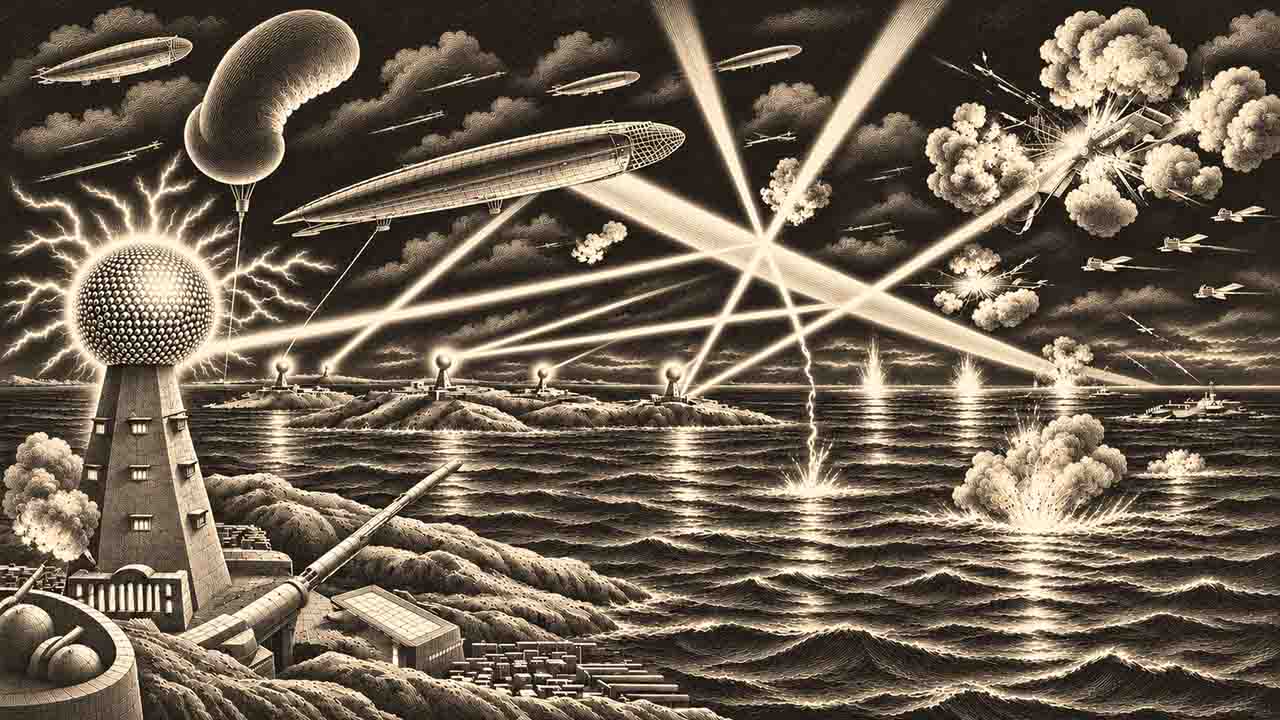
Nikola Tesla believed a beam of microscopic particles could destroy aircraft 250 miles away and make war impossible. His proposal drew foreign interest and a paid disclosure agreement; decades later, laboratories demonstrated that electrically accelerated dust could reach extraordinary speeds. The unresolved challenge was delivering that energy through ordinary air.
A Death Beam Designed to End War
Nikola Tesla had just turned seventy-eight when he described his latest invention to a reporter at the Hotel New Yorker. The account appeared in The New York Times on July 11, 1934, carrying an extraordinary claim: a defending nation could bring down 10,000 enemy aircraft at a distance of 250 miles. Large generating stations would stand along national borders, projecting concentrated streams of particles toward approaching forces. Tesla presented the apparatus as a means of making invasion futile. The announcement offered a technological answer to a political problem that had already consumed a generation: how could another catastrophic war be prevented?
Tesla’s answer rested on the prospect of overwhelming defense. If even a small country could make its borders impenetrable, superior armies and larger fleets would lose their power to intimidate it. He argued that the generating stations would be too large and immovable to support offensive campaigns, although he allowed for smaller installations aboard battleships. That exception exposed a weakness in the strategic argument. A weapon’s purpose depends on where it’s deployed and who controls it. John J. O’Neill, Tesla’s later biographer, recognized the problem: a system offered as protection could also give its purchaser a powerful instrument of coercion.
The popular name “death ray” made the machinery sound simpler than it was. The proposal associated with Teleforce concerned electrically accelerated particles, which later investigators interpreted as microscopic pieces of solid matter. That would make it a machine for projecting material at extreme speed. Tesla’s wireless power projects and his remotely controlled devices shared parts of his electrical vocabulary, but they posed different engineering problems. Teleforce’s defining challenge was to put energy into particles and preserve a useful concentration of that energy during a long passage through the atmosphere. Whatever happened inside the generator, the beam would eventually have to contend with the world outside it.
A successful system would therefore need to accomplish several things in sequence. It would have to supply power, charge and accelerate particles, release them into the air, and deliver a predictable effect at a distant target. Performance at one stage wouldn’t automatically establish performance at the next. A spectacular electrical potential could coexist with a modest energy output; a fast particle could lose most of its energy long before arrival. Those distinctions give Tesla’s proposal a more concrete history than its nickname suggests. They also explain why its component ideas remained interesting long after Tesla’s death.
Four Engineering Problems in One Machine
The 1992 reconstruction treats Teleforce as a macroparticle accelerator. “Macroparticle” is a relative term: a dust grain is enormous compared with an electron or an individual ion, even when it’s too small to see. In their paper, K. L. Corum, James Corum, and J. F. X. Daum called these projectiles “macrons” and described a proposed stream moving at roughly 16 kilometers per second. Their interpretation relies on a familiar physical process. A conducting grain can acquire an electrical charge, allowing an electric field to accelerate the grain as a whole. Its constituent atoms travel together as a tiny material projectile.
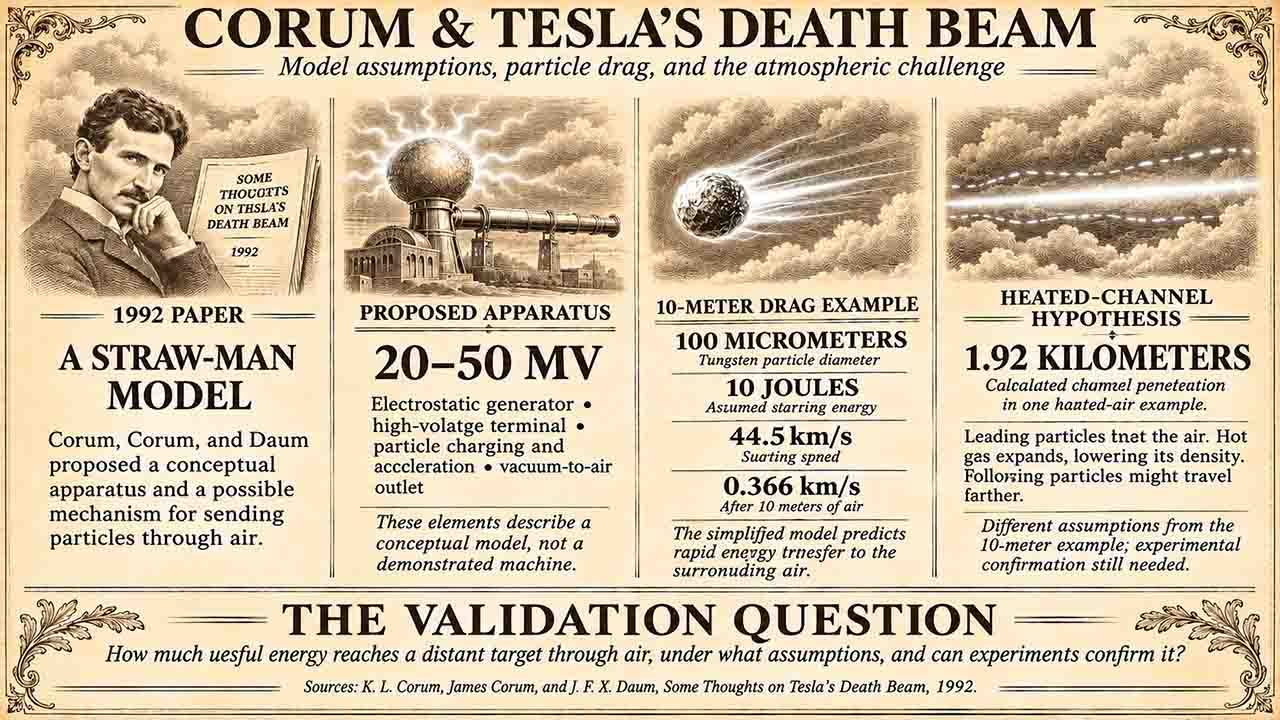
The authors organized the apparatus around four functions: projecting particles from a chamber connected to the atmosphere, imparting a substantial electrical charge, supporting an extreme voltage without breakdown, and supplying adequate power. Their reconstruction placed the generator in the 20–50-megavolt range. Voltage, however, describes an electrical potential difference; it doesn’t by itself specify the energy delivered by the entire stream each second. That also depends on the charge transported and the number of particles accelerated. A machine capable of reaching millions of volts can still have limited sustained output. The distinction between high voltage and high power sits near the center of the Teleforce problem.
For an individual grain, the amount of charge relative to its mass helps determine how strongly it responds to an electric field. Increasing the charge encounters physical limits. At sufficiently intense surface fields, charge can escape through field emission, constraining the particle’s charge-to-mass ratio. Andrew Higgins discusses this limitation in his analysis of dust acceleration for spaceflight research. The apparatus faces its own insulation and discharge problems, while the grain must retain the charge needed for acceleration. Tesla’s high-voltage terminal ideas, including those in US Patent 1,119,732, gave later investigators material to examine, but a terminal’s voltage and a projectile’s final performance remain separate quantities.
The connection to outside air creates another difficulty. A low-pressure region helps limit collisions and unwanted discharges during acceleration, yet an atmospheric beam needs an exit. Tesla described an open-ended vacuum arrangement that the 1992 authors interpreted through differential evacuation and flowing gas. They also connected its gas-handling function to his valvular-conduit patent, US 1,329,559, which describes a passage offering different resistance to flow in opposite directions. The challenge was to preserve useful vacuum conditions while maintaining an atmospheric outlet. That joins accelerator physics to pumping and fluid dynamics: changes in gas flow can alter the electrical environment in which the particles acquire their charge.
The Soviet Agreement and the British Correspondence
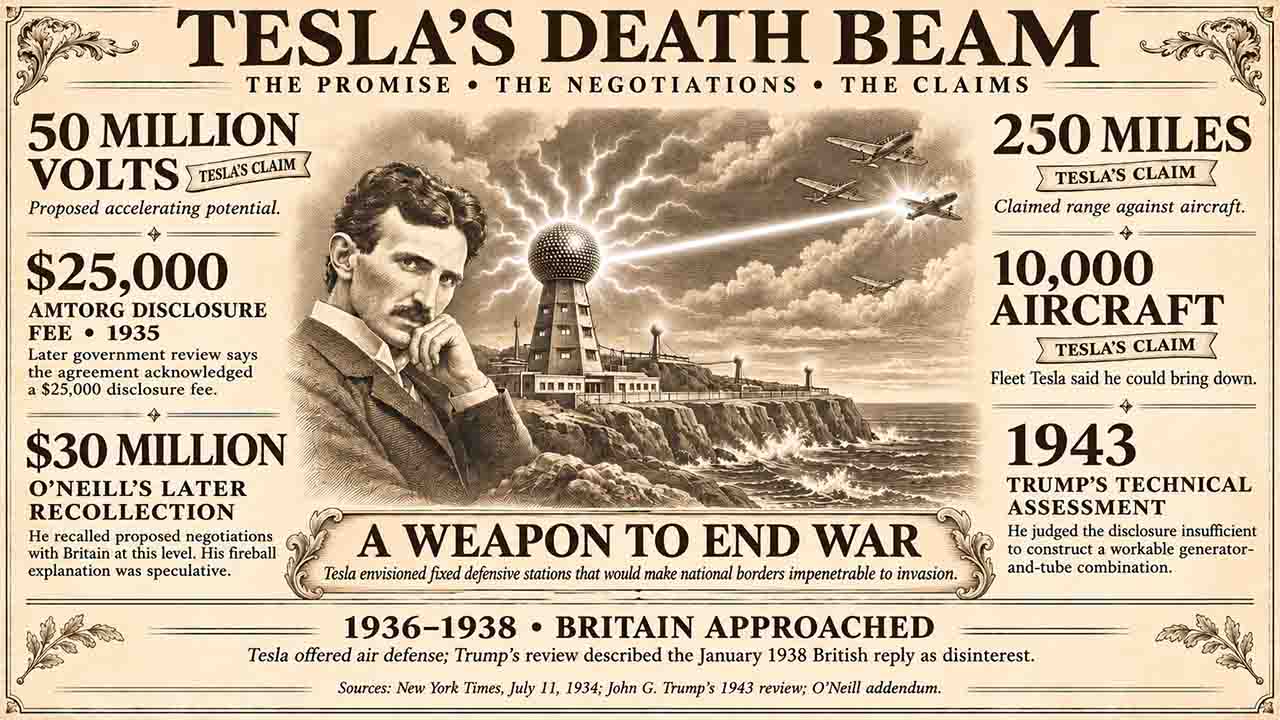
Tesla’s efforts to sell the proposal produced a record more substantial than publicity alone. A 1943 examination of his papers by MIT electrical engineer John G. Trump describes an agreement dated April 20, 1935, between Tesla and Amtorg Trading Corporation. It acknowledged receipt of $25,000 for technical disclosure. The promised specifications included potentials up to 50 million volts, particle projection over at least 100 miles, and a maximum particle speed of no less than 350 miles per second. Those details survive in Trump’s official abstract of the agreement. The payment concerned the disclosure of technical information, so it establishes a commercial transaction without establishing the promised performance.
The exchange continued after the initial agreement. Trump’s inventory identifies a November 8, 1935 reply in which Tesla addressed questions from Soviet engineers and scientists about a proposal dated May 16. The questions show that the disclosure received technical attention. Trump later concluded that it proved unworkable, although his assessment isn’t a recovered Soviet experimental report. The speed figures also vary dramatically across accounts. The agreement’s promised maximum of at least 350 miles per second is approximately 563 kilometers per second, far beyond the roughly 16 kilometers per second described in the later reconstruction. These are different claims about capability, rather than interchangeable measurements of one established machine.
Britain received a series of approaches between August 1936 and April 1938. According to the estate review, Tesla offered disclosure of a method for accelerating minute particles to protect the country against air attack. The correspondence included letters dated October 26 and December 15, 1937, and a British reply dated January 7, 1938, which Trump characterized as a polite expression of disinterest. Tesla’s follow-up letters sought to clear up misunderstandings and secure acceptance. The exchange captures the practical difficulty behind the promise. He needed officials to commit resources to an unfamiliar system on the strength of the information he was prepared to disclose.
O’Neill remembered an even larger financial ambition. In his account, Tesla spoke of negotiations to sell Britain the system for $30 million, believing it could protect the British Isles and alter Europe’s strategic balance. The figure comes from the biographer’s recollection of what Tesla told him; the surviving correspondence abstract doesn’t confirm that price or a purchase agreement. O’Neill also recalled the inventor’s disappointment when the negotiations collapsed. With the funding went an opportunity to demonstrate what Tesla considered some of his most important discoveries. Even in this sympathetic account, the decisive demonstration belonged to a project he still hoped to finance.
Accelerating Dust into the Space Age
By the early 1960s, laboratory physicists had demonstrated that electrically accelerated dust could reach extraordinary speeds. Shelton, Hendricks, and Wuerker published electrostatic microparticle-acceleration research in 1960. J. F. Friichtenicht’s 1962 paper described a two-million-volt accelerator that sent iron particles to about 14 kilometers per second. NASA’s December 1965 report, Investigation of High-Speed Impact Phenomena, collected this work in the context of micrometeoroid research. Spaceflight had created a practical need to understand the collision of tiny, fast-moving objects with spacecraft surfaces. Accelerated grains allowed researchers to investigate those collisions under controlled conditions and connect an impact to the properties of the incoming particle.
The University of Colorado’s IMPACT facility provides a contemporary comparison. Its three-megavolt accelerator reports particle diameters spanning approximately 0.03–2 micrometers and velocities spanning 0.5–115 kilometers per second. These ranges cover different particles; they don’t mean that every particle size achieves the highest reported speed. The beamline operates at pressures in the low 0.0000001-torr range, removing most of the gas that would otherwise collide with the grains. The measured velocities describe performance within that controlled environment.
Throughput provides another measure. Colorado reports typical target arrival rates of approximately 0.5–1 particle per second without selection. Choosing particles traveling at least 10 kilometers per second reduces the rate to around 5–10 per minute. These are operating figures for a particular scientific facility, not universal physical limits. They illustrate why maximum velocity, particle mass, and sustained delivery must be considered separately. For a researcher, individually identifiable arrivals can be ideal. They allow a particular impact to be connected to a particular incoming grain.
The scientific value extends beyond producing dramatic collisions. Such experiments help investigate micrometeoroid effects and calibrate instruments used in space. Their relevance to Tesla is equally specific: they establish that electrostatic acceleration can put substantial speed into microscopic material particles. His proposed defensive system added a much longer atmospheric journey and a demand for a useful effect at its far end. That required the particles’ survival, trajectories, and cumulative energy delivery to be established as well. The laboratory work makes the concept worth examining because it supplies measured evidence for one part of the chain, along with a clear view of the conditions supporting that evidence.
Reconstructing Tesla in 1992
Corum, Corum, and Daum brought these strands together in Some Thoughts on Tesla’s Death Beam. Their sixteen-page paper assembled Tesla documents, patents, newspaper accounts, accelerator research, and hypervelocity-impact literature into a proposed interpretation of the machine. They called it a “straw-man” model, signaling an explanation to be analyzed rather than a recovered set of complete manufacturing drawings. The underlying proposal was already documented in 1935, although the authors discussed a memorandum they dated to 1937. Their contribution was to ask how the components described in that material might fit within later engineering knowledge—and what additional physics would be needed to achieve the advertised result.
The most consequential part of their reconstruction concerned the atmosphere. Leading particles would surrender energy to the gas along their path, heating it and causing it to expand. That expansion could lower the density encountered by particles arriving afterward. A continuing stream might therefore modify its own propagation environment: some particles would transfer energy to the air, potentially allowing others to travel farther through the disturbed region. The authors connected this idea to Tesla’s observations of successive electrical discharges at Colorado Springs. Their use of “tunneling” referred to passage through a developing gas channel, a process involving ordinary fluid dynamics and plasma physics.
The attraction of the idea is easy to understand. Air resistance would no longer be treated solely as a loss; some of the deposited energy might create conditions favorable to later particles. The difficulty is that a heated channel changes with time. Its density, width, pressure, and position evolve as gas moves, and the following particles must encounter the useful part of that changing structure. The paper calculated a penetration distance of approximately 1.92 kilometers in one hypothetical example. That result depends on the assumed interaction between the stream and the gas. It was a prediction from the model, with no accompanying demonstration of a sustained atmospheric channel.
At the target, the authors explored an analogy with hypervelocity jets. This introduced another set of assumptions about how a stream of separate particles would behave collectively. A dense jet has a spatial organization and flow behavior that a dispersed collection of grains doesn’t automatically share. The relevant quantities include how much material arrives, how tightly it’s concentrated, and how its impacts overlap in time and space. The authors acknowledged that effective parameters for their jet analogy would require experimental determination. The reconstruction thus identified two major transitions that needed evidence: passage through a self-modified atmosphere and conversion of the arriving stream into the proposed target effect.
When the Death Beam Meets Air
The paper’s own drag calculation shows why atmospheric propagation dominates the problem. Its hypothetical example begins with a tungsten sphere 100 micrometers in diameter, assigned an initial kinetic energy of 10 joules. Under the stated assumptions, that corresponds to a starting speed of approximately 44.5 kilometers per second. After ten meters through ordinary air, the calculated speed falls to about 366 meters per second. The model therefore loses most of its spectacular initial velocity over a very short distance. Launch performance is only the beginning of the problem; the surrounding gas determines how much of that motion remains available farther along the path.
The proposed channel uses energy deposited in the air, but the heating calculation reveals the limitations of a simplified treatment. For the first meter, the paper obtains a temperature rise exceeding 600,000 kelvin. At that inferred temperature, a fixed heat capacity for ordinary air isn’t an adequate description. Molecules dissociate, atoms ionize, radiation transports energy, and expansion changes the gas density. Energy goes into these processes as well as into raising temperature. The quoted figure is an output of an idealized model, not a measured plasma temperature. It points toward a coupled problem in which particle motion and gas behavior have to be followed together.
Experiments on artificial micrometeoroids demonstrate another distinction: a grain’s survival and its speed are different questions. In a 2016 study, Evan Thomas and colleagues examined iron particles traveling at 20–90 kilometers per second. In their selected data at gas pressures above 15 millitorr, the particles completely ablated, losing their identity as solid grains. Charge measurements and the absence of a terminal impact signal supported that finding. Numerical simulations indicated less than a ten-percent speed change under the analyzed conditions. The material could remain fast even as the solid projectile disappeared. These experiments used different particles and conditions from the tungsten example, but they show why velocity alone can’t describe the delivered beam.
Ablation also changes what the downstream system must handle. The stream can evolve from solid grains into vapor and ionized material, with different interactions with its surroundings. Collisions and disturbances in the gas can spread trajectories, while particles carrying like charges tend to repel one another. A region of reduced air density doesn’t automatically act as a focusing system. Nor does energy transferred to a luminous gas necessarily remain available as the intended impact at a distant surface. The central engineering question is whether the whole stream retains the properties needed for its purpose after these interacting processes have acted on it.
The Missing Chapter and the Fireballs
A different explanation entered the history through O’Neill’s recollections. A text attributed to him, “Tesla Tries To Prevent World War II,” circulated as the unpublished Chapter 34 of his 1944 biography, Prodigal Genius. The publication trail cited by the Corums leads to TCBA News in 1988. The chapter connects Tesla’s defensive ambitions to luminous electrical fireballs, revealing how another interpretation developed around the inventor’s guarded statements. O’Neill wanted Tesla to develop a commercially useful part of his work that could earn money for larger investigations. He pressed for details, hoping to identify an opportunity that could turn the inventor’s ideas into a practical enterprise.
Fireballs particularly fascinated him. O’Neill recalled Tesla describing destructive luminous phenomena produced accidentally during the Colorado Springs experiments of 1899, including incidents that damaged equipment. Tesla’s January 3, 1900 notes discuss luminous discharge phenomena and successive discharges passing through disturbed air. Those contemporary observations help explain the later interest in electrical channels and unusual discharges. O’Neill’s account adds remembered conversations about their violence and possible significance. The combination is suggestive, but the physical subjects remain distinct: an electrical discharge, a microscopic projectile, and a system for delivering energy over long distances each require their own explanation.
O’Neill speculated that electrical excitation could produce destructive fireballs aboard a distant vessel. His proposed mechanism involved interactions among oscillations at different frequencies, drawing on what he remembered of Tesla’s descriptions. He repeatedly identified the explanation as his own deduction from scattered remarks and admitted, “I could be completely wrong.” He also stated that he had no evidence this was the process Tesla had developed. That candor is central to the chapter. It preserves a hypothesis formed by a curious biographer, while the Corums’ reported laboratory fireball work represents a later attempt to investigate electrical phenomena. Neither establishes that fireballs were Teleforce’s operating mechanism.
The circulating chapter also carries signs of an imperfect historical transmission. It describes Stanley Baldwin replacing Neville Chamberlain as prime minister; Chamberlain actually succeeded Baldwin in May 1937, and Churchill followed Chamberlain in 1940. A footnote cites a 1998 book, showing that the copy contains later editorial material. These details affect the weight that can be placed on its chronology and technical deductions. Its strongest contribution is the human picture it preserves: Tesla guarding information, seeking financing, and believing an electrical invention might avert another war. O’Neill’s account explains how those hopes became intertwined with phenomena he found compelling but couldn’t fully establish.
The Wartime Examination
After Tesla’s death, evaluating his late work became a practical wartime assignment. The Office of Alien Property Custodian held materials from his effects, and John G. Trump examined papers and apparatus at the Manhattan Warehouse on January 26–27, 1943. His report followed on January 30. The questions were whether the collection contained something useful to the American war effort or dangerous in unfriendly hands. The later presence of correspondence about the episode in FBI files helped blur the distinction between investigation and custody. The FBI has stated that it didn’t search Tesla’s effects or possess his original papers.
Trump’s abstract of the “New Art” memorandum described an electrostatic generator and an open-ended evacuated acceleration tube. He identified the accelerated particles as “presumably electrons.” The later Corum reconstruction instead centered on charged grains containing many atoms. That discrepancy is technically meaningful because electrons and material particles interact differently with gas and targets. Identifying the proposed carrier is fundamental to assessing the apparatus. Trump’s interpretation therefore raises a specific question about how he understood the disclosure, although resolving that question wouldn’t by itself establish the performance of a complete atmospheric system.
His conclusion was strongly unfavorable. Trump judged the memorandum insufficient to enable construction of a workable generator-and-tube combination, even at limited power. More broadly, he described much of Tesla’s work during the preceding fifteen years as “speculative, philosophical, and somewhat promotional.” This was an assessment by a technically qualified reviewer examining a particular collection for a defined military purpose. Later authors disputed it and questioned his relationship to competing electrostatic-generator research. Those disagreements are most useful where they identify a technical misunderstanding or an overlooked document. Professional rivalry, even if demonstrated, wouldn’t supply the missing performance measurements.
The review also had a stated limit. Trunks that had remained untouched in the New Yorker Hotel basement for approximately ten years weren’t investigated. Trump’s conclusion consequently can’t stand as an examination of every item Tesla ever produced. The unexamined trunks, in turn, don’t identify their own contents as a missing weapon. What the review does preserve is unusually valuable: a dated account of proposals, correspondence, an agreement, and the apparatus the examiner encountered. Its abstracts provide some of the most concrete evidence of Tesla’s foreign negotiations, even as its conclusions challenge the technical promises behind them.
What Remains of the Death Beam
The surviving record gives Tesla’s proposal a substantial foundation as a historical engineering project. He advanced a method for electrically accelerating particles, sought foreign support, and entered a paid disclosure arrangement recorded in the estate review. Later laboratories demonstrated that microscopic material grains could acquire extreme velocities through electrostatic acceleration. The 1992 reconstruction connected that measured physics with Tesla’s descriptions and proposed a mechanism for extending it into the atmosphere. Together, these developments make the idea worth examining on technical terms. They also locate the unresolved achievement precisely: maintaining useful performance across the complete sequence from generator to distant target.
That distinction changes how apparently decisive statements should be read. In July 1937, Tesla declared, “I have built, demonstrated and used it.” In the original newspaper account, he was discussing a tube for atomic experiments; the luncheon included several separate announcements, and no apparatus or sketches were displayed. The 1992 paper cited the statement in its discussion of Tesla’s beam, although the original passage concerns the tube for atomic experiments. A demonstrated tube, a high-voltage terminal, or an accelerated grain could each represent a meaningful accomplishment. Evidence for a complete defensive system would also need to establish sustained output, atmospheric range, and effects under independently recorded conditions.
The engineering burden grows because the requirements interact. Increasing the energy deposited in air changes the medium through which subsequent particles must travel. Ablation changes the form of the delivered material. Electrical repulsion and gas motion can change its concentration, while the target response depends on what ultimately arrives. A successful experiment at one stage can’t simply be added to a successful experiment elsewhere and assumed to produce a working whole. The most useful legacy of the technical reconstruction is that it turns a spectacular promise into identifiable physical questions, each open to calculation and measurement.
Tesla imagined border stations that would make invasion so costly that war would cease to be a rational choice. His proposal placed enormous confidence in the ability of electrical engineering to settle a human conflict. The history that followed contains real agreements, serious physical ideas, and experiments that demonstrated part of what he envisioned. It also reveals how much was demanded of the unseen space beyond the machine. Between a particle leaving an accelerator and the promise of an impenetrable national border lies the atmosphere it must cross. That passage remains the central test of Tesla’s death beam.
References
Core Source Documents
- Some Thoughts on Tesla’s Death Beam — K. L. Corum, James Corum, and J. F. X. Daum. International Tesla Society, 1992, pp. 183–198.
- Tesla Tries To Prevent World War II — John J. O’Neill. Circulated as the unpublished Chapter 34 of Prodigal Genius; the linked version includes later editorial material.
Contemporary Reporting and Tesla’s Patents
- Tesla, at 78, Bares New “Death-Beam” — The New York Times, July 11, 1934. Reproduced by Tesla Universe.
- Sending of Messages to Planets Predicted by Dr. Tesla on Birthday — The New York Times, July 11, 1937. Reproduced by Tesla Universe.
- Tesla’s Writings — Nikola Tesla Museum. Catalog of Tesla’s writings, including The New Art of Projecting Concentrated Non-dispersive Energy Through Natural Media, dated circa May 16, 1935.
- Apparatus for Transmitting Electrical Energy — Nikola Tesla. US Patent 1,119,732, granted December 1, 1914.
- Valvular Conduit — Nikola Tesla. US Patent 1,329,559, granted February 3, 1920.
Government Records and Historical Context
- John G. Trump’s Letter on the Examination of Tesla’s Papers — January 30, 1943. Describes the examination’s purpose, dates, scope, and excluded materials. Reproduced by Tesla Universe from the Tesla FBI files.
- John G. Trump’s Assessment of Tesla’s Later Work — Continuation of the January 30, 1943 letter. Reproduced by Tesla Universe from the Tesla FBI files.
- Soviet Correspondence and the “New Art” Proposal: Exhibits D and F — John G. Trump’s abstracts of Tesla’s November 8, 1935 reply to Amtorg and his proposal for transmitting concentrated energy through natural media.
- Technical Assessment and British Correspondence: Exhibits F and H — John G. Trump’s evaluation of the proposed apparatus and summary of Tesla’s correspondence with British representatives between 1936 and 1938.
- Amtorg Agreement Abstract: Exhibit Q — John G. Trump’s summary of the April 20, 1935 agreement, including the $25,000 disclosure fee and proposed performance specifications.
- FBI 100: The Top Ten Myths in FBI History — Federal Bureau of Investigation, July 24, 2008. Includes the FBI’s account of its role and the custody of Tesla’s effects.
- History of Neville Chamberlain — UK Government. Historical account of Chamberlain’s premiership and the chronology surrounding his succession to Stanley Baldwin.
Particle Acceleration and Atmospheric Physics
- Investigation of High-Speed Impact Phenomena — J. F. Friichtenicht. Volume I, TRW Systems for NASA, December 1965. Covers electrostatic microparticle acceleration, micrometeoroid simulation, and hypervelocity impacts.
- IMPACT Dust Accelerators — University of Colorado Boulder. Facility description, particle size and velocity distributions, vacuum conditions, and particle arrival rates.
- Measurements of the Ionization Coefficient of Simulated Iron Micrometeoroids — Evan Thomas and colleagues. Geophysical Research Letters, volume 43, pp. 3645–3652, 2016.
- Experimental Simulation of Dust Impacts at Starflight Velocities — Andrew Higgins. Journal of the British Interplanetary Society, volume 71, no. 8, 2018. Discusses electrostatic acceleration and limits imposed by field emission and particle charge.