

Mark McCandlish’s ARV: Was the Flux Liner Electrogravitic?
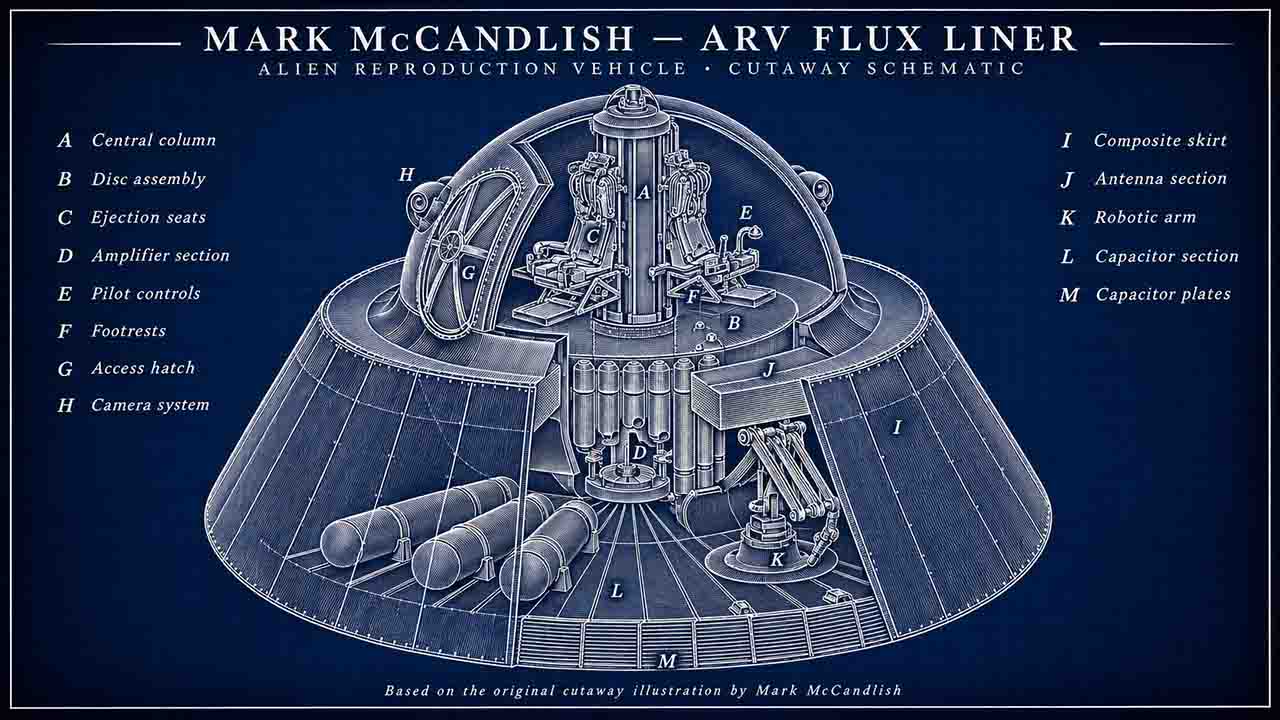
Could the capacitor banks in Mark McCandlish’s Flux Liner ARV explain its alleged antigravity propulsion? His reconstruction places high-voltage electrical hardware at the center of the vehicle, while Thomas Valone proposes a pulsed-electrokinetic explanation for its operation. Comparing their accounts turns a familiar UFO story into an engineering investigation of megavolt potentials, segmented electrodes, pulse timing, and a decisive question: could the proposed system propel an entire spacecraft?
From McCandlish’s Reconstruction to Valone’s Propulsion Hypothesis
The connection appears explicitly in Thomas Valone’s 2008 paper, “Empirical Analysis of Electrogravitics and Electrokinetics and its Potential for Space Travel.” On page 8, Figure 9 reproduces McCandlish’s cutaway under the description of an electrogravitic demonstration vehicle associated with Norton Air Force Base in 1988. Valone compares its radial capacitor arrangement with devices proposed by Jonathan Campbell and Hector Serrano. His argument isn’t simply that the machines look alike. He suggests that changing electrical currents in their capacitor-and-dielectric structures could produce a related directional force.
The drawing’s origin remains important to that interpretation. In a public clarification posted in 2003, McCandlish stated that Brad Sorensen—not McCandlish himself—reportedly saw the vehicles on November 12, 1988. McCandlish developed the reconstruction through subsequent discussions. The historical account, the internal arrangement, and the propulsion explanation therefore occupy different evidentiary levels. A witness reportedly described a machine; an aerospace illustrator reconstructed it; a researcher later proposed how its electrical components might work. None of those steps automatically verifies the next.
Valone’s terminology also distinguishes two possibilities often grouped together as antigravity. In his usage, electrogravitics concerns a proposed electrical interaction involving mass or gravity. Electrokinetics concerns electrically generated motion that needn’t alter either. McCandlish associated the Flux Liner’s high-voltage system with mass reduction, whereas Valone emphasized transient electrical forces. That difference is substantial: a thruster could accelerate a vehicle without changing its mass, and a claim that an object becomes lighter doesn’t, by itself, establish how it would accelerate or steer.
The useful question is consequently narrower than whether the entire ARV narrative is true. Does the reconstructed hardware specify a mechanism that can be tested? Answering that requires following the proposed electrical path—from the source through the switching system and into the capacitor banks—then accounting for forces throughout the assembly. Recognizable components can make a drawing understandable, but the propulsion claim depends on their combined behavior. A force on an electrode or dielectric becomes a spacecraft engine only when the complete vehicle acquires a measurable, controllable change in momentum.
Forty-Eight Capacitor Banks Beneath the Hull
McCandlish’s December 2000 testimony describes the smallest vehicle as approximately 24 feet, or 7.3 meters, across, with a lower assembly about 11–12 inches thick. He reconstructed that base as 48 radial sectors, each containing eight half-inch copper plates. Importantly, he said he determined the sector count through his work as a conceptual artist. These figures describe an early reconstruction, not dimensions obtained by inspecting an authenticated aircraft. They nevertheless provide enough information to begin asking concrete questions about geometry, mass, and electrical connections.
The distinction between stacked electrodes and an operating propulsion unit begins with the wiring. Which plates share a connection? Which gaps receive the full supply voltage? Does the dielectric occupy every gap, and how are neighboring sectors insulated from one another? McCandlish described alternating plate polarities, but ordinary capacitor physics doesn’t allow each adjacent gap to be treated automatically as an identically oriented thruster. In a simple alternating-polarity stack, the electric-field direction reverses between neighboring gaps. Establishing a consistent net force would require a complete explanation of the geometry and current paths, not just positive and negative labels.
The early copper description also implies considerable mass. As an illustrative calculation, eight half-inch layers contain a combined 4 inches, or 101.6 millimeters, of copper wherever the stack is present. At a representative copper density of 8.91 grams per cubic centimeter, that amounts to approximately 905 kilograms per square meter. Extending the layers across an entire 24-foot disc would produce roughly 38 metric tonnes of copper alone. This isn’t an estimate of the actual vehicle’s measured mass: central openings, sector gaps, cutouts, and different materials would change it. It demonstrates how strongly the proposed propulsion requirements depend on the reconstruction’s physical details.
The dielectric—the insulating material separating the electrodes—is equally consequential. Its relative permittivity affects capacitance, while its breakdown strength limits the electrical stress it can withstand. Those aren’t the same property: a material that stores more charge in a given geometry isn’t necessarily the best insulator at extreme voltage. Thickness, temperature, internal defects, surface condition, and repeated electrical cycling also matter. A useful engineering description would identify the material and its operating conditions rather than relying on the broad category of glass, plastic, or ceramic. Without that information, neither energy storage nor operating margins can be established.
Why Valone Thinks the Pulse Matters
Valone’s proposed explanation centers on Oleg Jefimenko’s treatment of electromagnetic induction. Changing currents contribute to electric fields that act on surrounding charges. Valone applies this description to capacitor structures, arguing that a sufficiently rapid current change could produce a strong transient interaction with charges in the dielectric and transfer force to its material structure. The underlying electromagnetic field description belongs to classical physics. The further proposition—that this interaction supplies net propulsion to a complete isolated assembly—is the step his interpretation must establish.
Brown’s reported experiments supplied part of the motivation. Valone reproduces Townsend Brown’s description of suspended apparatus operated at 75–300 kilovolts. Brown reported that the assembly reached maximum displacement in less than five seconds, then returned toward its starting position over approximately 30–80 seconds, even while the voltage remained applied. Valone interprets the transient behavior as a reason to examine charging dynamics rather than voltage alone. Those seconds-long movements, however, don’t identify the rise time or shape of the electrical excitation. Establishing the relationship would require synchronized electrical and mechanical measurements that the historical description doesn’t provide.
Applied to the ARV, the hypothesis becomes more specific. In Figure 11 of his 2015 review, Valone describes a distributor energizing three equidistant capacitor banks at a time. Three equally spaced locations would lie 120 degrees apart. Assuming 48 equally sized sectors, each would occupy 7.5 degrees, placing those three active locations 16 sectors apart. Those angles follow from the proposed geometry; they aren’t recovered operating specifications. They describe how a symmetrical firing sequence might be organized, while leaving unanswered the force produced by each bank, the pulse frequency, and the reason that particular sequence would be effective.
Valone also discusses shaped waveforms intended to favor one force direction during 75 percent of a cycle. The essential engineering test is the total impulse over the complete cycle, not simply the fraction of time a force points in the desired direction. A short opposing pulse could cancel a longer favorable one if it were sufficiently strong. Charging, discharging, return currents, and forces on the remaining components must all enter the accounting. Valone acknowledges the quantitative gap in his 2008 paper: more detailed information is needed to calculate the proposed forces and compare them with experiments.
What 1.25 Million Volts Does—and Doesn’t—Tell Us
The voltage associated with the Flux Liner evolved in McCandlish’s public explanations. His early testimony estimated approximately 500,000 to 1,000,000 volts. In the later APEC discussion covered in AltSci’s original reverse-engineering feature, he described capacitor charging above approximately 1.25 million volts, associating it with an alleged reduction in mass. That is a claimed operating condition, not a measured performance curve. No voltage trace accompanying the reconstruction shows the onset, magnitude, or repeatability of such an effect.
Voltage becomes more informative when combined with distance. Consider an explicitly hypothetical example: 1.25 million volts across a 25-millimeter insulating gap would produce an average electrical field of 50 million volts per meter, assuming a uniform field. Local conditions near edges, connectors, and material interfaces could differ substantially. The 25-millimeter gap isn’t an established ARV dimension; it illustrates why a voltage number alone can’t define the electrical stresses. The same supply voltage distributed across several series-connected gaps would produce different conditions from that voltage appearing across every individual gap.
Capacitance introduces another missing quantity. An ideal 1-nanofarad capacitor charged to 1.25 million volts would store approximately 781 joules. At 10 nanofarads, the stored energy would rise to approximately 7.8 kilojoules. These capacitances are illustrative assumptions, not recovered Flux Liner specifications. Their significance is that identical voltage readings can conceal very different energy requirements. Plate area, spacing, dielectric properties, and the way the sections are interconnected determine how much energy the proposed machine would store.
Repetition rate then connects the stored energy to the power system. Completely dissipating and replenishing the 1-nanofarad example’s 781 joules 100 times per second would require approximately 78 kilowatts simply to replace that energy, before additional conversion losses. A circuit that recovers and recirculates much of the energy could need substantially less external input. But recovery efficiency, switching losses, and dielectric heating would have to be measured. Neither 100 pulses per second nor 78 kilowatts is an ARV specification. Together, they show why megavolt operation cannot be evaluated without knowing what happens during every pulse.
Power, Switching, and Steering
The early account includes two 24-volt marine-style batteries feeding an electrical arrangement McCandlish interpreted as transformer-like. Such a description identifies a possible starting point for voltage conversion, not a complete energy budget. Generating a high voltage from a low-voltage supply is different from delivering substantial average power at that voltage. Battery capacity, connection arrangement, current draw, conversion efficiency, and operating duration would all be needed to assess the system. Describing the entire craft as powered by two batteries skips the most important unknowns.
McCandlish’s later interpretation assigned a different role to the internal rotating disc: a proposed homopolar generator interacting with magnetic fields to produce electrical output. That creates an understandable component-level model, but it introduces another energy question—what maintains the rotation while electrical power is extracted? Likewise, his interpretation of the central column as a high-voltage switching device, possibly involving mercury vapor, suggests a function without establishing its performance. A generator, a switch, and a capacitor bank don’t become an independent energy source merely by being connected together. Their inputs, losses, and outputs still have to balance.
The steering proposal is more readily expressed as a conditional engineering model. Assuming each capacitor sector could generate a controllable force normal to the vehicle’s base, increasing the force on one side could produce a pitching or rolling moment. Equal forces at three symmetrically spaced positions could instead balance those moments, provided the center of mass lay appropriately within the arrangement. But vertical sector forces alone don’t automatically supply yaw control about the central axis. A complete flight-control explanation would also need to show how heading changes, disturbances, and unwanted oscillations are managed.
The distributor therefore has a demanding proposed role: repeatedly connecting selected banks at extreme potential while keeping their timing and output predictable. An engineering assessment would need peak-current measurements, switching durations, timing variation, insulation clearances, and evidence of electrode or dielectric wear. Conductors and their return paths would also affect the electrical and mechanical behavior of the assembly. The decisive challenge isn’t simply making a spark appear at the desired location. It’s reproducing the commanded pulse, controlling its unwanted interactions, and maintaining useful performance through repeated operation.
What High-Voltage Propulsion Experiments Have Actually Shown
There is a real experimental phenomenon behind part of this discussion. Asymmetric high-voltage devices can generate atmospheric thrust through charge transport and momentum transfer to surrounding gas. In their Army Research Laboratory investigation, Thomas Bahder and Chris Fazi compared different models of that interaction. An illustrative ionic-drift calculation using one milliampere and a four-centimeter gap produced approximately 0.16 newton, sufficient to support roughly 16 grams. That was a calculated force scale, not a measured payload rating. Its importance was showing that the choice of charge-transport model could explain forces that a simpler ballistic estimate could not.
A 2004 NASA contractor study by Francis Canning, Cory Melcher, and Edwin Winet found atmospheric results consistent with ions repeatedly colliding with air and transferring momentum. Tests reached 50 kilovolts. With one exception, the devices showed no rotation below 300 Torr. These findings support a conventional explanation for atmospheric capacitor thrust, rather than evidence of gravity modification. They also demonstrate why a successful test in air cannot establish space-propulsion capability.
The exception occurred at 44 kilovolts and approximately 0.000055 Torr. A large arc accompanied about one-eighth of a rotation, after which the device stopped. The investigators suggested expelled material as the likely cause. They also acknowledged that their setup wasn’t optimized to detect very small forces. Both qualifications matter: an isolated movement during arcing isn’t sustained propulsion, while a null result constrains the tested configuration and sensitivity rather than every imaginable capacitor system.
More recent precision work strengthens the experimental comparison without reproducing the alleged ARV. In 2024, Martin Tajmar, Matthias Kößling, and Oliver Neunzig reported high-vacuum tests using shielded, remotely controlled electrical devices and sensitive balances. They examined capacitors, coils, and other configurations, finding no anomalous forces or torques at sensitivities reaching the nanonewton and nanonewton-meter ranges. Their study concerned steady-field arrangements, not an authenticated megavolt ARV pulse sequence. It places constraints on broad electromagnetic–gravity claims while leaving any different pulsed proposal responsible for specifying—and demonstrating—its own predicted effect.
From a Hovering Disc to a Spacecraft
Space travel requires more than extrapolating an atmospheric demonstration. NASA’s barrel-shaped asymmetric-capacitor program separately reported no performance in hard vacuum. For an ARV-like device, the key issue would be whether a complete assembly produces repeatable thrust without relying on ambient gas, expelled electrode material, or unintended interaction with its surroundings. Electromagnetic fields can carry momentum, but including them doesn’t remove the need for momentum accounting. A calculation limited to the dielectric or one electrode cannot establish the motion of the complete spacecraft.
A convincing investigation would also distinguish thrust from the mass-reduction claims associated with the Flux Liner. A balance reading can decrease because an ordinary upward force partially supports the device; that doesn’t establish a change in gravitational mass. Reduced resistance to acceleration would require a separate inertial measurement. This distinction prevents two different hypotheses from becoming interchangeable explanations: McCandlish’s proposed mass reduction and Valone’s proposed electrokinetic force might suggest different experiments, different signatures, and different spacecraft behavior. Demonstrating one would not automatically demonstrate the other.
A useful test would begin with a fully characterized capacitor assembly, including its operating electrical system on the force-measurement platform wherever feasible. Voltage, current, pulse shape, pressure, temperature, and force would be recorded together. Matched controls would reproduce heating and electrical interference without the proposed active configuration. Orientation changes, controlled alterations to chamber coupling, and monitoring for vibration, outgassing, and material loss would test competing explanations. The predicted response should be stated in advance, and another laboratory should be able to reproduce it from the published construction and operating details.
Was the Flux Liner electrogravitic? It was interpreted that way by McCandlish, and Valone supplied a more specific pulsed-electrokinetic explanation for its reconstructed capacitor system. The sources examined here don’t establish an operational engine, but they do identify questions that can be made experimentally precise: which geometry, which dielectric, which waveform, and what net force on the complete apparatus? The next meaningful advance wouldn’t be a more elaborate rendering of the craft. It would be a documented capacitor assembly producing a repeatable vacuum result that survives independent testing—the point where a proposed mechanism begins to become propulsion engineering.
References
Mark McCandlish and the Flux Liner ARV
- Mark McCandlish: Reverse-Engineering the “Flux Liner” ARV — Tim Ventura, AltSci, January 7, 2026. Overview of McCandlish’s reconstruction, capacitor architecture, voltage claims, and proposed power system.
- APEC 11/21: UFO Reverse-Engineering & Inertial Propulsion — Alternative Propulsion Engineering Conference, November 21, 2020. Archive of McCandlish’s technical presentation and ARV question-and-answer sessions.
- Testimony of Mr. Mark McCandlish — Disclosure Project interview, December 2000. Archived transcript containing the early descriptions of vehicle dimensions, radial capacitor sectors, copper plates, electrical potentials, and batteries.
- Correction on Mark McCandlish Statements; Sep 18, 2002 — Mark McCandlish, posted May 27, 2003. Clarifies that Brad Sorensen, rather than McCandlish, reportedly witnessed the Norton vehicles.
Thomas Valone’s Electrogravitic and Electrokinetic Interpretation
- Empirical Analysis of Electrogravitics and Electrokinetics and its Potential for Space Travel — Thomas F. Valone, 2008. Author-hosted paper connecting pulsed electrical excitation with proposed capacitor propulsion and reproducing McCandlish’s ARV cutaway as Figure 9.
- Electrokinetics as a Propellantless Propulsion Source — Thomas Valone, Physics Procedia, Volume 38, pages 87–98, 2012. SPESIF conference paper developing the proposed electrokinetic interpretation. DOI: 10.1016/j.phpro.2012.08.014.
- Review of Electrogravitics & Electrokinetics Propulsion — Thomas F. Valone, International Journal of Geosciences, Volume 6, pages 413–428, 2015. Includes the proposed three-bank ARV firing sequence in Figure 11. DOI: 10.4236/ijg.2015.64033.
Historical Sources, Electromagnetic Theory, and Capacitor Patents
- How I Control Gravitation — T. Townsend Brown, Science and Invention, August 1929. Archived account of Brown’s high-voltage experiments and reported transient mechanical responses.
- Causality, Electromagnetic Induction, and Gravitation: A Different Approach to the Theory of Electromagnetic and Gravitational Fields — Oleg D. Jefimenko, Electret Scientific Company, 2000. Theoretical reference underlying Valone’s discussion of changing currents and induced electric fields.
- Apparatus and Method for Generating Thrust Using a Two Dimensional, Asymmetrical Capacitor Module — Jonathan W. Campbell, NASA-assigned U.S. patent US6317310B1, issued November 13, 2001. Capacitor configuration compared with the ARV reconstruction in Valone’s paper.
- Propulsion Device and Method Employing Electric Fields for Producing Thrust — Hector L. Serrano, international patent application WO2000058623A2, published October 5, 2000. Layered capacitor proposal discussed by Valone.
Experimental Propulsion Research and Vacuum Tests
- Force on an Asymmetric Capacitor — Thomas B. Bahder and Chris Fazi, Army Research Laboratory Technical Report ARL-TR-3005, June 2003. Compares ballistic ionic-wind and ionic-drift models, including the numerical example discussed in the article.
- Asymmetrical Capacitors for Propulsion — Francis X. Canning, Cory Melcher, and Edwin Winet, NASA/CR-2004-213312, October 2004. Reports atmospheric and reduced-pressure tests, collision-mediated thrust analysis, and the discharge-associated vacuum event.
- NASA Marshall Space Flight Center Barrel-Shaped Asymmetrical Capacitor — Jonathan W. Campbell and colleagues, NASA/TM-2004-213283, June 2004. Experimental report describing atmospheric operation and no observed performance in hard vacuum.
- In-Depth Search for a Coupling between Gravity and Electromagnetism with Steady Fields — Martin Tajmar, Matthias Kößling, and Oliver Neunzig, Scientific Reports, Volume 14, Article 19427, 2024. High-vacuum precision tests reporting no anomalous forces or torques in the examined configurations. DOI: 10.1038/s41598-024-70286-w.
Engineering Data and Calculation References
- C11000 Electrolytic Tough Pitch Copper: Alloy Properties — Copper Development Association. Material-property reference supporting the article’s illustrative copper-mass calculation.
- Capacitors and Capacitance — OpenStax, University Physics, Volume 2, Section 8.1. Background on electrode geometry, charge storage, and the relationship between voltage and capacitance.
- Energy Stored in a Capacitor — OpenStax, University Physics, Volume 2, Section 8.3. Background for the article’s explicitly hypothetical stored-energy and pulse-repetition calculations.