

Takaaki Matsumoto’s Nuclear Frontier: Cold Fusion, Ball Lightning & New Physics
Takaaki Matsumoto began with a question that sounded straightforward: what was happening inside the metals used in cold-fusion experiments? His search for an answer led from hydrogen clusters and unusual photographic tracks to proposals involving new particles, neutron-only nuclei, microscopic black holes, and a process he called electro-nuclear collapse. Over more than a decade, the Japanese nuclear researcher assembled a distinctive body of experiments, microscopy, and theory that extended far beyond the original cold-fusion debate. Decades later, Bob Greenyer and the Martin Fleischmann Memorial Project have helped bring that work back into view through recovered documents, remastered publications, online presentations, and new experiments. What’s emerging is both a story of scientific preservation and an unresolved question: which of Matsumoto’s observations point toward unfamiliar physics, and which require a different explanation?
A Nuclear Engineer Before Cold Fusion
Matsumoto didn’t arrive at nuclear physics through the cold-fusion controversy. A contemporary journal biography records that he earned a master’s degree in nuclear engineering from Kyoto University in 1966, then worked on neutron and reactor physics at Kyoto University’s Research Reactor Institute from 1966 to 1973. He joined Hokkaido University in 1973 as an associate professor of nuclear engineering. His early career concerned recognizable problems in established nuclear science, including how neutrons propagate through systems containing nuclear fuel and moderating materials.
His publication record makes that background concrete. A 1970 paper examined the source-transient region of neutron waves in multiplying systems, followed in 1973 by work on neutron-wave interference in heterogeneous multiplying systems. At Hokkaido, he coauthored a 1979 paper on neutron diffraction in liquids using the university’s 45-MeV electron linear accelerator. A 1982 study investigated the neutron transmutation of americium-241 in a proposed tokamak fusion reactor. Long before he began discussing unconventional nuclear transformations, he was studying how nuclear reactions might alter radioactive materials through conventional mechanisms.
The 1989 Fleischmann–Pons announcement presented a different kind of problem. Reports associated with cold fusion appeared to combine heat production, low or irregular neutron signals, and claims involving tritium and helium in proportions that didn’t fit straightforward expectations for ordinary deuterium–deuterium fusion. Matsumoto approached those inconsistencies as clues. Rather than assuming that every reported effect arose from familiar reactions between individual pairs of nuclei, he began asking whether a larger, collective structure inside a metal could change the reaction process.
By 1995, that effort had become a 24-page synthesis, Mechanisms of Cold Fusion: Comprehensive Explanations by the Nattoh Model, published in Hokkaido University’s engineering memoirs. Introducing the problem, Matsumoto wrote, “Our thoughts need to drastically change in order to appropriately understand the mechanisms of cold fusion.” The paper attempted to organize years of observations into one framework. Its ambition was considerable: Matsumoto wasn’t merely proposing an adjustment to a reaction rate. He was developing a different account of the reacting matter, its products, and the mechanisms connecting them.
The Nattoh Model: Nuclear Reactions in Clusters
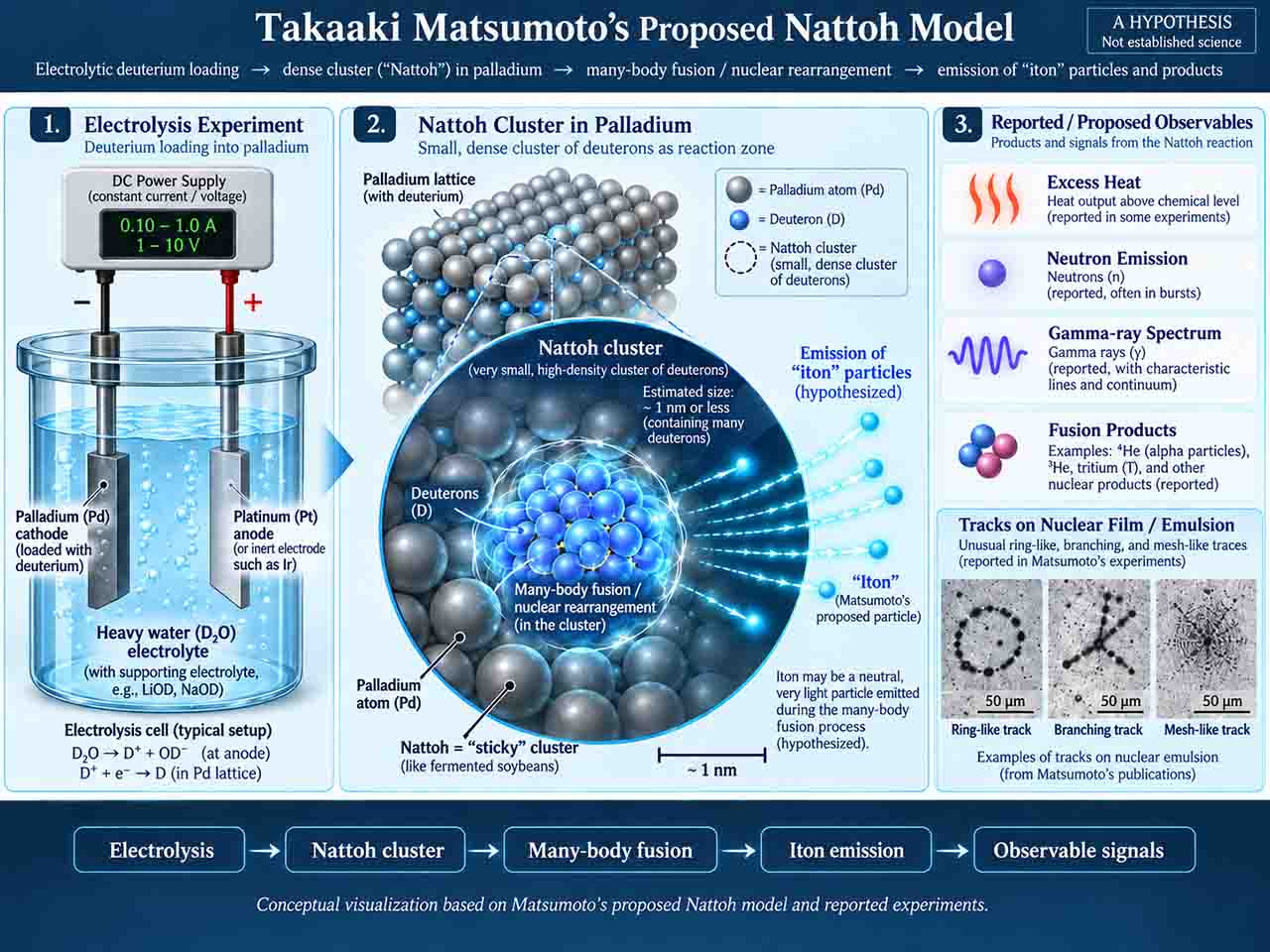
The starting point appeared in 1989 in a three-page Fusion Technology paper titled “Nattoh” Model for Cold Fusion. Matsumoto proposed that small clusters of deuterons—the nuclei of heavy hydrogen—could participate in many-body fusion reactions. The name referred to natto, the Japanese food made from fermented soybeans, giving the model an image of material gathered into a connected cluster. Instead of treating every nuclear encounter as an isolated collision between two deuterons, Matsumoto asked what might happen when numerous hydrogen nuclei occupied a collective reaction environment.
The picture grew more elaborate over time. In the 1995 review, hydrogen accumulated in microscopic regions associated with grain boundaries, defects, and interfaces. Matsumoto proposed that local hydrogen pressure and electrochemical conditions could drive the clusters into a compressed state; he speculated that some clusters might contain many millions of hydrogen atoms. Energetic hydrogen released during one event could then help initiate activity in neighboring clusters. He described the principal process as hydrogen-catalyzed fusion, with conventional deuterium–deuterium reactions playing an associated or secondary role.
One proposed many-body pathway combined four deuterons into beryllium-8, which then separated into two helium-4 nuclei. Written compactly, the sequence was 4D → ⁸Be → 2⁴He. Within Matsumoto’s framework, such channels offered a way to discuss helium production without relying on the familiar gamma-emitting route from a single deuterium pair. But a proposed reaction sequence isn’t itself a calculation of how frequently that reaction occurs. The difficult questions concerned whether the clustered state could form, how it overcame the relevant barriers, and whether its predicted products and energy release matched measurements.
Matsumoto also introduced a hypothetical emitted entity called the iton. His 1990 paper, Prediction of New Particle Emission on Cold Fusion, assigned it a proposed rest mass between roughly two and 26 electron masses, inferred from his analysis of reaction-energy differences and other parameters. By 1995, he was considering a more complicated structure involving electrons, positrons, and neutrinos, with an excess of electrons giving it a negative charge. These were theoretical proposals rather than measurements of a particle’s internal composition. The later vocabulary of itonic meshes and itonic clusters expanded the concept further; it shouldn’t be mistaken for one unchanged particle definition maintained throughout his career.
Reading the Marks Left Behind
Matsumoto’s experiments combined electrochemical cells with close examination of their surroundings and aftermath. Across the program, he used ordinary or heavy water, several electrode materials, and electrolytes including potassium carbonate and sodium chloride. His 1995 review discusses palladium, nickel, titanium, and copper cathodes, together with platinum anodes. Nuclear emulsions, including Fuji Film MA-7B material approximately 100 micrometers thick, were positioned outside cells or behind thin metal foils. Optical microscopy, scanning-electron microscopy, and energy-dispersive X-ray analysis provided complementary ways to examine tracks and altered surfaces.
The resulting images became central to his theoretical development. His 1990 paper on new-particle observations interpreted tracks recorded during heavy-water electrolysis as evidence for itons. Subsequent publications described rings, star-shaped events, and mesh-like structures. In the 1993 paper Observation of Meshlike Traces on Nuclear Emulsions during Cold Fusion, he distinguished meshes associated with ring traces from meshes without them. He interpreted these patterns through an increasingly detailed picture of neutron aggregates surrounded by itonic structures. The photographs preserved the features he was trying to explain, but identifying their cause required more than recognizing their shape.
The claims became particularly striking in the 1991 paper Observation of Quad-Neutrons and Gravity Decay during Cold Fusion. Matsumoto interpreted emulsion features as the decays of four-neutron systems and associated microscopic explosive patterns with a proposed gravitational process. In 1992, Searching for Tiny Black Holes during Cold Fusion extended the interpretation to the production and evaporation of microscopic black holes. These weren’t labels invented by later commentators; they appeared in Matsumoto’s own publications. Nevertheless, the directly recorded evidence consisted of microscopic traces, not measurements that independently established a black hole’s defining gravitational properties.
Another line of investigation concerned elemental composition. In 1991, Matsumoto and Kazuya Kurokawa reported sodium, magnesium, aluminum, and zinc associated with defect regions in palladium after heavy-water electrolysis. They interpreted the findings as products of explosive cold-fusion activity. That result raised a different identification problem. Energy-dispersive X-ray analysis can identify elements through characteristic X-ray signals, but it doesn’t establish that an atom was newly synthesized or determine its isotope ratio. Establishing nuclear transmutation would require distinguishing reaction products from impurities, transferred electrode material, electrolyte residues, and contamination introduced during handling or analysis.
From Electrolysis to Electrical Discharges
Matsumoto gradually moved toward experiments that concentrated electrical activity into small, identifiable regions. His 1993 paper Experiments of One-Point Cold Fusion described discharges in ordinary or heavy water containing 0.6 moles per liter of potassium carbonate. A platinum pin anode faced a copper-plate cathode at right angles. After discharge, he examined the copper surfaces optically and reported numerous ring-shaped spots and other traces. The paper included 12 figures, tying a relatively simple apparatus to a varied collection of microscopic effects.
Later work shifted toward underwater sparking with thin metal wires. A 1996 conference account, preserved in Greenyer’s archival transcription, describes nickel wires approximately 0.1–0.3 millimeters in diameter, ordinary water containing about two moles per liter of potassium carbonate, and sparking above roughly 40 volts. This was a different experimental environment from slowly loading a palladium electrode with deuterium. Rapid heating, localized discharges, material transport, and short-lived luminous structures became increasingly prominent in the observations Matsumoto sought to explain.
The late-1990s experiments identified as S70 and S71 brought the investigation into another recognizable configuration. The archived S71 description specifies a one-millimeter lead-wire electrode, copper reference and monitoring plates, and discharges under a pulsed 120-volt AC mode in an ordinary-water solution. The related S70 material identifies a potassium-hydroxide solution at 1.5 moles per liter. Those details matter because the experiments weren’t all interchangeable: electrode composition, electrolyte, geometry, and electrical operation changed across the program.
The deposits and damaged surfaces included spherical structures, openings in spheres, trails, films, and tube-like material. Matsumoto increasingly interpreted such features as evidence that compact, organized objects were moving through the apparatus and undergoing transformations. In his later terminology, these objects were itonic clusters or micro ball lightning. The shift broadened the research question again. He was no longer asking only how hydrogen might fuse inside a metal; he was proposing that electrically generated structures could carry matter, reorganize it, and leave distinctive products behind.
Electro-Nuclear Collapse and Regeneration
By 2000, micro ball lightning had become an explicit part of Matsumoto’s published framework. His IEEE conference contribution Transport and Collapse of Micro Ball Lightning described objects generated during underwater spark discharges and interpreted them as atomic clusters in an itonic state. Related conference material connected their apparent behavior with the movement of charge and matter. The terminology expressed a proposed physical identity, not merely a visual resemblance to atmospheric ball lightning, although the evidence still depended heavily on discharge observations and microscopic examination.
Matsumoto called the broader proposed class of transformations electro-nuclear reactions. Within that framework, electro-nuclear collapse, or ENC, referred to a profound breakdown or reorganization of ordinary matter under the influence of the clustered state. Electro-nuclear regeneration, or ENG, described the proposed subsequent formation of recognizable materials, including carbon-, oxygen-, and iron-containing structures. Films and tubes were particularly important to his interpretation. These terms went beyond conventional fusion or fission: Matsumoto was suggesting that an electrically organized environment could drive matter through a more radical transformation and back into ordinary material forms.
He also considered how the proposed clusters might be controlled. Acceleration Methods of Itonic Clusters, associated with the 25th Linear Accelerator Meeting in Japan in July 2000, treated the clusters as negatively charged objects that could potentially be accelerated electrically. The idea connected his observations to possible devices for transporting or directing the hypothesized active material. It also linked back to his longstanding interest in nuclear transformation and radioactive-waste treatment. These were proposed applications, however, rather than demonstrations of an operating technology that reliably performed the claimed nuclear processes.
The underlying analogy was partly astrophysical. Matsumoto contrasted gravitational collapse in stars with the much stronger electromagnetic interactions available at particle scales, arguing that electromagnetic organization might permit a laboratory counterpart. That comparison explains his vocabulary, but it doesn’t supply a complete mechanism. A literal black-hole interpretation would still have to account for mass, energy, and the relevant spacetime behavior. A collapse-and-regeneration interpretation would have to explain where the starting material went, what products appeared, and how conservation laws were satisfied. The analogy framed an ambitious hypothesis; it didn’t resolve those quantitative questions.
Four Neutrons, Three Decades Later
One aspect of Matsumoto’s work now has a particularly interesting modern comparison. In 2022, a collaboration led by M. Duer reported a resonance-like structure in a four-neutron system in Nature. The experiment used a high-energy helium-8 beam and a proton target, removing an alpha particle from the helium nucleus and reconstructing the remaining system through reaction kinematics. Unlike Matsumoto’s interpretation of emulsion morphology, the evidence came from measured particle energies and momenta and a missing-mass analysis.
The observed structure lay approximately 2.37 MeV above the four-neutron threshold, with an extracted width of about 1.75 MeV. Interpreted as a resonance, that width corresponded to a lifetime of roughly 3.8 × 10⁻²² seconds. This was an extraordinarily short-lived system, not a stable neutron-only nucleus capable of persisting through an ordinary laboratory sequence. The measurements made four-neutron correlations a concrete experimental issue, but they didn’t establish the long-lived, iton-associated objects or gravitational decay processes proposed in Matsumoto’s framework.
Even the modern result has required careful interpretation. In a 2023 Physical Review Letters paper, Rimantas Lazauskas, Emiko Hiyama, and Jaume Carbonell presented a reaction model in which correlations between neutron pairs could explain the low-energy peak. The distinction is important: observing a structure in an energy distribution and determining exactly what physical state produced it are related but separate tasks. The modern discussion concerns competing nuclear-reaction explanations supported by quantitative calculations, not a retrospective confirmation of Matsumoto’s microscopic-track assignments.
The comparison illustrates both the interest and the limitation of Matsumoto’s earlier proposal. His discussion of four-neutron systems shouldn’t be treated as meaningless simply because it was unconventional, but modern tetraneutron research doesn’t validate the rest of his model by association. A connection would require measurements establishing that his apparatus produced a particular neutron system with identifiable properties. The shared number—four neutrons—is a starting point for comparison, not an evidentiary bridge between two very different experiments.
Bob Greenyer Reopens the Archive
Greenyer’s involvement began long after Matsumoto’s original cold-fusion experiments. In his own account, the researcher associated with the Martin Fleischmann Memorial Project first encountered some Matsumoto material at a conference in Sochi in October 2018. By late 2020, he wanted to locate additional work. Through a colleague in Japan named Sho, Greenyer says he learned on January 10, 2021, that Matsumoto was still alive and that a rare copy of his privately published collected papers had been sent to them. The documented relationship began with contact and access to material, not participation in the original Hokkaido experiments.
The collection revealed both the scale of the research and the gaps in its preservation. Writing on February 17, 2021, Greenyer observed, “The book cites 84 papers of which only 26 are included.” Some images were clearer than copies available elsewhere, while others remained too poorly reproduced to interpret confidently. He outlined a preservation effort involving missing publications, Japanese-to-English translation, original digital images, high-resolution photographic scans, recovered video, proofreading, and remastered books. Those were practical archival tasks, independent of whether his interpretation of the physics ultimately proved correct.
The effort expanded in 2024, when Greenyer reported a recovery trip to Japan and access to original books, logbooks, and radiographic plates. A Kickstarter campaign, Understanding the Transformational Magic of Ball Lightning, ran from November 28 through December 25, 2024. It raised £34,582 from 212 backers against an £8,000 goal. Its central purpose was to remaster Matsumoto’s Steps to the Discovery of Electro-Nuclear Collapse using original source material, rather than leave the research dependent on deteriorating originals and uneven reproductions.
By May 2026, the project had produced a Scientist Reference Edition, credited to Matsumoto with Greenyer as editor. The edition contains 289 pages, and Greenyer described a spiral-bound format designed to remain open on a laboratory bench, using 600-dpi source material for the black-and-white printing. That detail captures the project’s dual character. It’s an effort to preserve a historical record, but also to put usable experimental descriptions and images back into the hands of people who might examine them critically or attempt related work.
From Archived Images to Live Experiments
Online presentations have given Matsumoto’s research another route to an audience. Greenyer’s Matsumoto—Steps to the Discovery of Electro-Nuclear Collapse provides a book-oriented introduction, while Acceleration Methods of Itonic Clusters by Takaaki Matsumoto—Bob Greenyer Explains concentrates on the later cluster concept. These presentations are valuable guides to a difficult and scattered literature. They’re also retrospective explanations by Greenyer, rather than recordings in which Matsumoto personally confirms every comparison or interpretation being discussed.
The MFMP video A Quick Look at a Few of Dr. Takaaki Matsumoto’s Scrapbooks brings viewers closer to the physical archive. Across his broader work, Greenyer compares Matsumoto’s structures with material associated with Kenneth Shoulders’ EV/EVO research and other discharge or cavitation experiments. His argument is that apparently different systems may be producing related organized objects. That’s a comparative hypothesis worth distinguishing from the archival task itself: preserving an original image establishes what was recorded, while identifying the same underlying mechanism across different laboratories requires additional evidence.
At the Advanced Energy Systems Prague workshop in 2025, Greenyer and Paul Harris attempted to reproduce the S71 lead-wire experiment, with Matsumoto’s daughter, Hiroko, and one of his grandsons present. Subsequent electron microscopy revealed a sphere approximately 26 micrometers across with a hole in one side, and another roughly 22.5 micrometers across with material Greenyer described as carbon-rich ejecta. The experiment moved the discussion beyond reviewing old photographs: a related apparatus had produced new structures that could be examined against the archive.
Greenyer was enthusiastic. “I believe we made a successful replication,” he wrote in his September 28, 2025, report. But he also acknowledged that microscope time had been unexpectedly short and detailed elemental analysis remained incomplete. The reported result was therefore a reproduction attempt showing similar structures and some similar elemental findings—not an independent demonstration of electro-nuclear regeneration. That distinction doesn’t make the attempt unimportant. It identifies the next scientific task: determining whether the resemblance reflects the same ordinary discharge processes, an unfamiliar material phenomenon, or an actual nuclear transformation.
The Experiment That Would Matter
A decisive continuation of Matsumoto’s work wouldn’t need to prove his entire theoretical framework at once. It could begin with one narrowly defined observation: a particular structure, elemental change, or radiation signal produced under a specified discharge condition. Active experiments and comparison runs would need matched materials, documented handling, and criteria defined before the results were examined. The aim would be to establish what reliably changes when the relevant electrical condition is introduced, rather than selecting the most striking image after the experiment.
For a transmutation claim, the strongest next step would be isotope-resolved analysis tied to carefully characterized starting materials. Lead wire, copper plates, electrolyte, water, sample mounts, and environmental contamination would all have to be accounted for. Independently analyzed, coded samples could test whether an apparent new element was transferred from elsewhere or genuinely produced by a nuclear process. An unusual isotope ratio would itself need scrutiny for contamination and fractionation, but a reproducible pattern that survived those explanations would be far more consequential than an unexpected elemental peak alone.
Claims involving new particles or neutron aggregates would require a different set of measurements. Calibrated radiation detectors, energy spectra, timing information, and independently consistent reaction signatures would be needed to move beyond morphology. Electrical interference would have to be separated from genuine detector events, and any excess-energy claim would need a complete input-and-output energy account. Microscopy would remain valuable, especially when correlated with a precisely recorded event, but it would become one part of a converging measurement rather than the main basis for identifying an exotic object.
Matsumoto’s lasting contribution may ultimately lie in a mechanism that survives testing, in observations that acquire a different explanation, or in an experimental record that helps others ask better questions. Greenyer’s recovery work makes those possibilities easier to investigate by returning papers, images, and apparatus descriptions to circulation. The archive doesn’t settle the physics, but it preserves the opportunity to test it. The next chapter won’t be decided by how closely a microscopic mark resembles a dramatic theory. It’ll be decided by an experiment capable of telling competing explanations apart.
References
Nuclear Theory and the Nattoh Model
- “Nattoh” Model for Cold Fusion — Takaaki Matsumoto (1989).
- Prediction of New Particle Emission on Cold Fusion — Takaaki Matsumoto (1990).
- Observation of New Particles Emitted during Cold Fusion — Takaaki Matsumoto (1990).
- Mechanisms of Cold Fusion: Comprehensive Explanations by the Nattoh Model — Takaaki Matsumoto (1995).
Experiments, Particle Tracks, and Micro Ball Lightning
- Cold Fusion Observed with Ordinary Water — Takaaki Matsumoto (1990).
- Microscopic Observations of Palladium Used for Cold Fusion — Takaaki Matsumoto (1991).
- Observation of Quad-Neutrons and Gravity Decay during Cold Fusion — Takaaki Matsumoto (1991).
- Observation of Heavy Elements Produced During Explosive Cold Fusion — Takaaki Matsumoto and Kazuya Kurokawa (1991).
- Observation of Gravity Decays of Multiple-Neutron Nuclei during Cold Fusion — Takaaki Matsumoto (1992).
- Searching for Tiny Black Holes during Cold Fusion — Takaaki Matsumoto (1992).
- Observation of Stars Produced during Cold Fusion — Takaaki Matsumoto (1992).
- Observation of Meshlike Traces on Nuclear Emulsions during Cold Fusion — Takaaki Matsumoto (1993).
- Experiments of One-Point Cold Fusion — Takaaki Matsumoto (1993).
- Transport and Collapse of Micro Ball Lightning — Takaaki Matsumoto (2000; IEEE conference abstract).
Earlier Nuclear-Physics Research
- On Source-Transient Region of Neutron Waves in Multiplying Systems — Takaaki Matsumoto (1970).
- Interference Phenomena of Neutron Waves in Heterogeneous Multiplying Systems — Takaaki Matsumoto (1973).
- Neutron Diffraction for Liquids Using a 45 MeV Electron Linear Accelerator at Hokkaido University — Takaaki Matsumoto, Norio Ohtomo, and Masanori Senda (1979).
- Neutron Transmutation of Long-Lived Radioactive Wastes: Depleting Calculation of 241Am in a TOKAMAK Fusion Reactor — Takaaki Matsumoto and colleagues (1982).
Bob Greenyer, Archive Recovery, Books, and Replication
- ‘O’riginal? — Bob Greenyer’s account of his connection to Matsumoto’s research.
- Matsumoto’s Book Received, What Does It Mean? — Bob Greenyer (2021).
- Acceleration Methods of Itonic Clusters — Bob Greenyer’s discussion of Matsumoto’s accelerator proposal (2021).
- Understanding the Transformational Magic of Ball Lightning — Matsumoto archive-remastering Kickstarter campaign (2024).
- Steps to the Discovery of Electro-Nuclear Collapse — Scientist Reference Edition — Edition announcement and access information (2026).
- O-Day — Intersection? — Bob Greenyer’s S71 replication report, microscopy, and analysis (2025).
Videos
- Matsumoto — Steps to the Discovery of Electro-Nuclear Collapse — Bob Greenyer / Martin Fleischmann Memorial Project.
- Acceleration Methods of Itonic Clusters by Takaaki Matsumoto — Bob Greenyer Explains — Bob Greenyer / Martin Fleischmann Memorial Project.
- A Quick Look at a Few of Dr. Takaaki Matsumoto’s Scrapbooks — Martin Fleischmann Memorial Project.
Modern Tetraneutron Research and Analytical Methods
- Observation of a Correlated Free Four-Neutron System — M. Duer and colleagues, Nature (2022).
- Low Energy Structures in Nuclear Reactions with 4n in the Final State — Rimantas Lazauskas, Emiko Hiyama, and Jaume Carbonell, Physical Review Letters (2023).
- SEM/EDS Trace Analysis: Limits Imposed by Fluorescence of the Detector — National Institute of Standards and Technology.